


I find it impossible to ignore how rapidly technology is expanding beyond software and into the physical world. What once felt like isolated research breakthroughs is now converging into real systems that are beginning to influence how we live, work, learn, and connect. This next wave is not driven by a single invention, but by multiple innovations evolving at the same time and reinforcing each other.
Displays Are Becoming Immersive and Energy Efficient
One of the most visible changes I notice is happening in display technology. Screens are no longer just flat surfaces for information. New micro-scale LED systems are making displays brighter, more efficient, and longer-lasting compared to older technologies. This shift is especially important for wearables and AR devices, where power consumption has always been a limitation.
Alongside this, transparent and holographic displays are moving closer to real-world use. I imagine a near future where navigation is projected directly onto car windshields or where retail windows become interactive digital surfaces. These developments suggest that digital content will no longer be confined to devices but integrated into physical environments.
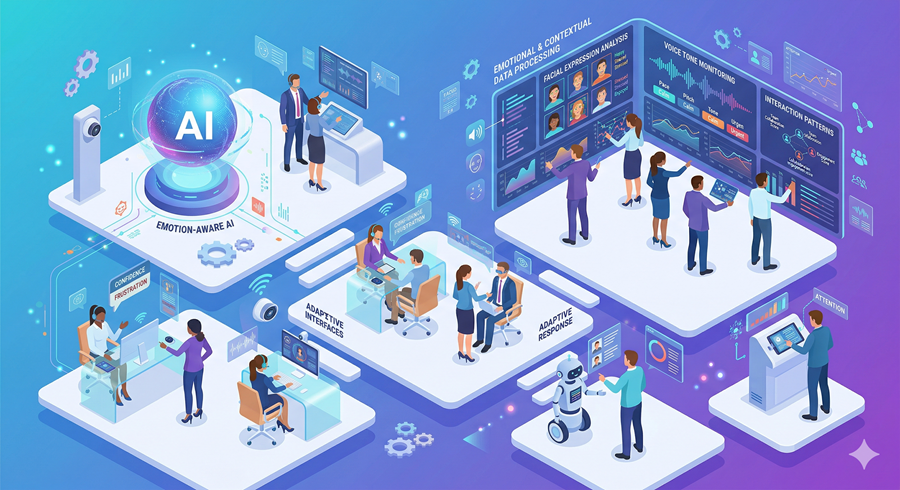
Emotion-Aware and Context-Aware AI Systems
Another major shift I observe is in how AI systems are beginning to interpret human behavior. Instead of responding only to text or commands, new models are being designed to understand tone, facial expression, and emotional cues.
This opens the door to applications that feel much more adaptive. In vehicles, it can help detect driver fatigue or distraction. In healthcare, it may assist in identifying early signs of stress or mental strain. What stands out to me is that AI is moving from purely functional responses toward contextual understanding of human states.
Autonomy Expanding Across Entire Industries
Autonomy is no longer limited to self-driving cars. I see it expanding across logistics, shipping, and delivery systems. Drones are already handling package transport in controlled environments, while autonomous ships are beginning to operate on real routes. Long-haul trucking is also undergoing large-scale testing with minimal human intervention.
What this signals to me is a transformation in how goods move globally. Instead of isolated autonomous vehicles, we are starting to see coordinated systems where entire supply chains operate with reduced human involvement.
Security, Identity, and Digital Trust Are Evolving
As digital systems grow more complex, trust becomes a central issue. Blockchain technology is increasingly being applied beyond cryptocurrency, including supply chain tracking, identity verification, and fraud prevention.
At the same time, cybersecurity is entering a new phase. AI-based defense systems are being trained to detect threats in real time, while researchers prepare for a future where quantum computing could break traditional encryption methods. This dual shift shows that innovation and risk are evolving together.
Personalized Learning Through AI Tutors
Education is undergoing one of the most personal transformations I have seen. AI tutors are now able to adjust lessons in real time based on how a student learns. Instead of a single standardized approach, learning becomes adaptive and individualized.
To me, this represents a fundamental change in accessibility. It means education is no longer tied strictly to classrooms or fixed curricula, but can evolve dynamically with each learner.
Materials, Biology, and Infrastructure Becoming Programmable
Some of the most transformative developments are happening at the physical and biological level. Self-healing materials are being developed that can repair cracks automatically, extending the lifespan of infrastructure and devices. Nanotechnology is enabling targeted treatments in medicine, improving precision and reducing side effects.
At the same time, digital twins are allowing cities and industries to simulate real-world systems in virtual environments. Synthetic biology is pushing even further, enabling engineered organisms to produce fuels, materials, and medical solutions. It increasingly feels like biology itself is becoming a programmable system.
