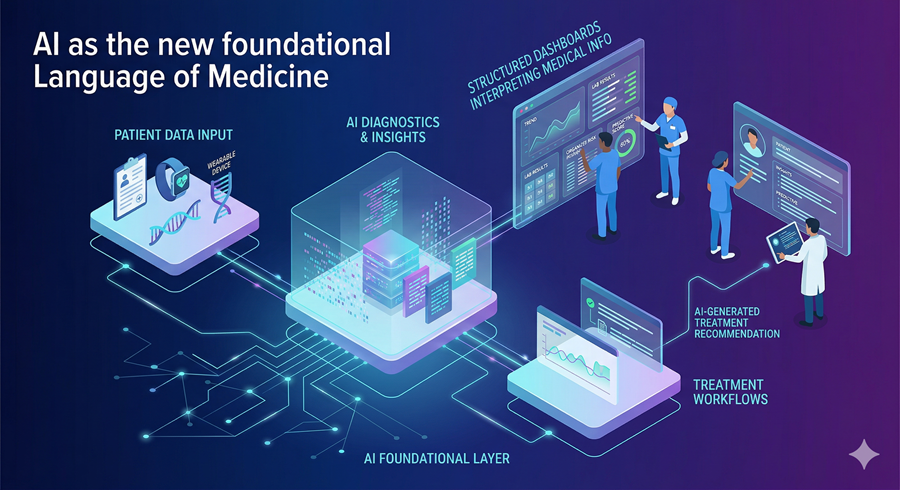
I keep coming back to one idea when I think about AI in healthcare: it is not just another tool. It feels more like a foundational shift in how medicine itself works. In the same way algebra changed how we understand math, AI is beginning to change how we interpret health, disease, and care.
We are not just improving old systems. We are rewriting them.
From Support Tool to Medical Transformation
For years, AI in healthcare stayed in the background. It helped with simple tasks like transcription, documentation, and basic patient chat systems. Useful, but limited.
Now, with modern generative AI systems, the scope has expanded dramatically. I see AI being used to predict health risks earlier, assist with faster and more accurate diagnoses, and even support drug discovery. What once required large teams of specialists can now be accelerated by models trained on vast medical datasets.
This is not an incremental improvement. It feels like a change in direction.
Diagnosis Is Becoming a Shared Process
One of the most important shifts I notice is in diagnostics. AI systems are getting better at interpreting medical data like scans, lab results, and cardiac readings. They do not replace doctors, but they change how decisions are made.
Instead of a single expert interpreting everything alone, diagnosis becomes a shared process between human judgment and machine pattern recognition. The AI identifies signals that may not be obvious, while clinicians interpret them in the context of patient history and lived experience.
This combination has the potential to reduce errors and speed up care.
The Promise and the Pressure of Accuracy
But with this capability comes a serious concern: trust. If AI suggests a wrong diagnosis or misses something critical, who is responsible?
I find this question central to the entire discussion. Medicine cannot afford uncertainty at scale. That is why regulatory bodies and professional organizations are beginning to build frameworks for oversight, validation, and ethical use.
The goal is not just innovation, but safe innovation. Systems must be tested for fairness, accuracy, and reliability before they ever reach patients.
Specialized AI and the Rise of Medical Innovation Labs
Beyond big tech, I also see a growing ecosystem of specialized research labs and universities working directly on healthcare AI. These groups are focused on specific problems like imaging, cardiology, and personalized treatment planning.
One example of this shift is how AI is being applied to electrocardiograms. Instead of manually reading complex heart data, models can now generate structured interpretations and detect patterns linked to serious conditions. In some cases, they identify risks that are not immediately visible to the human eye.
This does not remove the clinician. It extends their capability.
The Real Question Is Not Capability, But Integration
What stands out to me most is that AI is no longer the central question. Capability is assumed. The real challenge is integration.
How do we embed AI into clinical workflows without overwhelming doctors? How do we ensure patients trust the system? How do we prevent over-reliance while still using its strengths?
These are not purely technical questions. They are structural, ethical, and deeply human.
A New Medical Era Is Taking Shape
I often think about how every major leap in healthcare came from enabling technologies like imaging, communication systems, and computing. AI belongs in that same category.
It is not just improving healthcare. It is redefining how knowledge is generated and applied in medicine.
We are still early in this transition, but the direction is clear. Healthcare is moving toward a system where human expertise and machine intelligence operate together, not separately, and if we get that balance right, the impact could be transformative in a way we are only beginning to understand.
Follow Us on:
Clutch
Goodfirms
Linkedin
Instagram
Facebook
Youtube