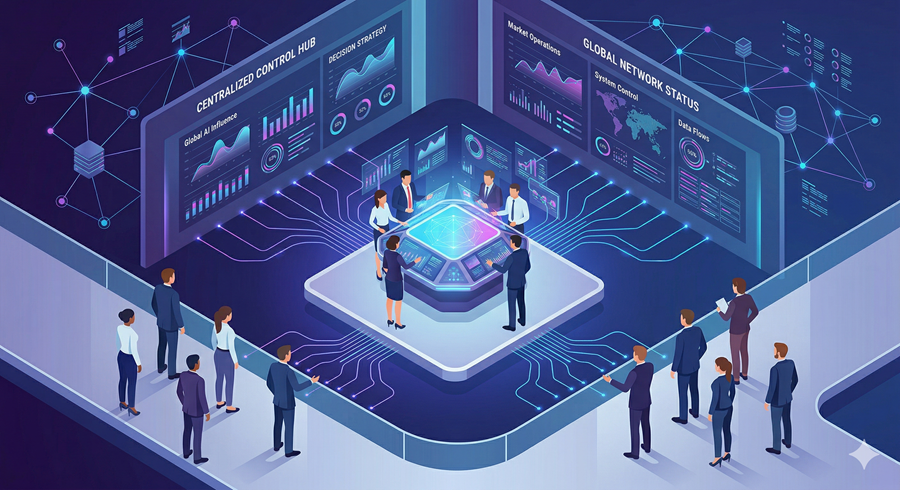
I keep coming back to a simple question. Who actually decides how AI evolves?
It is not governments. It is not the public. It is a small group of companies and the people leading them. And their decisions increasingly shape how billions of people live and work.
That imbalance is not accidental. It is structural. The way the industry is built concentrates power at the top while everyone else reacts to the outcomes. There is no meaningful participation from the people most affected by these systems.
This is not just a technology story. It is a powerful story.
The Race That Cannot Slow Down
From the outside, the speed of AI development feels reckless. But when I look closer, it starts to make sense.
These companies are not just building tools. They are competing for dominance. Data, infrastructure, talent, and distribution are all part of that race. Slowing down is not seen as responsible. It is seen as a loss.
That creates a dangerous dynamic. Even if risks are acknowledged internally, the incentives push in the opposite direction. Progress becomes mandatory, not optional, and once that mindset takes hold, alignment with broader human interests becomes secondary.
Myth-Making as Strategy
One of the most subtle dynamics here is narrative control.
I notice how often the same story appears. AI could either destroy everything or create unimaginable abundance. Both extremes are presented together.
At first, it sounds like transparency. But it also serves another purpose. If the stakes are that high, then control must stay with the builders. The argument becomes self-reinforcing.
Fear and optimism work together. They justify why a small group should continue making decisions for everyone else.
Over time, that narrative stops feeling like strategy and starts feeling like belief.
When Systems Start Replacing Work
There is another layer that feels more immediate. Jobs.
AI is being trained not just to assist, but to replace. That shift is gradual, but its direction is clear. And the economic system we rely on depends on people earning and spending.
If large parts of the population lose economic relevance, the consequences will not be technical. They will be social. Instability, tension, and breakdowns in trust are far more likely than smooth transitions.
The real risk is not just smarter systems. It is what happens when people are no longer needed by the systems they helped build.
Control Without Accountability
Even if leadership changes, the structure remains.
That is what makes this difficult to solve. The issue is not just individual decisions. It is that the system allows a small group to make decisions at a global scale without meaningful accountability.
And as AI becomes more capable, that gap widens.
I do not think the core question is whether AI will be good or bad. It is whether the people affected by it will ever have a say in how it is shaped.
Right now, they do not.
Follow Us on:
Clutch
Goodfirms
Linkedin
Instagram
Facebook
Youtube