
Fine-Tuning Foundation Models: The Development Shortcut US Enterprises Are Finally Using
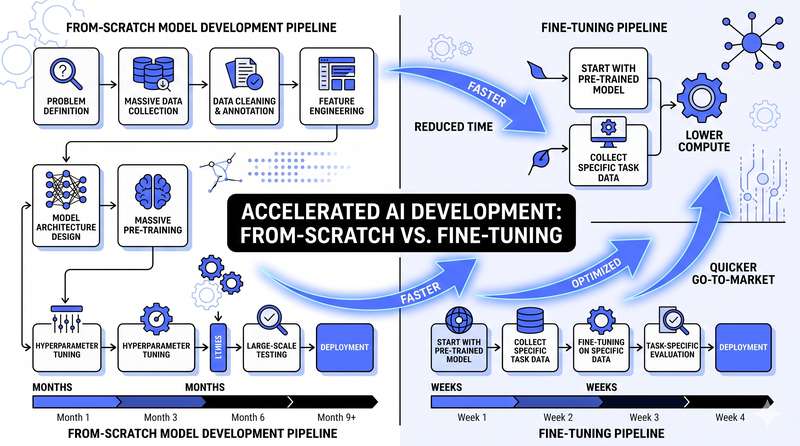
Eight months. That is roughly how long it takes to build, train, validate, and deploy a custom AI model from scratch for a specialized domain application. Now consider fine-tuning an existing foundation model on domain-specific data, reaching production-ready performance in six to eight weeks. This is the reality that US enterprises are discovering as foundation model fine-tuning matures from a research technique into a reliable engineering practice. Why Fine-Tuning Accelerates Development So Dramatically A model like Llama 3 has been trained on trillions of tokens of text. It understands language structure, grammar, reasoning patterns, and factual knowledge across hundreds of domains. When you fine-tune this model on your domain data, you are not teaching it language from scratch – you are teaching it the specifics of your domain, your terminology, your task format, and your quality standards. The equivalent of hiring a highly educated generalist and training them on your specific business versus hiring someone with no education and training them from zero. The data quality characteristics that determine fine-tuning success or failure The Data Requirements for Effective Fine-Tuning Effective fine-tuning data has clear input-output pairs that represent the exact task the model should learn, consistent quality across examples, sufficient diversity to cover the range of real inputs, coverage of edge cases, and accurate high-quality labels throughout. For tasks relatively close to the model’s existing strengths, a few hundred high-quality examples can produce meaningful improvement. Modern Fine-Tuning Techniques Techniques like LoRA (Low-Rank Adaptation) and QLoRA have made fine-tuning significantly more efficient and less risky. These approaches update only a small subset of the model’s parameters rather than all of them, preserving general capabilities more reliably and reducing the compute requirements for the fine-tuning process itself. US industries seeing the strongest results from foundation model fine-tuning Industries Seeing the Strongest Results Legal services organizations are fine-tuning models on contract language, case law, and internal document libraries. Healthcare organizations are fine-tuning on clinical documentation and patient communication data – accuracy improvements on clinical tasks directly affect patient care quality. Financial services firms are fine-tuning on regulatory documents and financial analysis reports to build systems that understand financial instruments and regulatory requirements with genuine precision.
Llama or GPT: A Practical Comparison for US Enterprises Making the Decision Now
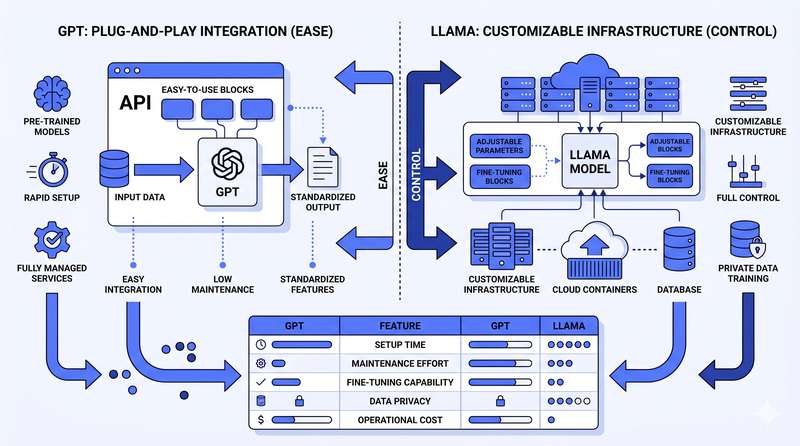
GPT-4 from OpenAI has been the default choice for many organizations simply because it was first to market with impressive capabilities. Llama, Meta’s open-source model family, has grown rapidly and is increasingly a serious alternative or complement to GPT in enterprise deployments. This is a practical guide to which model family makes more sense for different enterprise contexts – not a raw benchmark comparison. The Fundamental Difference: Closed vs Open With GPT, you are using a service. Your data passes through OpenAI’s infrastructure. You pay per token. You accept OpenAI’s terms of service and data handling policies. You have no control over how the model changes between versions. With Llama, you are running software. You deploy it on your own infrastructure. You pay for compute, not per token. Your data never leaves your environment. You have complete control over the model, including the ability to fine-tune it extensively on your proprietary data. When GPT Is the Right Choice GPT makes the most sense when your use case requires the absolute highest level of reasoning capability and you are not handling sensitive proprietary data. For enterprises deeply integrated into the Microsoft ecosystem, GPT models accessed through Azure OpenAI Service provide enterprise-grade security with native integration. For organizations that need strong multimodal capabilities, GPT-4o currently has a more mature implementation. The growing set of enterprise use cases where Llama consistently outperforms GPT When Llama Is the Right Choice Data privacy and security requirements are the most common driver – US enterprises in healthcare, financial services, legal, and defense have data that simply cannot be sent to a third-party API. Llama deployed on private infrastructure is the only viable foundation model option for these organizations. Cost at scale – GPT’s per-token pricing becomes expensive at enterprise scale. Deep customization requirements favor Llama when an enterprise needs to fine-tune extensively on proprietary data with full control over the training process. How leading US enterprises are using both GPT and Llama for different purposes within the same AI architecture The Hybrid Approach Many US enterprises are adopting a hybrid strategy – GPT handles complex, low-volume reasoning tasks where its frontier capabilities justify the cost. Llama handles high-volume, specialized tasks where its deployability, customizability, and cost profile are superior. This approach requires more architectural sophistication but delivers better performance and economics than relying exclusively on either model family.
Foundation Models Explained: Why US Enterprises Are Betting Big on This Technology
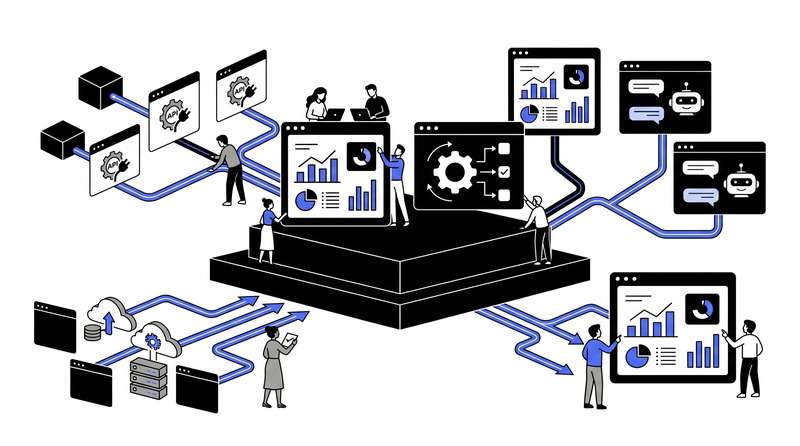
The term foundation model has become one of the most used and least understood phrases in enterprise AI. But foundation models represent a genuinely important shift in how AI is developed and deployed – one that every US enterprise building serious AI capabilities needs to understand clearly. What a Foundation Model Actually Is A foundation model is a large AI model trained on an enormous and diverse dataset, designed to serve as a general-purpose starting point that can be adapted for a wide range of specific tasks. Before foundation models, building an AI system for a specific task meant collecting task-specific training data, designing a model architecture, and training the entire system from scratch – expensive, time-consuming, and requiring significant technical expertise. Foundation models change this entirely. A model like GPT-4, Llama 3, or Claude has already learned a broad representation of language, reasoning, and knowledge. Building a specialized application on top requires far less data, compute, and time than building from scratch. The fundamental shift in enterprise AI development enabled by foundation models Why This Represents a Fundamental Shift Development cost and time have dropped dramatically – a specialized AI application that previously required months can now be built in weeks through fine-tuning. The quality ceiling has risen substantially because foundation models trained on vast datasets have developed capabilities that would be prohibitively expensive to replicate through task-specific training. Adaptability has improved because broad general capabilities allow handling novel inputs and edge cases more gracefully than narrow task-specific models. Fine-Tuning Foundation Models for Enterprise Use Fine-tuning a foundation model is fundamentally different from training from scratch. The model already understands language, reasoning, and general knowledge. Fine-tuning teaches it your specific domain, terminology, format preferences, and task requirements. The amount of data required is dramatically smaller – typically hundreds to thousands of examples rather than millions. The three deployment options for foundation models and what they mean for US enterprises Deployment Options and What They Mean API access through providers like OpenAI, Anthropic, or Google offers the lowest implementation overhead but involves sending data to an external provider. Managed cloud deployment through services like AWS Bedrock or Azure AI provides better data isolation. Private deployment on dedicated infrastructure provides maximum control and data security – the approach preferred by US enterprises in highly regulated industries.