
How to Build AI Cloud Infrastructure That Stays Up When Everything Else Falls Apart
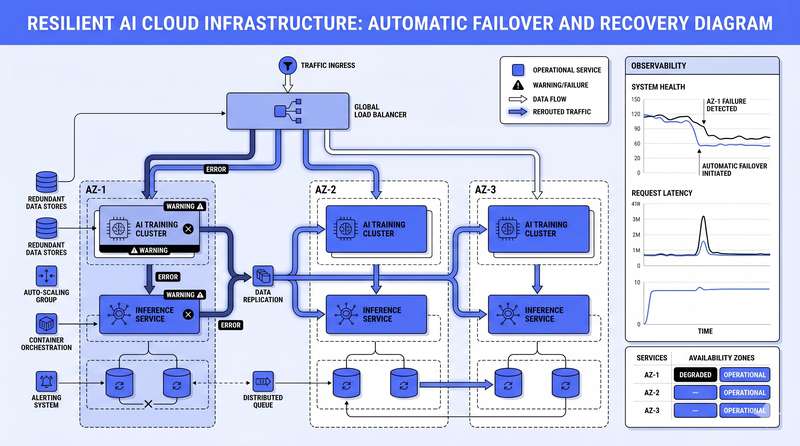
Downtime has always been expensive. Add AI to the equation and the stakes change in ways that many US enterprises have not fully accounted for. When an AI-powered customer service system goes down, for organizations that have reduced human support capacity in anticipation of AI handling the load, an AI system outage creates a customer service crisis. The consequences of AI infrastructure failures are often more severe than equivalent traditional software failures. Why AI Infrastructure Fails Differently Than Traditional Infrastructure The AI-specific failure modes that traditional infrastructure monitoring cannot detect Model serving infrastructure failures – servers or containers running inference going down prevents any AI-powered features from functioning. Model performance degradation is a failure mode traditional infrastructure does not have – your servers can be fully operational while your AI system is effectively failing because the model’s performance has degraded below acceptable thresholds. Dependency failures in AI systems cascade more severely – an AI-powered application typically depends on model serving infrastructure, retrieval infrastructure, data pipelines, embedding services, and orchestration layers simultaneously. Latency spikes under load are a common AI infrastructure failure mode that is easy to underestimate during capacity planning. The Architecture of Resilient AI Infrastructure Redundancy at the model serving layer means running multiple inference infrastructure instances across multiple availability zones, with load balancing that routes traffic away from unhealthy instances instantly. Graceful degradation – rather than failing completely when an AI component is unavailable, well-designed systems fall back to a reduced but functional experience. Circuit breakers prevent cascading failures by automatically stopping requests to a failing dependency before they overwhelm other components. Caching strategies can significantly reduce the load on AI infrastructure components and improve resilience to load spikes for common queries. The key differences in capacity planning for AI workloads versus traditional web applications The Investment That Prevents the Expensive Emergency Building genuinely resilient AI infrastructure costs more upfront than building the minimum viable version. Redundant infrastructure, proper monitoring, graceful degradation, and load testing all require investment that a minimum viable deployment can skip. The cost of skipping this investment is not zero – it is deferred until the first significant outage, at which point it arrives as emergency engineering effort, customer impact, revenue loss, and reputational damage.
AWS or Google Cloud for AI: The Honest Comparison US Enterprises Need Right Now
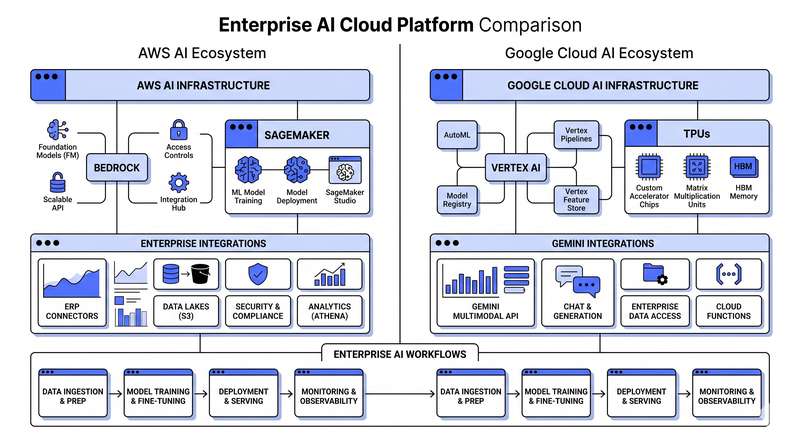
Cloud platform decisions are among the most consequential infrastructure choices US enterprises make, and for organizations building serious AI capabilities, the platform choice has implications that extend well beyond storage and compute costs. The AI tooling, model access, MLOps infrastructure, and developer experience differences between AWS and Google Cloud are significant enough to materially affect how quickly and effectively your organization can build and deploy AI systems. Where Google Cloud Has a Genuine Advantage Google Cloud’s genuine AI advantages for US enterprises in 2026 Vertex AI is Google Cloud’s unified AI platform, covering the full ML lifecycle from data preparation through model training, evaluation, deployment, and monitoring in a more integrated way than AWS’s equivalent services. TPU access is a genuine differentiator – Google’s Tensor Processing Units are purpose-built for neural network workloads and offer significant performance and cost advantages over GPU training. Gemini integration throughout the Google Cloud ecosystem means native access to Google’s frontier multimodal models. BigQuery ML allows training and running ML models directly on data in BigQuery without moving data to separate training infrastructure. Where AWS Has a Genuine Advantage Ecosystem breadth is AWS’s most durable advantage – more third-party tools, more enterprise software integrations, and more specialized services than any other cloud platform. Bedrock provides access to foundation models from multiple providers – including Anthropic’s Claude, Meta’s Llama, and Mistral – through a unified API with enterprise security features. SageMaker remains one of the most widely used managed ML platforms in US enterprise environments. Compliance certifications and enterprise security features are more mature on AWS, reflecting its longer history serving regulated US industries. How to make the right cloud AI platform decision for your specific organization Making the Decision for Your Organization The single most important input to this decision is your existing infrastructure. If your organization has significant existing investment in AWS, the migration cost and operational disruption of moving to Google Cloud for AI workloads needs to be weighed against the capability differences. For most US enterprises, the AI capability gap between the two platforms is not large enough to justify a wholesale migration from an established AWS environment.
What Is MLOps and Why Every US Enterprise Deploying AI Needs to Understand It
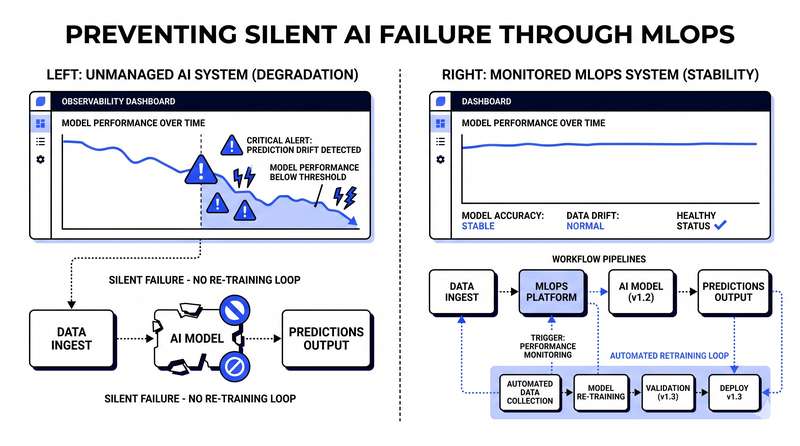
There is a moment that happens in nearly every US enterprise AI project. The model is trained. The accuracy metrics look good. The demo works beautifully. The team deploys to production and moves on. Three months later, the model’s performance has quietly degraded to the point where it is producing worse outcomes than the manual process it replaced, and nobody noticed until the damage was done. This scenario is almost entirely preventable with proper MLOps practice. What MLOps Actually Means MLOps – Machine Learning Operations – is the set of practices, tools, and cultural norms governing how machine learning models are deployed, monitored, maintained, and improved in production. ML systems behave differently from traditional software. Traditional software does what it is programmed to do, consistently, until the code is changed. ML systems do what the data told them to do – and when the world changes, the patterns change, and model performance degrades even though nobody changed a line of code. This degradation, called model drift, is invisible without monitoring. The core components of a mature MLOps practice that keeps AI systems performing reliably The Core Components of MLOps Model versioning and registry provides a systematic way to track which model version is deployed where. Automated training pipelines allow models to be retrained on fresh data without requiring manual engineering intervention every time. Continuous integration and deployment for ML automates testing a new model version and deploying to production when it meets defined quality thresholds. Model monitoring tracks performance metrics in production continuously. Data quality monitoring watches for changes in the statistical properties of data flowing through the system. What Model Drift Looks Like in Practice Data drift occurs when the distribution of real-world inputs changes relative to training data – a fraud detection model trained before a new fraud pattern emerged will not detect that pattern. Concept drift occurs when the relationship between inputs and desired outputs changes even if the input distribution stays the same. Upstream data changes occur when systems feeding data into the model change in ways that alter the data’s meaning without changing its format. The true cost of not investing in MLOps – and why it always exceeds the cost of doing it right The Business Case for MLOps Investment Consider the cost of a customer-facing AI feature that degrades silently over six months – degraded user experience, reduced conversion, potentially incorrect decisions, and the eventual emergency effort required to diagnose and fix the problem when it becomes visible. This cost is almost always significantly larger than the cost of proper monitoring infrastructure that would have caught the drift early. MLOps is not an insurance policy. It is the operational infrastructure that makes AI systems reliably deliver the value they were built to deliver.