
Project Overview
An early-stage US SaaS startup with a founding team of three was being overwhelmed by customer support volume. The same 40 questions accounted for 70 percent of all tickets, but the team had no system to identify, route, or respond to them efficiently. Tickets were piling up overnight with no one available, and the team was spending hours each day on support that was pulling them away from product and sales work. We built an ML classification model that changed how incoming tickets were handled from the moment they arrived.
The Challenge
The team was using a basic shared inbox with no tagging, routing, or prioritization. Every ticket required a human to read it, decide what it was, and find the right response. For a team of three doing everything, that overhead was unsustainable as the user base grew.
- No ticket categorization or routing in place: every message landed in a single queue in the order it arrived
- The same 40 questions made up 70 percent of total ticket volume, but responses were being written from scratch each time
- Tickets were piling up overnight and during weekends with no coverage and no automated handling
- The team needed something they could operate themselves, with no dedicated support staff and no ongoing technical help
Our Solution
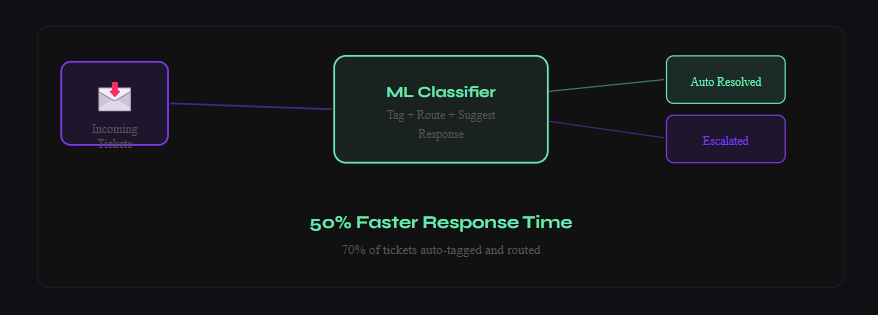
We built an ML classification model that automatically tagged incoming tickets by category and urgency the moment they arrived, and pre-loaded suggested responses for the 40 most common issue types. The system was designed to be operated by non-technical founders without any ongoing maintenance from our side.
- Ticket Classification Model: A multi-label classifier trained on the startup’s historical support ticket data, categorizing incoming tickets by issue type across categories including billing, onboarding, feature questions, and bug reports.
- Urgency Scoring: A secondary model component that assigned urgency flags based on signals in the ticket content, surfacing time-sensitive issues to the top of the queue automatically.
- Suggested Response Library: For each of the 40 most common issue categories, we built a template response that appeared pre-loaded in the agent interface when a ticket was routed to that category. The team could send, edit, or override at their discretion.
- Integration: The model was integrated directly into their existing helpdesk tool via API, requiring no new interface or workflow changes for the team.
Technical Approach
The classification model was built using a fine-tuned text classification approach on the client’s historical ticket data, with categories defined collaboratively with the founders based on the issue types they dealt with most frequently. We used a lightweight transformer-based classifier that ran efficiently within the startup’s budget constraints. The integration layer connected to their helpdesk via webhook, so classification and routing happened in real time as new tickets arrived, including overnight and on weekends when no one was available to triage.
Results & Impact
- First response time cut by 50 percent, as routine tickets were being auto-tagged and pre-loaded with suggested responses before any team member opened them
- 70 percent of incoming tickets auto-tagged correctly on arrival, eliminating the manual triage step for the majority of support volume
- Team focused exclusively on complex tickets that required genuine human judgment, with routine queries handled through the suggested response workflow
- Overnight and weekend ticket backlog eliminated, as classification and routing happened automatically regardless of when tickets arrived
- The founders were able to operate the system entirely independently after a brief handoff, with no ongoing technical management required
Lessons Learned
The most important design constraint on this project was that the team could not rely on us to maintain or troubleshoot the system after delivery. That shaped every decision, from choosing a simpler model architecture that was easier to inspect, to building the suggested responses as editable templates rather than automated replies. A fully automated response system would have been faster, but a suggested response that a founder reviews before sending was the right balance of efficiency and control for a team at this stage.
Defining the ticket categories collaboratively with the founders also turned out to be essential. Their intuition about how customers described problems was more accurate than any topic clustering we ran on the raw data. The categories we landed on through that conversation produced a significantly better training dataset than a purely data-driven categorization would have.