
Project Overview
A small US medical clinic was losing revenue and wasting clinical capacity through a no-show rate running between 20 and 25 percent. Every missed appointment meant a slot that could not be filled on short notice, a clinician with unused time, and a patient who did not receive care they had scheduled. The clinic’s existing response was a paralegal making blanket reminder calls the day before to every patient on the schedule. The calls helped at the margins but did not move the no-show rate meaningfully because every patient was treated as equally likely to miss regardless of their actual risk profile. We built a lightweight ML model trained on 18 months of their appointment data that predicted no-show probability for each upcoming appointment, allowing staff to direct their outreach effort toward the patients who actually needed it.
The Challenge
The clinic had a consistent no-show problem with no structured way to distinguish which patients were genuinely at risk from those who were reliably on time. Blanket outreach consumed staff time without producing meaningful improvement.
- No-show rate of 20 to 25 percent consistently across all appointment types
- Blanket reminder calls consuming staff time with no differentiation between high and low risk patients
- No visibility into which patient segments or appointment types drove the majority of no-shows
- Small clinic with limited historical data compared to a large hospital system, requiring a model approach that worked with the data available
- Patient data required HIPAA-compliant handling throughout the entire project
Our Solution
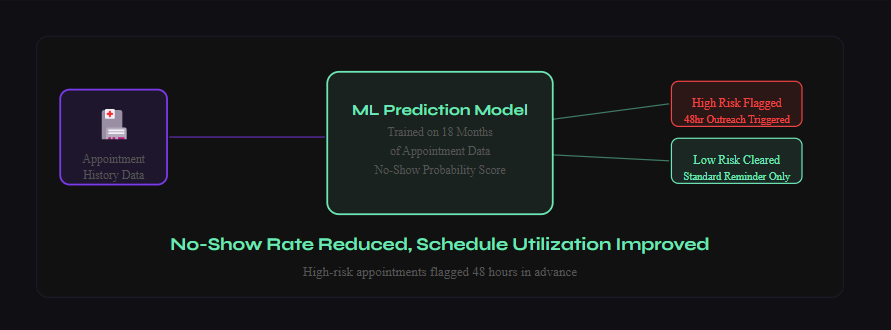
We built an ML prediction model trained on the clinic’s appointment history that scored each upcoming appointment by no-show probability, enabling the team to concentrate outreach on the patients most likely to miss rather than calling everyone on the schedule.
- Data Audit and Preparation: We pulled 18 months of appointment records including show and no-show outcomes, appointment type, time of day, day of week, lead time between booking and appointment, and reminder response history.
- Feature Engineering: We identified the variables most predictive of no-show behavior in this specific clinic’s patient population.
- Prediction Model: A lightweight ML model trained on the prepared dataset producing a no-show probability score for each upcoming appointment.
- Automated Flagging: Appointments above the risk threshold were flagged automatically for a second outreach touchpoint 48 hours before the appointment.
- HIPAA-Compliant Handling: Data anonymization during model development and secure integration with the clinic’s scheduling system ensured compliant handling throughout.
Technical Approach
The model was built in Python using a gradient boosting approach which performed best on the clinic’s tabular appointment data during cross-validation testing. Feature importance analysis revealed that lead time between booking and appointment date, prior no-show history, and appointment type were the three strongest predictors in this clinic’s dataset. The model was integrated with the clinic’s scheduling software via a lightweight API that ran the prediction each morning for appointments in the next 48 to 72 hours, writing risk scores back to the scheduling system and triggering the automated secondary outreach workflow for flagged appointments.
Results & Impact
Deployment produced measurable improvement across the clinic’s scheduling operation within the first 60 days.
- No-show rate reduced measurably in the first 60 days following deployment
- Schedule utilization improved as fewer appointment slots went unfilled
- Staff reminder call time reduced because outreach was concentrated on flagged high-risk appointments rather than the full schedule
- Revenue per clinical day improved as the no-show reduction translated directly into more completed appointments
- Feature importance analysis identified two appointment types that drove a disproportionate share of no-shows, which the clinic used to redesign their booking confirmation process for those specific appointment categories
Lessons Learned
The feature importance analysis was one of the most valuable outputs of the project beyond the model itself. Knowing which variables drove no-show behavior gave the clinic operational insights they could act on independently of the ML system. The finding that two specific appointment types drove a disproportionate share of no-shows led the clinic to redesign their confirmation messaging for those categories, a change that did not require any AI system to implement and that contributed to the overall improvement in schedule utilization. The best ML projects often produce insights that create value beyond the model itself.