Something shifted this week in artificial intelligence, and it was not just another model update or flashy demo. It felt like the industry quietly crossed into a completely different era.
The biggest surprise came from an unlikely alliance. Elon Musk reportedly gave Anthropic access to massive supercomputing infrastructure packed with Nvidia AI chips. That matters because Anthropic and OpenAI are direct rivals, while Musk has spent years publicly fighting Sam Altman and OpenAI. Watching Musk empower OpenAI’s biggest competitor feels less like business and more like strategic warfare.
The result is immediate. Claude users are already seeing faster responses, fewer limits, and dramatically higher capacity. For everyday users, this means AI tools that actually work during peak hours instead of constantly breaking under demand.
But the bigger story is what this says about the future. AI companies are no longer competing only on intelligence. They are competing on raw infrastructure, energy, chips, and scale.
AI Is Becoming Autonomous
The most important updates this week were not chatbots. They were AI systems learning how to operate independently.
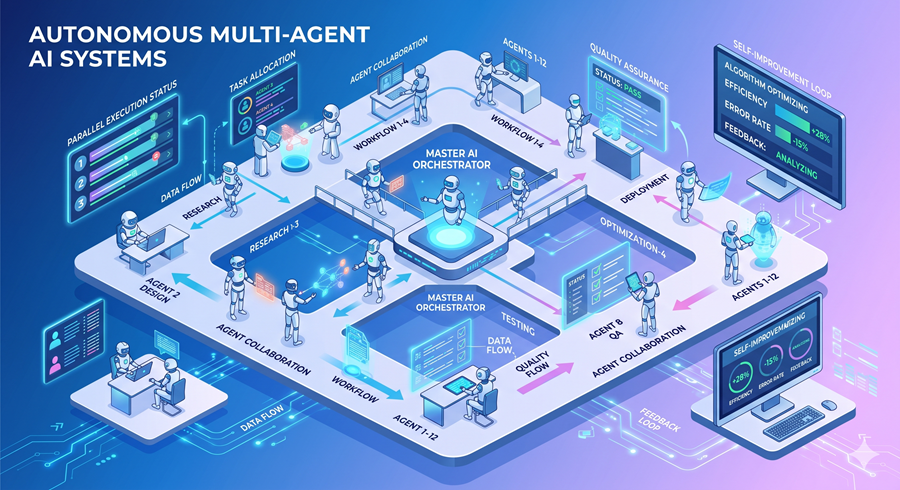
Anthropic introduced multi-agent systems where one AI can assign work to other AIs simultaneously. Another feature lets AI evaluate its own output against a quality checklist and improve itself before a human even reviews it.
Then came the strangest concept of all. AI that “dreams.”
These systems now review past work during idle time, organize memory, identify patterns, and wake up more optimized than before. It sounds bizarre, but it hints at a future where AI continuously improves without direct supervision.
That is a massive leap beyond the chatbot era most people still think we are in.
Robots Are Finally Catching Up
While software keeps evolving, robotics has suddenly accelerated, too.
One humanoid robot demonstrated cooking, lab work, piano playing, and complex hand coordination. Neuralink revealed a surgical robot capable of placing microscopic brain threads with precision beyond human capability.
Meanwhile, AI-powered systems are beginning to run businesses directly from chat interfaces. You can now manage stores, analyze spreadsheets, build dashboards, and automate workflows without opening traditional software.
The interface is disappearing. AI is becoming the operating system itself.
The Future Might Not Live on Earth
One of the wildest announcements came from India, where startups are exploring orbital AI data centers.
At first, the idea sounds ridiculous until you think about the energy demands of modern AI. Space offers nearly uninterrupted solar power and reduced dependence on foreign cloud infrastructure.
If successful, this could redefine how future AI infrastructure is built.
At the same time, tools that transform a single image into a real-time talking character are making human interaction with AI feel unsettlingly natural. We may soon stop typing on machines altogether.
We Are Entering the Real AI Economy
The most overlooked shift is that AI is no longer experimental. It is becoming infrastructure.
Google released tools capable of generating entire marketing campaigns automatically. OpenAI and Anthropic are partnering directly with investment giants to push AI adoption into thousands of companies at once.
The race is no longer about who builds the smartest model.
It is about who becomes impossible to live without.