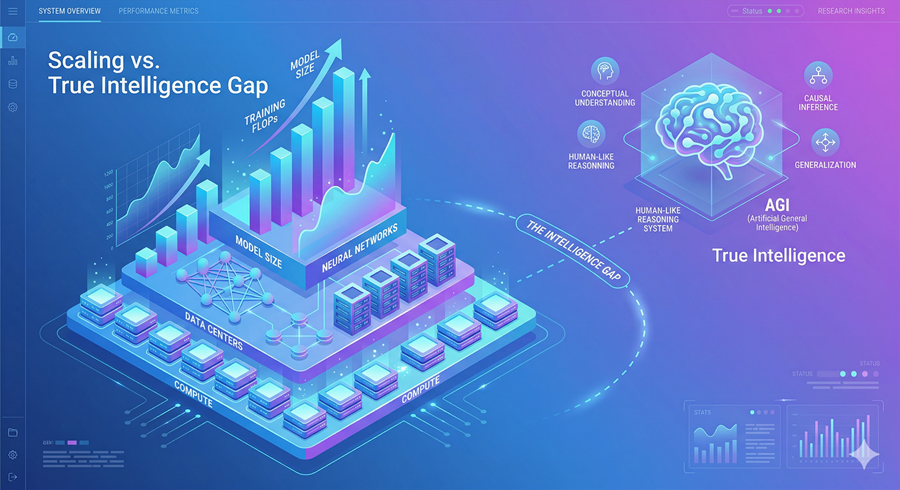
I used to believe that if we kept improving current AI systems, they would eventually reach human-level intelligence. More data, more computers, more time. It felt inevitable.
Now, I’m not so sure.
The deeper I look, the more it seems like we are pushing against limits that scaling alone cannot solve. The gap between today’s AI and true general intelligence might not be a matter of progress, but of approach.
The Limits of Pattern Recognition
Modern AI systems are incredibly good at finding patterns. Whether it is text, images, or video, they learn from massive datasets and generate outputs that resemble what they have seen before.
But that is also their core limitation. They are built for specific types of data and tasks. Language models handle text. Image models handle visuals. Each system is confined by its training structure.
What we actually need for general intelligence is something far more flexible. A system that can think abstractly and apply reasoning across any domain, not just remix patterns within one.
Right now, that kind of adaptability is missing.
Why Hallucinations Aren’t the Real Problem
People often point to hallucinations as a major flaw. AI sometimes produces confident answers that are simply wrong.
At first glance, that seems like a dealbreaker. But I do not think it is the biggest issue.
These systems are not retrieving facts. They are predicting what a plausible answer looks like. When certainty is low, they still generate a response, even if it lacks grounding in reality.
There are ways to reduce this, like teaching models to admit uncertainty. That might not be ideal, but if it happens rarely, it is manageable. The real danger is when users assume every answer is correct.
So yes, hallucinations matter, but they are not the fundamental barrier.
The Unfixable Problem of Prompt Injection
A more serious issue is something most people overlook. These systems cannot reliably separate instructions from input.
If you tell an AI to ignore previous directions and follow new ones, it often complies. This is not just a quirky behavior. It is a structural weakness.
Because the model processes everything as text, it cannot truly distinguish between what it should follow and what it should analyze. Safeguards can reduce the risk, but they cannot eliminate it.
That makes these systems inherently unreliable for many high-stakes applications.
The Failure to Think Beyond Training
Another major limitation is how these models handle new situations. They are excellent at interpolation, working within the range of what they have already seen.
But when pushed beyond that, they struggle. Ask for something truly novel or outside their training distribution, and the results quickly break down.
This is especially clear in creative and scientific tasks, where genuine breakthroughs require going beyond existing patterns.
Current AI does not truly invent. It reshapes.
What It Will Take to Reach AGI
If scaling existing models is not enough, then something fundamentally different is needed.
We may need systems built around abstract reasoning, not just pattern matching. Systems that can form internal world models and operate on logic that is not tied to language or images alone.
Some early ideas, like combining neural networks with symbolic reasoning, point in this direction. But we are still far from a clear solution.
For now, I see today’s AI as powerful but narrow. Useful, impressive, and rapidly improving, but not on a direct path to true general intelligence, and recognizing that might be the first step toward building something that actually is.
Follow Us on:
Clutch
Goodfirms
Linkedin
Instagram
Facebook
Youtube