




For the last two decades, software companies have built one of the most profitable business models in history. Instead of selling software once, they rented it forever.
Businesses paid monthly subscriptions just to access tools they relied on every day. Over time, those subscriptions stacked up across dozens of products. Design tools, CRM systems, project managers, analytics dashboards, and development platforms. Each required its own login and its own monthly fee.
But something is starting to shake that model at its core.
Artificial intelligence is turning software into something very different.
The Problem With Charging Per Seat
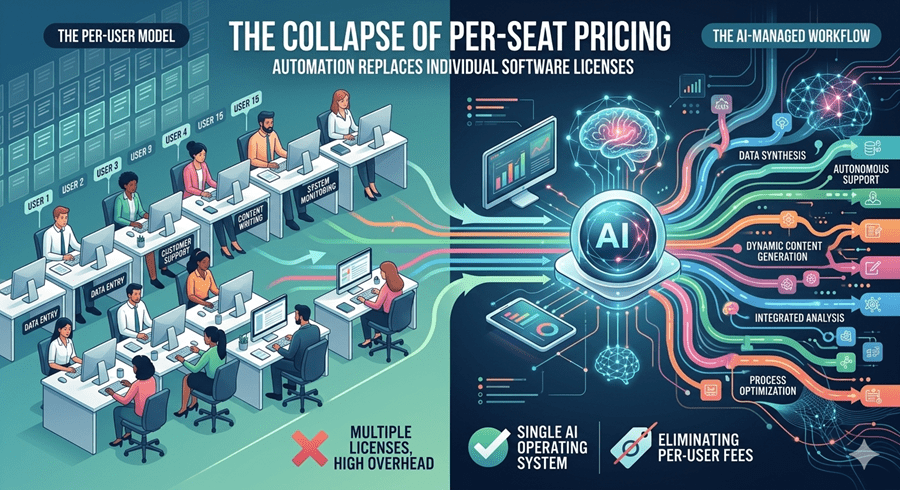
The SaaS model depends on one basic idea. Every employee who uses the software needs a paid seat.
If a company hires more workers, the software provider earns more revenue. More people mean more subscriptions.
AI agents break that equation.
Instead of ten employees using ten software seats, one intelligent system can perform the same work automatically. That single system might generate reports, write code, manage workflows, and analyze data all at once.
When intelligence becomes automated, the idea of charging per human user begins to collapse.
AI That Can Build the Software Itself
Another shift is even more disruptive. Modern AI models are getting extremely good at writing and maintaining code.
Instead of purchasing specialized software tools, companies can increasingly generate their own internal tools on demand. Need a dashboard, automation script, or small application? An AI model can create it in minutes.
That removes one of the biggest advantages SaaS companies have relied on for years.
If software can be generated instead of purchased, the economics change dramatically.
Open Models Are Breaking Vendor Lock-In
One reason SaaS companies thrived was vendor lock-in. Once a company built its workflows around a particular platform, switching became painful and expensive.
But open AI models are weakening that advantage.
Organizations can now run powerful models on their own infrastructure and use them to recreate or replace software tools internally. Instead of paying multiple subscriptions, they can deploy a single intelligent system capable of rebuilding those tools when needed.
The barriers that once protected SaaS providers are starting to erode.
The Rise of Autonomous Development
AI is also changing how software itself gets built.
New platforms allow multiple AI agents to work together on development tasks. One agent can fix bugs while another writes documentation, and another monitors system logs.
Instead of teams manually managing each stage of development, autonomous agents can coordinate the work themselves.
This turns software development into a kind of automated production pipeline.
What Comes After SaaS
None of this means software companies disappear overnight. Many tools still provide enormous value and will continue evolving alongside AI.
But the pricing structure that defined the SaaS era may not survive.
When intelligence becomes abundant, and software can be generated on demand, the concept of paying per user begins to look outdated.
The next generation of software may not be something companies buy at all.
It may simply be something they ask an AI to create.
