




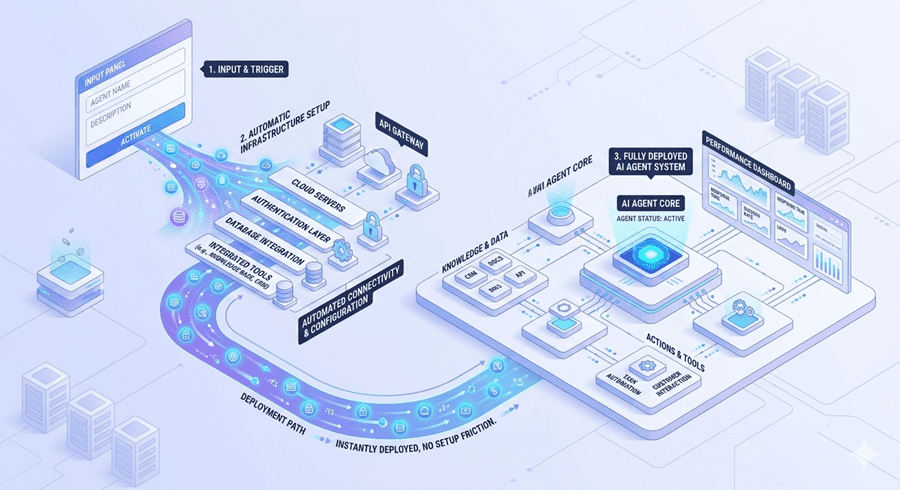
For a long time, the hardest part of using AI agents was not understanding their capabilities, but actually getting them to work. Setting up servers, connecting tools, and managing infrastructure often made the process feel complex and time-consuming.
Now, that friction is disappearing.
What once required careful configuration can now be launched in seconds. Instead of building systems step by step, users can simply describe what they need in plain language, and the system handles the setup automatically. It feels less like developing software and more like enabling a feature.
This shift significantly expands who can use AI agents, making them accessible to a much wider audience.
AI Agents That Plug Into Real Life
This change is not just about convenience. It also reflects how seamlessly AI agents can now connect to real-world platforms.
Agents can operate within messaging apps, respond to users, and perform tasks without constant supervision. For example, a customer support agent can access booking data, understand frequently asked questions, and provide personalized responses.
Importantly, these systems also recognize their limits. When a situation requires human input, they escalate the issue while providing full context instead of making uncertain decisions.
This is more than simple automation. It represents controlled decision-making within defined boundaries.
Automating Workflows That Used to Take Hours
The biggest impact becomes clear in workflows.
Tasks that once required multiple steps across different tools can now run as a single automated process. A single input can generate multiple outputs, each formatted and tailored for different platforms.
Processes like content creation, summarization, and organization that previously took hours can now be completed almost instantly.
Recurring work also becomes easier. Daily updates, reports, and summaries can run automatically by pulling information from emails, chats, and external sources. Instead of manually checking everything, users receive only the most relevant insights.
One Interface, Multiple Systems
Another key advantage is how these agents act as a central layer across tools.
Messaging platforms can function as control panels, while the agent handles operations in the background. It can gather information from multiple systems, execute tasks, resolve issues, and document outcomes.
At this stage, the agent begins to feel less like a simple assistant and more like an active collaborator.
The Shift From Doing to Managing
The most important change is how roles evolve.
Instead of performing every task manually, users manage systems that handle the work for them. These agents remember context, adapt to preferences, and improve over time.
They can run continuous processes such as reporting, analysis, and monitoring with minimal input. This shift is not about new AI capabilities, but about removing the barriers that once limited their use.
As those barriers disappear, the focus moves from what AI can do to what people choose to build with it.
