




For years, office software has looked almost the same. Documents, spreadsheets, and slides followed a familiar pattern where people started with blank pages and built everything manually. Recently, that began to change in a way that feels much bigger than a simple software update.
Productivity tools are quietly becoming AI-native environments. Instead of switching between separate tools, the intelligence is now built directly into the place where work already happens.
A Shift From Tools to Intelligent Workspaces
The most noticeable change is how AI now lives inside everyday applications. Rather than opening a separate chatbot or assistant, I can simply type a request directly inside the document or spreadsheet I’m working on.
For example, instead of writing a document from scratch, I can describe what I need. The system can pull information from my files, emails, and relevant online sources to generate a complete draft. What used to take an hour now appears in seconds.
But the real difference is that the AI works with context. It understands the documents I already have and builds new content around them instead of generating generic text.
AI That Learns How I Write
One of the most interesting improvements focuses on writing style. A common frustration with AI writing is that it often sounds robotic or detached from how people normally communicate.
New AI tools can analyze previous documents and adapt the tone of generated text to match the way I usually write. Instead of sounding like a machine, the output begins to feel like an extension of my own voice.
There is also automation around document formatting. Templates I regularly use can now be filled automatically by extracting details from emails, bookings, or other files. Information that once required copying and pasting across multiple tabs now assembles itself.
Spreadsheets That Build Themselves
Spreadsheets have always been powerful but intimidating. Many people struggle with structure before they even begin working with the data.
AI is starting to remove that barrier completely. Instead of designing tables, formulas, and categories manually, I can describe what I want to track. The system creates the spreadsheet structure automatically and organizes the information into useful sections.
It can even gather relevant details from emails or online sources and populate rows on its own. Searching, collecting, and organizing data are slowly merging into a single step.
Presentations Without the Pain
Presentations have long been one of the most time-consuming parts of office work. Writing content, designing slides, and choosing layouts often takes longer than the actual ideas behind them.
Now I can simply describe the presentation I want. The AI generates a full slide deck including structure, text, and visual layout. If something feels off, I can ask it to adjust the tone, simplify the wording, or change the design style.
Instead of manually building slides, I’m essentially directing a creative assistant.
The Rise of a Personal Knowledge System
Even file storage is evolving. Cloud drives have traditionally been messy collections of folders and filenames that become difficult to navigate over time.
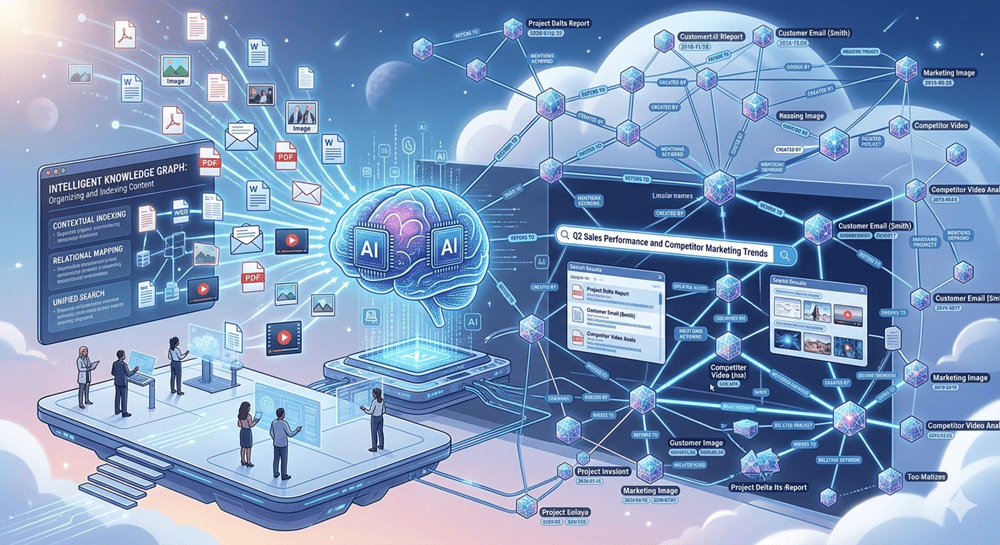
AI is changing that by turning storage into something closer to a knowledge system. Instead of remembering exact file names, I can describe what I’m looking for in plain language. The system interprets the intent and surfaces the most relevant documents.
At the same time, new AI infrastructure is emerging behind the scenes that allows text, images, audio, video, and documents to exist in the same searchable space. That means future systems will be able to connect ideas across different types of content in ways traditional databases never could.
What we are witnessing is not just an upgrade to office software. It is the beginning of a workplace where creating, organizing, and retrieving information happens alongside an AI that understands the context of everything we do.
