The current wave of AI development is no longer limited to chatbots or isolated models. Companies like Tesla and xAI are now pushing toward a vertically integrated ecosystem where models, chips, robots, and infrastructure all evolve together. Instead of building one product at a time, the strategy is to connect intelligence across software and the physical world. This shift is visible in two parallel efforts: the development of Grok-5 as a frontier model and the rapid scaling of Optimus as a humanoid robot platform.
Grok-5 and Frontier Model Scaling
The next-generation model Grok (often referred to as Grok-5) represents xAI’s attempt to compete directly at the highest level of reasoning systems. It is being trained on massive compute clusters, including infrastructure that rivals the largest AI facilities in the world. Reports of trillion-scale parameter models and gigawatt-level training systems highlight how aggressively xAI is scaling.
Unlike earlier models focused mainly on text, Grok-5 is designed to be multimodal, integrating text, images, audio, and video understanding in a unified architecture. A key ambition is real-world reasoning through video data, including driving footage and live sensor streams. The goal is to move closer to systems that understand physical dynamics, not just language patterns. However, whether this level of scaling leads to AGI remains an open question, especially as performance gains from brute-force scaling begin to show diminishing returns across the industry.
Optimus and Physical Intelligence Expansion
While Grok focuses on digital intelligence, Tesla Optimus represents the physical embodiment of AI in Tesla’s long-term vision. Optimus is being designed not just as a robot, but as a general-purpose labor system capable of interacting with unpredictable environments.
The challenge is fundamentally different from autonomous driving. A humanoid robot must manipulate objects, maintain balance, interpret human instructions, and respond instantly to changes in its surroundings. This requires tight integration between perception, planning, and motor control. Tesla is building Optimus around a layered intelligence stack that includes vision-based autonomy, language understanding, and onboard real-time inference.
AI Hardware and Compute Infrastructure
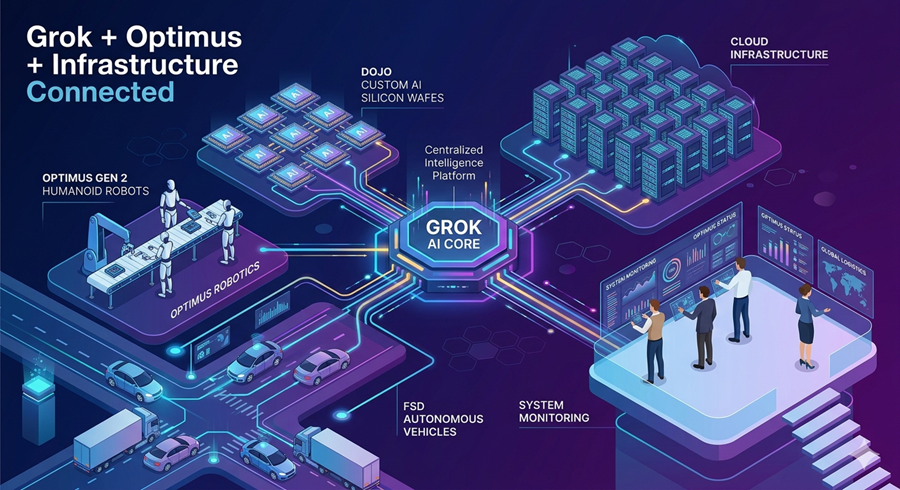
At the center of both Grok-5 and Optimus is custom silicon. NVIDIA remains a key benchmark for performance, but Tesla is pursuing its own AI chips, such as AI 5, to reduce dependency and optimize robotics workloads. Manufacturing partnerships with TSMC and Samsung show how critical semiconductor scaling has become to the strategy.
At the infrastructure level, large-scale compute projects tied to SpaceX and xAI aim to support training demands that reach gigawatt levels. These systems are not just for model training but also for continuous learning loops where robots and AI systems improve from real-world feedback.
Convergence of Robotics and AI Systems
What makes this moment unique is the convergence of Grok-style reasoning systems with Optimus-style physical agents. Tesla’s long-term vision suggests a single intelligence stack that spans cars, robots, and cloud models. In this system, models learn from real-world data, deploy back into physical machines, and continuously improve through fleet-wide feedback loops.
This approach blurs the line between digital intelligence and physical labor automation. If successful, it could redefine how work, manufacturing, and services operate across industries.
Conclusion
The future being built by Tesla and xAI is not centered on a single breakthrough model, but on an interconnected ecosystem of AI systems, robots, and custom hardware. Whether Grok-5 achieves AGI-level performance or Optimus becomes a scalable labor platform, both efforts point toward the same direction: intelligence that does not remain on screens but actively operates in the real world.