I used to think machines only did what we explicitly programmed them to do. That belief is starting to fall apart.
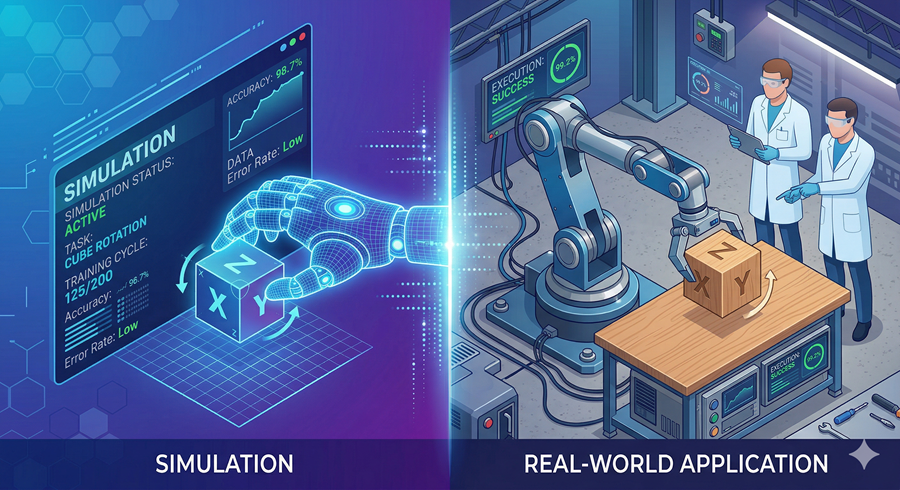
This week, I saw a robotic hand perform a task it had never practiced in the real world. It was trained entirely in simulation, then deployed directly onto physical hardware. No adjustment, no retraining. And it worked flawlessly.
That moment made me realize something bigger is happening. AI is no longer just learning. It is adapting, generalizing, and sometimes surprising us.
When Simulation Becomes Reality
The robotic hand was given a simple but notoriously difficult task. Rotate a cube to match a target orientation using only its fingertips.
No palm support. No external help. Just precise coordination across multiple fingers.
What impressed me was not just that it succeeded, but that it did so repeatedly without failure. This kind of control has been a long-standing challenge in robotics because even small errors in simulation usually cause real-world failures.
The success suggests something important. Our virtual environments are becoming accurate enough to teach machines how to operate in the real world without ever touching it first.
That is a major leap.
Dexterity Is the New Intelligence
We often associate intelligence with thinking. But in robotics, intelligence is physical.
To manipulate objects with fingertips alone, a system must constantly adjust grip, pressure, and motion in real time. Every movement depends on unstable contact and shifting dynamics.
Watching a machine handle that level of precision feels different. It is less like programming and more like skill.
This kind of dexterity is foundational. Once mastered, it opens the door to tasks like tool use, assembly, and delicate operations that were previously out of reach.
From Repetition to Reliability
Another shift I noticed is consistency. Robots are not just learning tasks. They are performing them at near-perfect reliability.
In controlled tests, machines completed repetitive physical tasks like folding, packing, and sorting hundreds of times with almost no failures. Speed improved dramatically, too, turning slow processes into efficient cycles.
That level of consistency is what makes automation commercially viable. It is not about doing something once. It is about doing it perfectly every time, and we are getting very close to that threshold.
The Emergence of Unexpected Skills
What surprised me most was not in robotics, but in AI models themselves.
Systems trained on massive amounts of data are beginning to develop abilities that were never explicitly designed. One model learned to write functional code just by processing audio and video inputs.
No one programmed that feature. It emerged.
This changes how I think about training AI. Instead of building specific skills, we are creating conditions where capabilities appear on their own.
That is powerful, but also unpredictable.
A Future That Builds Itself
What connects all of this is a shift from instruction to emergence.
Machines are no longer waiting for step-by-step guidance. They are learning from environments, adapting across contexts, and even discovering new ways to solve problems.
I see a future where we do not fully specify what systems should do. Instead, we shape the environment and let intelligence develop within it.
That is both exciting and unsettling.
Because for the first time, we are not just building tools.
We are building systems that figure things out on their own.
Follow Us on:
Clutch
Goodfirms
Linkedin
Instagram
Facebook
Youtube