


I keep noticing a pattern in how new AI models are released. On the surface, everything looks like a clean upgrade, but underneath, there is always a quieter competition shaping the direction of progress. The release of Opus 4.7 makes that tension hard to ignore.
Opus 4.7 and the Model Hierarchy That Still Matters
I think of model families as layered tools. The top tier is meant for deep reasoning, complex coding, and heavy workloads, while lighter versions handle simpler tasks. Opus 4.7 sits at the top of its lineup, positioned as the most capable general model. Yet there is an important caveat. Another internal model, often referred to as a preview system, is still considered more powerful in specific areas. That alone changes how I interpret this release. It feels less like a final answer and more like a step in a larger strategy.
Benchmark Wins That Do Not Tell the Whole Story
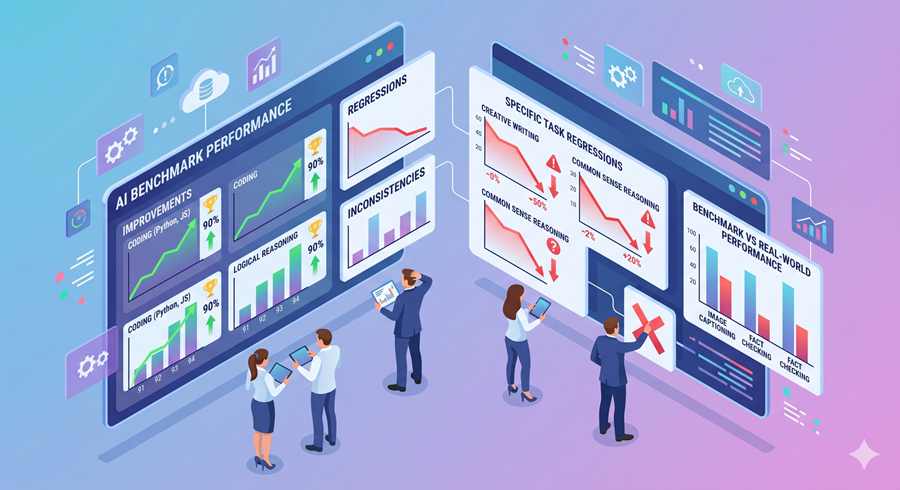
When I look at performance tests, Opus 4.7 clearly improves over its predecessor in many areas. It performs strongly in software engineering tasks, reasoning, and real-world problem-solving. In several categories, it competes closely with other frontier models and even leads in some office-style workloads.
But not everything moves forward. In agentic search tasks, which require finding precise information in large spaces, it surprisingly underperforms its earlier version in some cases. That inconsistency stands out because it shows that progress is not linear. One capability improves while another regresses, which makes the overall picture more complicated than typical marketing suggests.
Why Coding Still Sits at the Center of AI Strategy
One thing I cannot ignore is how heavily this model leans into software engineering. A large portion of its improvements is designed for coding workflows, debugging, and technical problem-solving. Developers remain the primary audience for these systems.
At the same time, the direction is expanding. The model is increasingly used in areas like financial analysis, legal workflows, and structured document interpretation. That shift suggests a broader ambition to move from “coding assistant” to “general office intelligence,” even if coding remains the strongest foundation.
Memory, Vision, and the Push Toward Real Work
Another interesting development is how these systems now handle longer workflows. The addition of persistent memory mechanisms means the model can carry context across sessions instead of relying only on short-term input. That changes how complex tasks can be structured.
Visual understanding also gets a noticeable upgrade. Higher resolution image processing allows better interpretation of screenshots, interfaces, and documents. This matters because so much of modern AI interaction is not just text, but visual feedback loops where the model evaluates what it produces.
The Hidden Strategy Behind “Not the Best Model” Claims
What stands out most to me is the repeated emphasis that this is not the absolute best model in their ecosystem. That role is reserved for a separate preview system that is positioned as the future direction.
This creates an unusual dynamic. Instead of one flagship model, multiple tiers are competing in different ways. One is public-facing and broadly capable. Another is experimental and more powerful in specific domains. It feels like a deliberate strategy to separate stable performance from frontier experimentation.
