


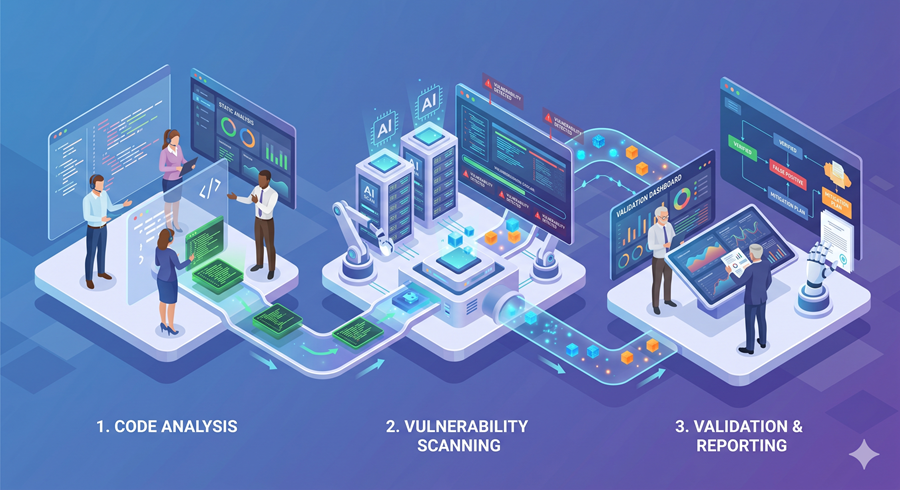
Microsoft’s latest announcement around M-DASH (Multi-Model Agentic Scanning Harness) represents a major shift in how cybersecurity is done using artificial intelligence. Instead of relying on a single powerful AI model, Microsoft has built a system where more than 100 AI agents work together in a structured pipeline to detect, validate, and even reproduce real software vulnerabilities.
What makes this especially notable is that M-DASH reached an 88.45% score on the CyberGym benchmark, placing it ahead of top systems from competitors like Anthropic and OpenAI. Anthropic’s Mythos preview reportedly scored around 83.1%, while OpenAI’s GPT-5.5 achieved 81.8%. But the most surprising detail is not just the score it’s how Microsoft achieved it.
Unlike its competitors, Microsoft did not rely on a single frontier model. Instead, it used a combination of publicly available AI models from different providers, orchestrated into one unified system. This means Microsoft effectively built a higher-performing system by combining multiple tools rather than relying on one “super model.”
A Multi-Agent System Instead of a Single AI
At the core of M-DASH is a multi-agent architecture, where each AI agent has a specialized job. Instead of one model trying to do everything, the system breaks cybersecurity analysis into stages and assigns different agents to each part.
The workflow is divided into five key stages:
1. Prepare Stage
The system begins by analyzing source code. It builds indexes, studies previous code changes, and maps possible attack surfaces. This stage helps the system understand where vulnerabilities might exist.
2. Scan Stage
Here, “auditor agents” inspect the code and generate potential security issues. They don’t just look for obvious bugs they also form hypotheses based on suspicious patterns.
3. Validate Stage
In this stage, “debater agents” step in. Their job is to challenge the findings. They argue whether a vulnerability is actually exploitable or just a false alarm. This introduces a kind of AI-driven peer review system.
Why Multiple AI Models Work Better Together
One of the most innovative parts of M-DASH is that it is model-agnostic. That means it can use different AI models depending on the task. Large, powerful models handle complex reasoning, while smaller optimized models handle high-volume scanning efficiently.
Even more interesting is the idea that disagreement between models is useful. If one agent detects a vulnerability and another fails to disprove it, the system treats that disagreement as a strong signal that the issue might be real. This creates a built-in verification mechanism that improves accuracy.
Real Vulnerabilities Found in Windows
Microsoft tested M-DASH on its own Windows systems and discovered 16 real vulnerabilities, which are now being patched. Four of these are considered critical, meaning they could potentially allow remote attackers to gain access without authentication.
Two examples highlight the seriousness of these findings:
Memory Reuse Bug in tcpip.sys
This vulnerability occurs when the system frees memory but later accidentally tries to use it again. It’s similar to returning a borrowed book to a library, only for someone else to modify it before you pick it up again. When the original system accesses it, the data is no longer safe or valid.
Double-Free Bug in IKEEXT Service
In this case, two parts of the system mistakenly believe they own the same memory. Both attempt to release it, causing corruption. This can lead to system crashes or even remote code execution in certain conditions.
What makes these bugs especially dangerous is that they are distributed across multiple files. A human reviewer or even a single AI model would likely miss the connections between them.
Benchmark Results and Testing
M-DASH was also tested on the CyberGym benchmark, which includes over 1,500 real-world vulnerability scenarios. The system showed extremely strong performance:
Nearly 100% recall on known historical Windows vulnerabilities
Detection of all 21 injected vulnerabilities in a private test driver
Zero false positives in controlled testing
These results demonstrate that the system is not just theoretical it can identify real, complex security issues reliably.
A Major Shift in AI Strategy
M-DASH highlights a bigger shift in artificial intelligence strategy. Instead of focusing only on building larger and more powerful single models, Microsoft is demonstrating the power of system-level AI design.
There are now two competing approaches in AI development:
Model-first approach (OpenAI, Anthropic): Focus on building the most powerful single AI model.
System-first approach (Microsoft): Combine multiple models into coordinated systems that outperform individual models.
Microsoft’s results suggest that system design may be just as important as raw model intelligence.
Ultimately, M-DASH is not just a cybersecurity tool it is a preview of how future AI systems will operate: not as single models, but as coordinated teams of intelligent agents working together.
