




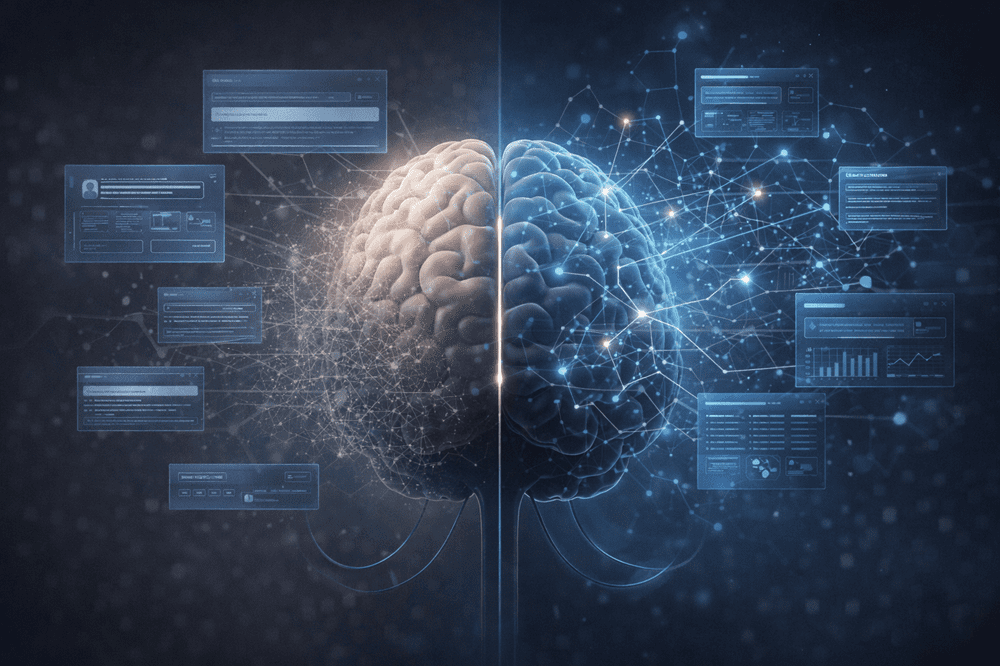
Artificial intelligence is no longer something I think of as the future. It is already part of how I write, learn, and make decisions every day. From drafting emails to analyzing information, AI has quietly become part of my workflow.
But this shift raises an uncomfortable question: is AI making me more capable, or slowly making me dependent?
The answer is not simple. It depends entirely on how I use it.
The Risk of Mental Outsourcing
One of the biggest concerns is how easy it is to hand over thinking.
Tasks that once required effort now take seconds. Writing, research, and problem-solving can all be done with a prompt. While this feels efficient, it comes with a hidden cost.
If I rely on AI too often, I stop practicing the underlying skills.
It is similar to how navigation apps reduced our ability to remember directions. The more I depend on AI, the less I engage in figuring things out. Over time, this can weaken critical thinking and creativity.
Convenience makes it tempting to skip the struggle, but that struggle is often where real learning happens.
When Efficiency Reduces Growth
There is another subtle shift.
AI removes friction. It simplifies the messy parts of work like drafting, debugging, and researching. But those messy parts are where growth usually happens.
When everything becomes faster and easier, I risk becoming a passive user instead of an active thinker.
This is not just about productivity. It is about depth.
If I stop engaging deeply with problems, I may get quicker results, but I lose true understanding.
The Case for Amplified Intelligence
At the same time, AI can be extremely powerful when used intentionally.
Instead of replacing thinking, it can extend it.
AI is good at processing large amounts of information, finding patterns, and handling repetitive tasks. This allows me to focus on higher-level work like creativity, strategy, and decision-making.
With the right approach, I can achieve more than ever before.
That is not laziness. That is leverage.
Passive vs Active Use
The real issue is not AI itself, but how I use it.
If I use AI to avoid thinking, it becomes a crutch. But if I use it as a collaborator, it strengthens my abilities. I can explore ideas, refine work, and stay mentally engaged.
AI does not decide whether I become lazy or powerful.
My habits do.
