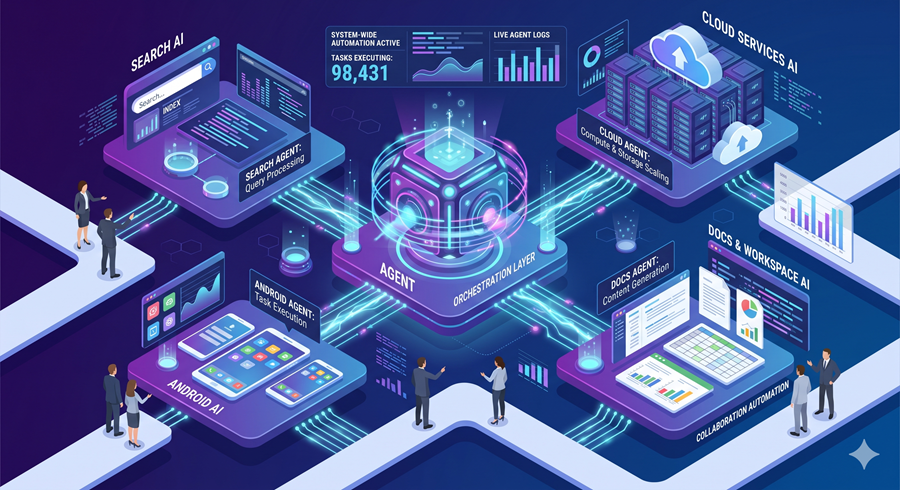
Google I/O 2026 wasn’t just another product update cycle it was a clear signal that AI is moving from “assistive tools” to full-scale autonomous systems. Instead of improving isolated features, Google introduced an interconnected ecosystem where AI agents can plan, execute, and manage tasks continuously across Search, Android, Docs, and cloud services.
What stood out most was the scale. Google revealed that its systems now process over 3.2 quadrillion tokens per month, compared to just 9.7 trillion two years ago. That’s not a linear increase, it’s exponential. Alongside that, the Gemini app has grown to 900 million monthly active users, while AI features in Search have crossed the billion-user mark. These numbers show that AI is no longer experimental; it’s becoming the default interface for digital work.
Gemini 3.5 Flash: Small Model, Hug
One of the biggest technical announcements was Gemini 3.5 Flash, a model designed for speed, efficiency, and scale. Despite being categorized as a “Flash” model, it performs at or above previous flagship systems on multiple benchmarks.
On coding and reasoning tests, it outperforms earlier Pro-level models while maintaining extremely high throughput around 280 tokens per second, significantly faster than most frontier models. This combination of speed and capability is important because it allows real-time AI systems to function smoothly without delay.
Even more significant is cost efficiency. Google highlighted that Gemini 3.5 Flash can reduce AI operational costs by more than half for large-scale workloads. For enterprises processing billions of tokens daily, this translates into millions of dollars saved annually. In other words, AI is becoming not only more powerful but economically unavoidable.
Anti-Gravity 2.0: Multi-Agent Work as a System
Another major shift comes from Anti-Gravity 2.0, Google’s platform for managing AI agents. Instead of interacting with a single model at a time, users can now deploy multiple agents simultaneously, each handling different parts of a task.
This changes the workflow structure entirely. Instead of linear execution, AI now operates like a distributed team. One agent can write code, another can test it, while another analyzes the output, all in parallel.
Google demonstrated this concept by generating a complex system using dozens of sub-agents working together. The key idea isn’t the demo itself, but the architecture: AI is no longer a tool you prompt step-by-step, but a system you assign outcomes to.
Gemini Spark: AI That Works While You Sleep
Perhaps the most impactful announcement is Gemini Spark, a 24/7 autonomous AI agent that runs on Google Cloud infrastructure. Unlike traditional assistants, Spark continues working even when your device is off.
It connects deeply with Gmail, Docs, Calendar, and external tools, breaking down tasks into structured workflows. It can analyze data, draft reports, manage communication, and even coordinate business operations with minimal human intervention.
For example, Spark can prepare a full client briefing by pulling CRM data, support tickets, and historical context, then generate emails and documents automatically. This shifts AI from “on-demand help” to continuous operational execution.
Search Becomes an AI Operating System
Google Search is also undergoing a fundamental transformation. With information agents, users can now assign ongoing tasks like tracking competitors, monitoring industries, or summarizing updates automatically.
Search results are no longer static pages they are becoming dynamic, personalized interfaces. Google also introduced generative UI, meaning the system can build dashboards, tables, or interactive layouts depending on the query.
This effectively turns Search into a lightweight operating system for information management, rather than just a retrieval tool.
The Bigger Picture: From Tools to Autonomous Ecosystems
Across all announcements, a clear pattern emerges: Google is rebuilding its entire ecosystem around AI agents. Search, Android, Workspace, and Chrome are no longer separate products; they are becoming execution surfaces for AI systems.
Instead of users switching between apps, agents will operate across them. Instead of manual workflows, tasks will be delegated to persistent systems that improve over time.
The real shift isn’t just technological it’s structural. Work is moving from human-driven execution to agent-coordinated systems where humans define intent, and AI handles implementation.
Conclusion
Google I/O 2026 marks a turning point where AI is no longer a feature inside products it is becoming the foundation of products themselves. With models like Gemini 3.5 Flash, platforms like Anti-Gravity, and autonomous systems like Gemini Spark, Google is building an ecosystem where AI doesn’t just respond to work, but actively performs it.
The biggest question now is not what these tools can do in demos, but how quickly they can be adopted in real-world workflows. Because if these systems scale as projected, the definition of “using software” may change entirely in the next few years.