



Every cell in my body carries the same instruction manual. It is written in DNA and contains more than 20,000 genes arranged across roughly three billion chemical letters. This code shapes everything from physical traits to the way our bodies respond to disease.
For decades, scientists have known that understanding genes requires more than simply reading DNA. We also need the ability to control it. That challenge led to one of the most powerful scientific breakthroughs of the modern era.
It is called CRISPR.
The Hidden Defense System Inside Bacteria
The technology behind CRISPR did not originate in a laboratory designed for genetic engineering. It began with a discovery about how bacteria defend themselves.
Bacteria constantly face attacks from viruses. To survive, they evolved a molecular immune system that identifies and destroys invading genetic material.
When viral DNA enters a bacterial cell, the organism produces small RNA molecules that recognize the invader’s genetic sequence. These RNA fragments join with a protein known as Cas9, which acts like molecular scissors.
Once the RNA locates the matching viral sequence, Cas9 slices the DNA, effectively disabling the virus before it can take over the cell.
Scientists eventually realized something remarkable. If the guiding RNA could be redesigned, the system could be programmed to cut almost any DNA sequence.
That discovery transformed a bacterial defense mechanism into a powerful gene editing tool.
How CRISPR Edits DNA
The basic idea behind CRISPR editing is surprisingly straightforward.
Researchers design a short piece of RNA that matches the DNA sequence they want to target. This guide RNA directs the Cas9 protein to a precise location within the genome.
Once the complex reaches the correct spot, Cas9 cuts both strands of the DNA helix.
Cells cannot ignore broken DNA, so they quickly attempt to repair the damage. That repair process creates an opportunity for scientists to modify genes.
Sometimes the repair introduces small mutations that disrupt a gene entirely. This allows researchers to observe what happens when a gene stops working, revealing its biological function.
In other cases, scientists provide a replacement DNA template. During the repair process, the cell uses this template to insert a new sequence, effectively rewriting the gene.
Why This Technology Changed Genetics
Before CRISPR, altering genes was slow, expensive, and technically difficult. Researchers could spend years engineering a single targeted mutation.
CRISPR dramatically simplified the process. It allows scientists to edit DNA inside living cells with far greater precision and efficiency.
The system can even target multiple genes at once. This is especially important for studying complex diseases where many genes interact, rather than a single mutation causing the condition.
Because of this flexibility, CRISPR has quickly become a core tool across biology and medicine.
Where Gene Editing Is Headed
Today, CRISPR is already transforming several fields.
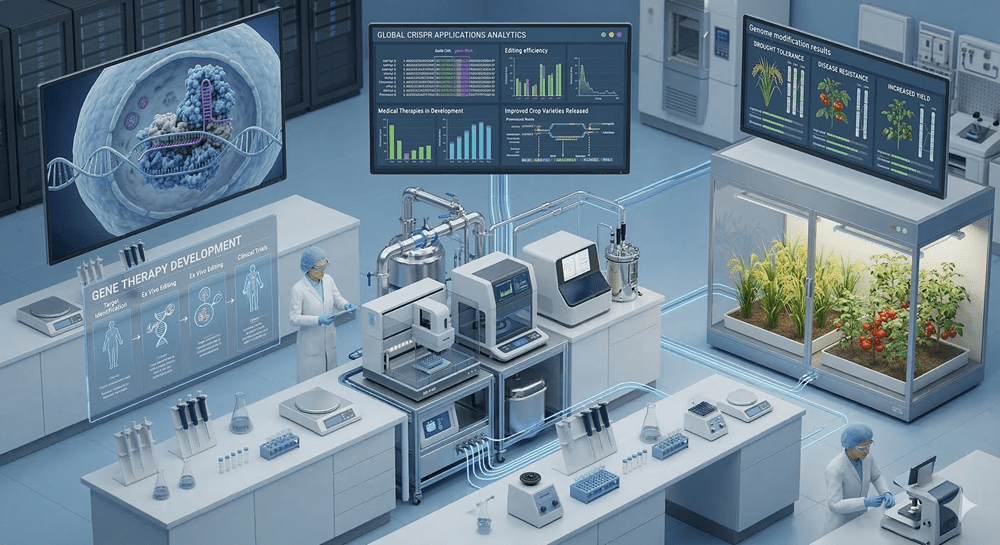
Researchers use it to explore how genes control development and disease. Pharmaceutical scientists apply it to discover new drug targets. Agricultural scientists are using gene editing to create crops with improved resilience and nutrition.
Perhaps the most profound possibility lies in medicine. Scientists are investigating whether CRISPR could one day correct genetic mutations directly in patients, offering potential treatments for inherited disorders.
The technology is still evolving rapidly, and many ethical and technical questions remain. Yet one fact is clear.
For the first time in history, humanity has a tool capable of editing the fundamental code of life.