The most downloaded AI model on the planet is not American. It is Chinese. It is called Qwen, and it has reportedly crossed more than 700 million downloads. Yet most people in the West have never even heard of it. The same is true for other major Chinese AI systems like DeepSeek, Kimi, GLM, and MiniMax. These models are widely used, rapidly improving, and in many cases completely free or open source.
What makes this more important is not just popularity but performance. In several benchmarks and real-world deployments, these models are matching or even outperforming Western models that cost significantly more to run. This shift is already visible in industry usage. Some companies use Chinese models for customer support systems, recommendation engines, and internal automation tools because they are cheaper and more efficient.
Adoption in Global Companies
A growing number of companies are integrating Chinese AI models into production systems. In some reported cases, Airbnb has used models like Qwen for customer service tasks, while Pinterest has explored similar models for recommendation systems. The reason is simple. These models can be significantly cheaper while still maintaining strong performance.
Across the startup ecosystem, especially in companies working with open source AI infrastructure, Chinese models are being used as backend systems for applications ranging from chatbots to automation pipelines. Many developers do not focus on the origin of the model as much as its cost, speed, and reliability.
The Debate Around Safety and Data
Whenever Chinese AI is mentioned, concerns about censorship and data security appear immediately. For example, some models may avoid answering politically sensitive questions or redirect conversations depending on the topic. This is often used as an argument against their adoption.
However, Western AI systems are not free from criticism either. Large language models from major US companies collect user data in different ways, often through prompt logging, product integration, or system improvement programs. Some services also retain conversation data for extended periods, depending on their policies.
The reality is that data privacy and control are complex issues across all major AI providers, not limited to one region or company. Businesses choosing AI tools often evaluate these risks based on use case rather than ideology.
Pricing Gap Between Models
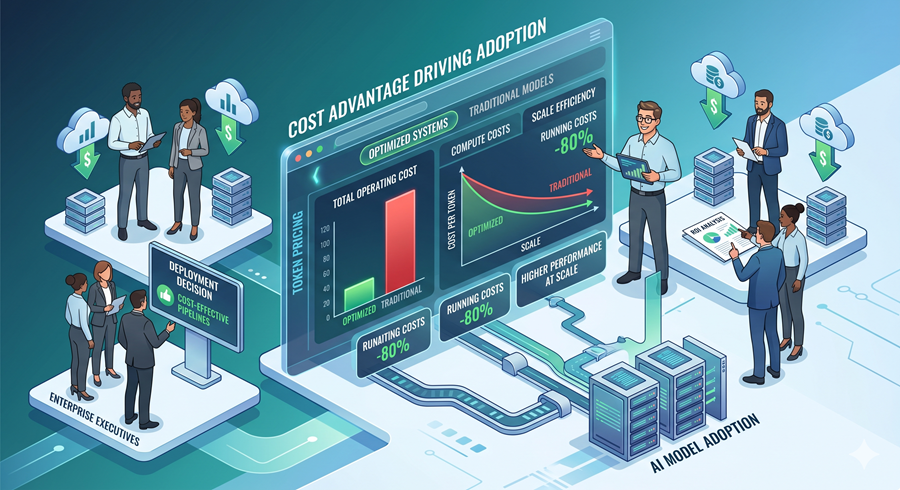
One of the most striking differences between Chinese and Western AI models is cost. Premium Western models can charge several dollars per million tokens depending on usage. In contrast, some Chinese models operate at a fraction of that price.
For example, certain budget models cost under one dollar per million tokens, while others go even lower depending on deployment. This creates a massive cost difference for companies processing millions or billions of tokens monthly.
At scale, this gap becomes extremely important. A task that costs thousands of dollars on one platform may cost only a few dozen dollars on another, without major differences in output quality for many use cases.
Why Chinese AI Became So Efficient
A major reason behind this efficiency is the engineering strategy. Instead of relying heavily on expensive compute resources, some Chinese AI labs focus on optimization techniques such as model specialization, efficient routing, and compressed architectures.
For example, some systems activate only a small portion of their model for each request instead of using the full network. This reduces compute cost and improves speed without significantly affecting performance.
In addition, restrictions on access to high-end hardware have pushed companies to innovate in software optimization rather than purely scaling hardware.
Investment and IPO Growth in China
The financial ecosystem around Chinese AI is expanding rapidly. Many AI startups in China are now entering public markets or preparing for IPOs in Hong Kong and Shanghai.
Investor interest has been extremely strong, with some listings heavily oversubscribed. Companies in sectors like AI models, robotics, and infrastructure are receiving significant capital inflows. In some cases, startup valuations have grown rapidly within short time periods after listing.
Large technology firms in China are also investing heavily in AI infrastructure, including data centers, chips, and model training systems. These investments are creating a parallel ecosystem that competes directly with Western AI development.
Real World Applications in China
China is also scaling AI adoption across industries at an extremely fast rate. AI tools are being used in content production, customer automation, robotics, and business operations.
In creative industries, for example, AI has reduced production time and costs for short-form content dramatically. This has enabled a surge in output across digital media platforms. Similar patterns are visible in logistics, manufacturing, and local government initiatives where AI is used to optimize workflows and decision-making.