Artificial intelligence is evolving at a pace that even top researchers and startup founders find difficult to predict. In a recent discussion about the future of AI coding agents like Devin, industry leaders explored how AI could completely reshape software development, business operations, and entrepreneurship by 2028 or 2029. Their insights reveal a future where AI systems handle increasingly complex tasks with minimal human supervision, fundamentally changing how companies are built and operated.
AI Agents Are Becoming More Capable Every Month
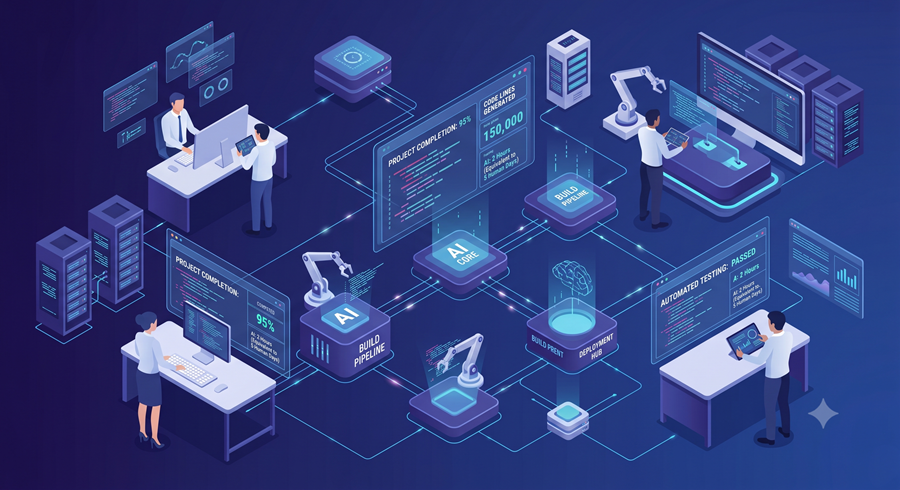
One of the biggest points discussed was how rapidly AI models are improving. Researchers referenced studies showing that modern AI systems can now complete tasks equivalent to many hours of human work before requiring intervention. Just a few years ago, AI could only handle tiny coding tasks lasting a few seconds before making mistakes. Today, advanced models can autonomously work through projects that would take humans nearly an entire day.
What makes this even more remarkable is that AI performs these tasks much faster than humans. While the “18 hours of work” metric refers to the amount of human effort replaced, the AI may finish the same assignment in only one or two hours. According to experts, these capabilities are doubling every few months, creating an environment where the technology landscape changes constantly.
Software Development Will Become More Autonomous
As AI systems improve, the role of developers will also evolve. Instead of manually guiding every line of code, engineers will increasingly assign broader objectives to AI agents. For example, rather than asking an AI to fix one bug, developers may ask it to optimize an entire application, perform testing, and verify the results independently.
This shift will create more proactive and event-driven AI workflows. AI agents could automatically respond to security vulnerabilities, maintain software systems, and manage upgrades without continuous human oversight. The experts believe that future AI systems will operate more like autonomous teammates rather than simple assistants.
Small Businesses Could Experience Massive Growth
One of the most optimistic predictions from the discussion was the idea that AI will create a boom in small businesses and independent entrepreneurs. Traditionally, starting a business required access to specialists, expensive resources, and large teams. AI is rapidly reducing those barriers.
Today, individuals can already use AI tools for legal guidance, financial analysis, software development, customer communication, and marketing support. As these systems improve, a single motivated entrepreneur may be able to perform the work that once required an entire company.
This trend could empower thousands of highly productive small businesses that compete with larger organizations. AI becomes a force multiplier, allowing ambitious individuals to execute ideas faster and more efficiently than ever before.
Hiring and Talent Evaluation Are Also Changing
The conversation also explored how AI is transforming hiring practices. In the past, companies often tried to prevent candidates from using AI tools during interviews. However, many forward-thinking organizations now encourage AI usage during assessments.
The reasoning is simple: if AI can already complete certain technical tasks, testing people on those exact tasks becomes less meaningful. Instead, companies want to evaluate higher-level thinking skills such as decision-making, creativity, product intuition, and problem-solving.
Some startups are even hiring large numbers of former founders because these individuals typically possess strong initiative, adaptability, and strategic thinking. In an AI-driven future, those qualities may become more valuable than traditional technical execution alone.
The Next Few Years Could Redefine Work
The overall message from the discussion was clear: AI is not slowing down. The rapid improvement of coding agents and autonomous systems could dramatically reshape software engineering, entrepreneurship, and the global workforce within just a few years. Businesses and individuals who learn how to work effectively alongside AI may gain enormous advantages in productivity and innovation.