
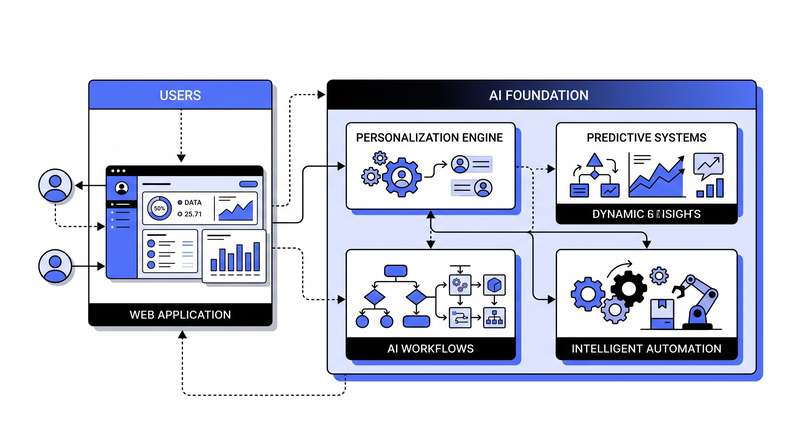
There is a meaningful difference between applications that use data to improve user experience incrementally and applications built from the ground up with AI as a core architectural component. That difference – in user engagement, conversion, and operational efficiency – is becoming one of the clearest competitive divides in US enterprise software.
A genuinely AI-powered web application is one where machine intelligence is woven into the core user flows, backend processing, and decision logic. Characteristics include dynamic personalization that adapts the interface and content to individual user context in real time, intelligent automation that handles complex processing without human intervention, natural language interfaces allowing users to interact through conversation rather than menus, and predictive features that anticipate user needs before they are explicitly requested.
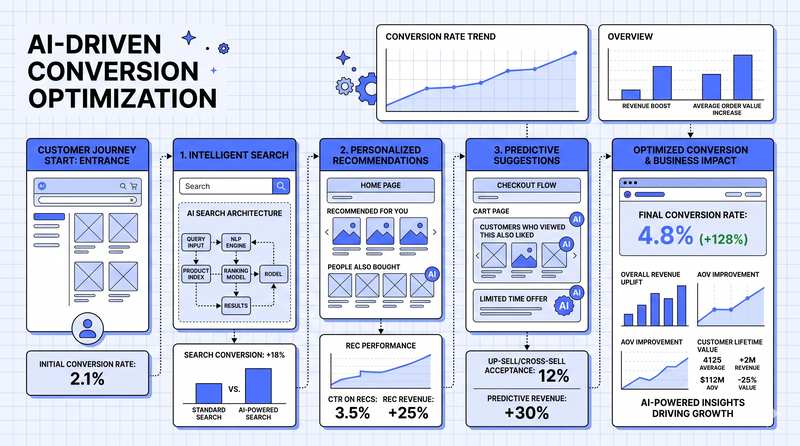
Where AI-powered web applications consistently outperform traditional builds in key metrics
User engagement increases when applications adapt to individual users rather than presenting a one-size-fits-all experience. Conversion rate improvements in AI-powered e-commerce and lead generation applications range from 15 to 40 percent depending on the baseline and implementation quality. Operational efficiency gains come from the automation of processes that would otherwise require human intervention – customer service handling, document processing, and data enrichment workflows that previously required manual effort can be automated end-to-end.
We build AI-powered web applications primarily on a Next.js and Node.js stack. Next.js provides server-side rendering capabilities critical for AI-powered applications where personalization needs to be rendered on the server to avoid layout shifts. Node.js provides the non-blocking I/O architecture particularly well-suited to AI application patterns where multiple concurrent model calls, streaming responses, and real-time processing are common requirements.
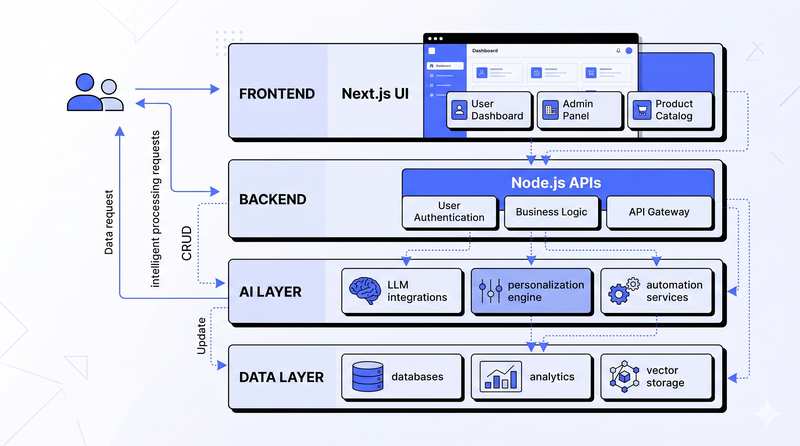
The three integration challenges that separate well-built AI applications from poorly integrated ones
We help US enterprises make this decision based on their specific workload requirements, existing infrastructure, and long-term AI roadmap - not platform preference.
Get expert insights on your use case and identify the most effective path forward.