
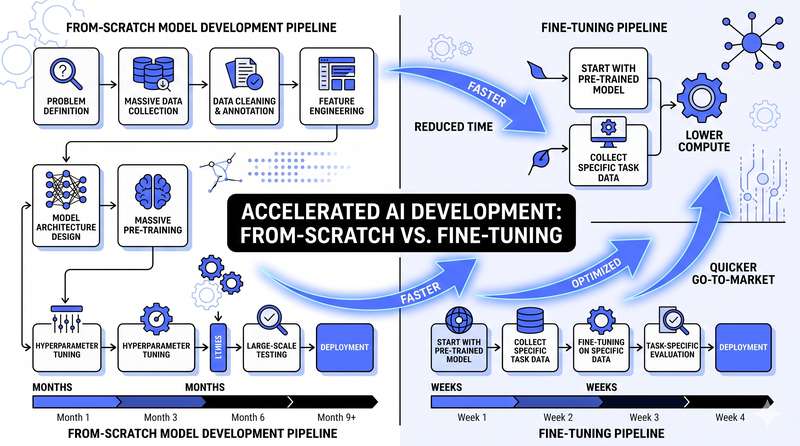
Eight months. That is roughly how long it takes to build, train, validate, and deploy a custom AI model from scratch for a specialized domain application. Now consider fine-tuning an existing foundation model on domain-specific data, reaching production-ready performance in six to eight weeks. This is the reality that US enterprises are discovering as foundation model fine-tuning matures from a research technique into a reliable engineering practice.
A model like Llama 3 has been trained on trillions of tokens of text. It understands language structure, grammar, reasoning patterns, and factual knowledge across hundreds of domains. When you fine-tune this model on your domain data, you are not teaching it language from scratch – you are teaching it the specifics of your domain, your terminology, your task format, and your quality standards. The equivalent of hiring a highly educated generalist and training them on your specific business versus hiring someone with no education and training them from zero.
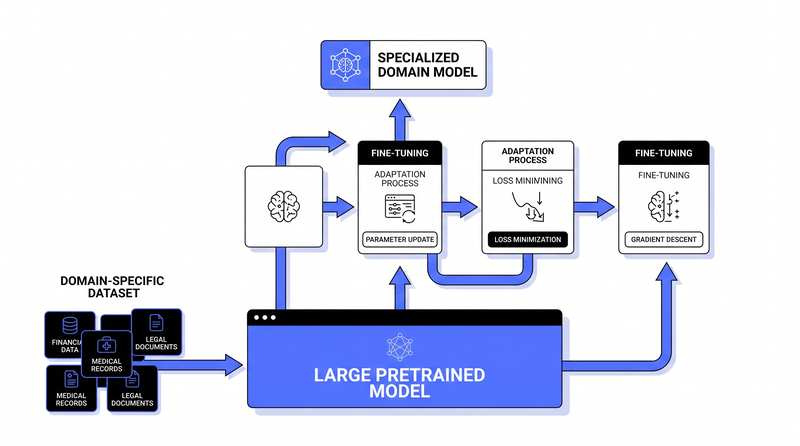
The data quality characteristics that determine fine-tuning success or failure
Effective fine-tuning data has clear input-output pairs that represent the exact task the model should learn, consistent quality across examples, sufficient diversity to cover the range of real inputs, coverage of edge cases, and accurate high-quality labels throughout. For tasks relatively close to the model’s existing strengths, a few hundred high-quality examples can produce meaningful improvement.
Techniques like LoRA (Low-Rank Adaptation) and QLoRA have made fine-tuning significantly more efficient and less risky. These approaches update only a small subset of the model’s parameters rather than all of them, preserving general capabilities more reliably and reducing the compute requirements for the fine-tuning process itself.
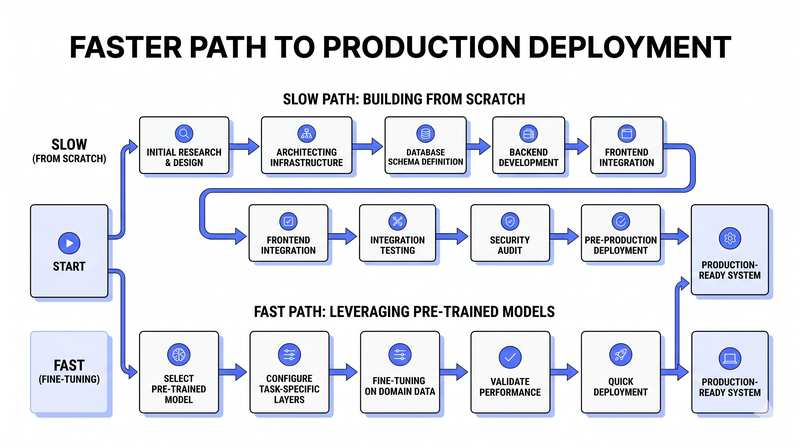
US industries seeing the strongest results from foundation model fine-tuning
Legal services organizations are fine-tuning models on contract language, case law, and internal document libraries. Healthcare organizations are fine-tuning on clinical documentation and patient communication data – accuracy improvements on clinical tasks directly affect patient care quality. Financial services firms are fine-tuning on regulatory documents and financial analysis reports to build systems that understand financial instruments and regulatory requirements with genuine precision.
We help US enterprises make this decision based on their specific workload requirements, existing infrastructure, and long-term AI roadmap - not platform preference.
Get expert insights on your use case and identify the most effective path forward.