
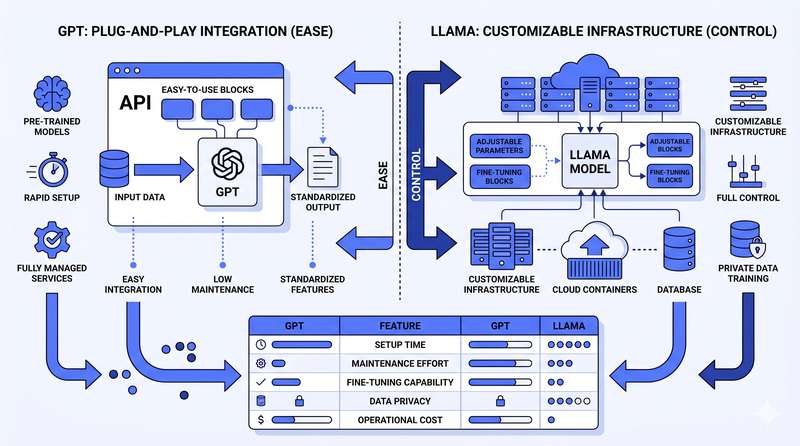
GPT-4 from OpenAI has been the default choice for many organizations simply because it was first to market with impressive capabilities. Llama, Meta’s open-source model family, has grown rapidly and is increasingly a serious alternative or complement to GPT in enterprise deployments. This is a practical guide to which model family makes more sense for different enterprise contexts – not a raw benchmark comparison.
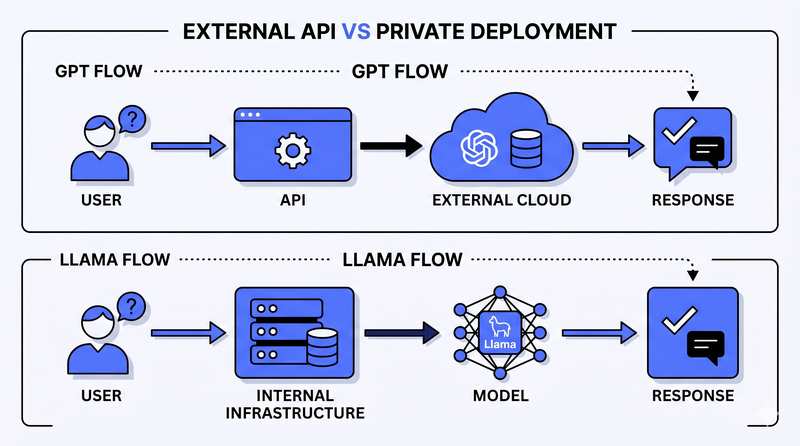
With GPT, you are using a service. Your data passes through OpenAI’s infrastructure. You pay per token. You accept OpenAI’s terms of service and data handling policies. You have no control over how the model changes between versions. With Llama, you are running software. You deploy it on your own infrastructure. You pay for compute, not per token. Your data never leaves your environment. You have complete control over the model, including the ability to fine-tune it extensively on your proprietary data.
GPT makes the most sense when your use case requires the absolute highest level of reasoning capability and you are not handling sensitive proprietary data. For enterprises deeply integrated into the Microsoft ecosystem, GPT models accessed through Azure OpenAI Service provide enterprise-grade security with native integration. For organizations that need strong multimodal capabilities, GPT-4o currently has a more mature implementation.
The growing set of enterprise use cases where Llama consistently outperforms GPT
Data privacy and security requirements are the most common driver – US enterprises in healthcare, financial services, legal, and defense have data that simply cannot be sent to a third-party API. Llama deployed on private infrastructure is the only viable foundation model option for these organizations. Cost at scale – GPT’s per-token pricing becomes expensive at enterprise scale. Deep customization requirements favor Llama when an enterprise needs to fine-tune extensively on proprietary data with full control over the training process.
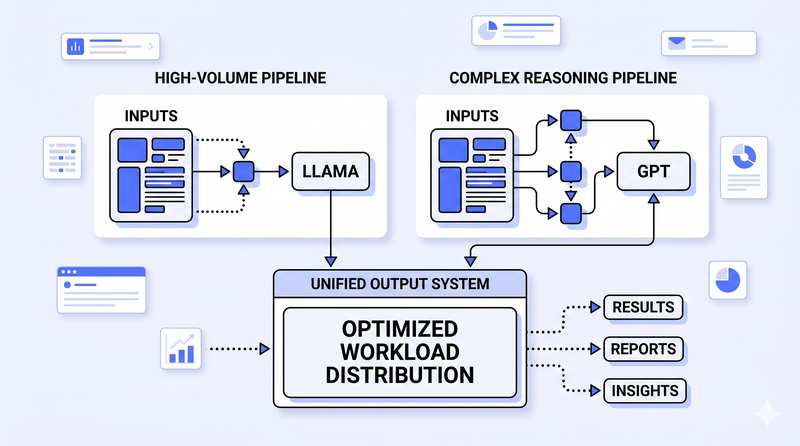
How leading US enterprises are using both GPT and Llama for different purposes within the same AI architecture
Many US enterprises are adopting a hybrid strategy – GPT handles complex, low-volume reasoning tasks where its frontier capabilities justify the cost. Llama handles high-volume, specialized tasks where its deployability, customizability, and cost profile are superior. This approach requires more architectural sophistication but delivers better performance and economics than relying exclusively on either model family.
We help US enterprises make this decision based on their specific workload requirements, existing infrastructure, and long-term AI roadmap - not platform preference.
Get expert insights on your use case and identify the most effective path forward.