
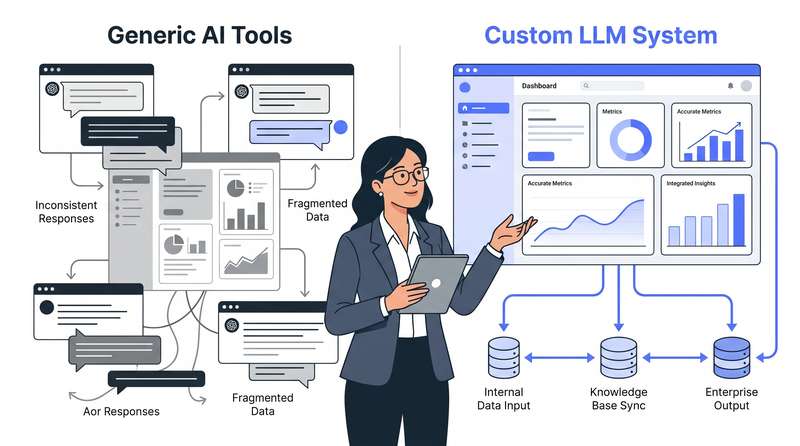
The first wave of enterprise AI adoption was largely about access. Organizations rushed to integrate ChatGPT or Copilot because the capabilities were genuinely impressive and the barrier to entry was low. But as US enterprises have moved beyond experimentation into serious AI-dependent operations, generic tools consistently hit a ceiling that arrives earlier and harder than most organizations anticipated.
Off-the-shelf AI tools deliver real value for general-purpose writing assistance, broad research support, basic code completion, and simple content generation where your specific business context does not significantly affect quality. For individual productivity enhancement in these areas, generic tools remain excellent. The ceiling appears when you need AI that understands your specific business deeply.
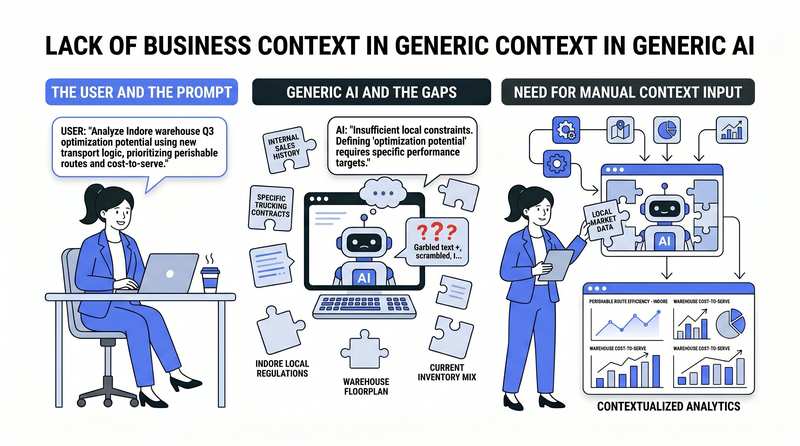
The four consistent failure points of generic AI tools in enterprise environments
Knowledge boundaries – a generic LLM knows nothing about your products, customers, internal processes, or compliance requirements. Hallucination risk is amplified when the model does not have specific information and generates plausible-sounding but fabricated content. Consistency and brand alignment are difficult to maintain at scale with generic tools. Data privacy and security concerns are significant for US enterprises in regulated industries where data cannot be sent to a third-party API.
Custom LLM development does not necessarily mean training from scratch. In most enterprise contexts it means fine-tuning a foundation model on proprietary data; building a RAG system connecting a powerful model to your specific knowledge base; developing a complete LLM application with custom prompt engineering, tool integrations, and memory management; or deploying a model on your own infrastructure to eliminate third-party data exposure.
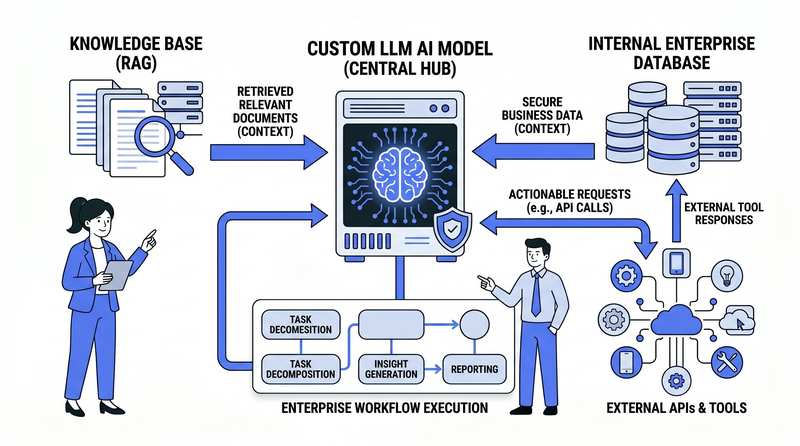
The compounding performance advantage of custom LLMs over generic tools over time
US enterprises that move from generic tools to custom LLM deployments consistently report improvements that are not marginal. The gap between a generic model answering questions about your business and a purpose-built system trained on your data is significant across every metric: accuracy, consistency, relevance, and reliability. This advantage compounds over time as foundation models improve at general tasks but still do not automatically improve at your specific tasks.
We help US enterprises make this decision based on their specific workload requirements, existing infrastructure, and long-term AI roadmap - not platform preference.
Get expert insights on your use case and identify the most effective path forward.