
Why US Enterprises Are Moving Away From Generic AI Tools Toward Custom LLMs
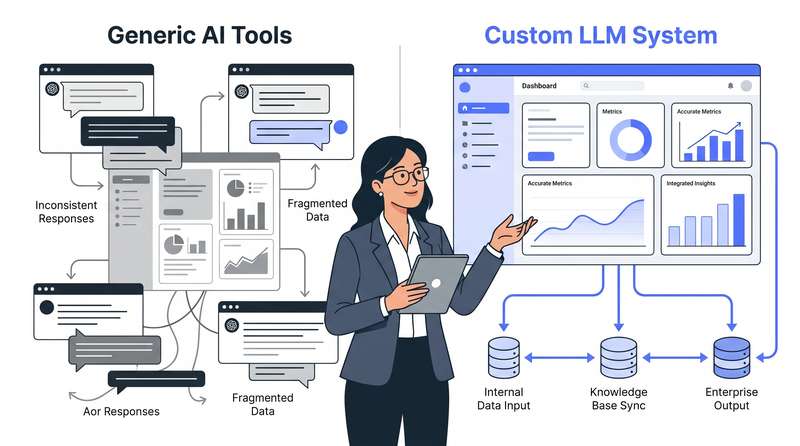
The first wave of enterprise AI adoption was largely about access. Organizations rushed to integrate ChatGPT or Copilot because the capabilities were genuinely impressive and the barrier to entry was low. But as US enterprises have moved beyond experimentation into serious AI-dependent operations, generic tools consistently hit a ceiling that arrives earlier and harder than most organizations anticipated. What Generic AI Tools Are Good At Off-the-shelf AI tools deliver real value for general-purpose writing assistance, broad research support, basic code completion, and simple content generation where your specific business context does not significantly affect quality. For individual productivity enhancement in these areas, generic tools remain excellent. The ceiling appears when you need AI that understands your specific business deeply. The four consistent failure points of generic AI tools in enterprise environments Where Generic Tools Break Down Knowledge boundaries – a generic LLM knows nothing about your products, customers, internal processes, or compliance requirements. Hallucination risk is amplified when the model does not have specific information and generates plausible-sounding but fabricated content. Consistency and brand alignment are difficult to maintain at scale with generic tools. Data privacy and security concerns are significant for US enterprises in regulated industries where data cannot be sent to a third-party API. What Custom LLMs Actually Look Like Custom LLM development does not necessarily mean training from scratch. In most enterprise contexts it means fine-tuning a foundation model on proprietary data; building a RAG system connecting a powerful model to your specific knowledge base; developing a complete LLM application with custom prompt engineering, tool integrations, and memory management; or deploying a model on your own infrastructure to eliminate third-party data exposure. The compounding performance advantage of custom LLMs over generic tools over time The Performance Gap Is Real and Widening US enterprises that move from generic tools to custom LLM deployments consistently report improvements that are not marginal. The gap between a generic model answering questions about your business and a purpose-built system trained on your data is significant across every metric: accuracy, consistency, relevance, and reliability. This advantage compounds over time as foundation models improve at general tasks but still do not automatically improve at your specific tasks.
LangChain and the New Era of Enterprise AI Workflow Development in the US
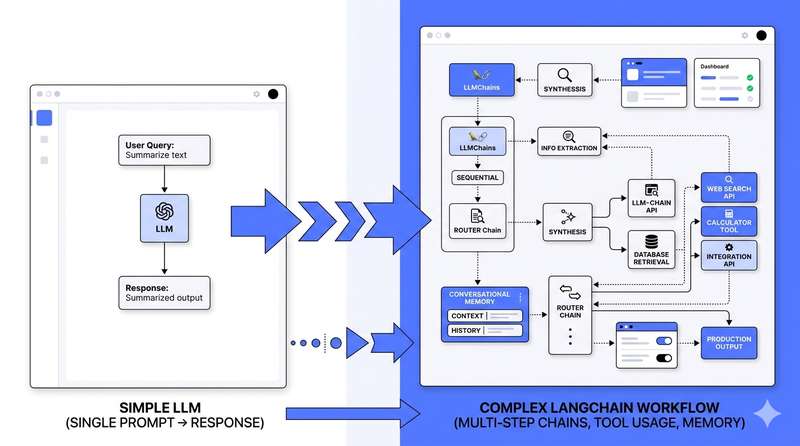
Building useful AI applications is harder than it looks. Taking a powerful language model and turning it into a production-ready system that connects to your data, follows multi-step reasoning, uses external tools, and handles real-world edge cases gracefully requires significant engineering scaffolding. LangChain was built to provide exactly that scaffolding. What LangChain Is and Why It Exists LangChain is an open-source framework that simplifies building applications powered by large language models. It provides standardized components and abstractions for the most common LLM application patterns: connecting models to data sources, building multi-step reasoning chains, managing conversation memory, integrating external tools, and orchestrating complex AI workflows. Before LangChain, building an LLM-powered application that retrieved information from a database, reasoned in multiple steps, and triggered actions in another system required building all of that plumbing from scratch. LangChain’s core components that enable enterprise-grade AI workflow development The Core Capabilities That Matter for Enterprise Chains link multiple LLM calls and processing steps into a single workflow – retrieving documents, summarizing them, comparing against criteria, and generating a structured recommendation. Agents allow the LLM to dynamically choose which tools to use to accomplish a goal – searching the web, querying a database, running calculations, or calling an external API. Memory management is critical for any AI application involving ongoing interaction. Retrieval integration is built into LangChain’s architecture, making it a natural foundation for RAG systems. Real Applications Being Built With LangChain US enterprises are using LangChain to build intelligent document processing systems that extract and summarize information from large volumes of contracts; customer service automation platforms that retrieve relevant information and escalate intelligently; internal research assistants that search across multiple data sources and generate structured reports; and code generation tools that analyze codebases with context awareness across large repositories. When LangChain wins over custom builds – and when custom architecture pays off LangSmith for Production Observability LangSmith, the observability platform developed by the same team, provides detailed tracing of every step in a LangChain application. For US enterprises that need to debug, optimize, and audit AI workflows in production, LangSmith is increasingly essential. The framework has matured significantly and is used in production by large organizations across the US.
Fine-Tuning or Prompt Engineering: What US Enterprises Need to Know Before Deciding
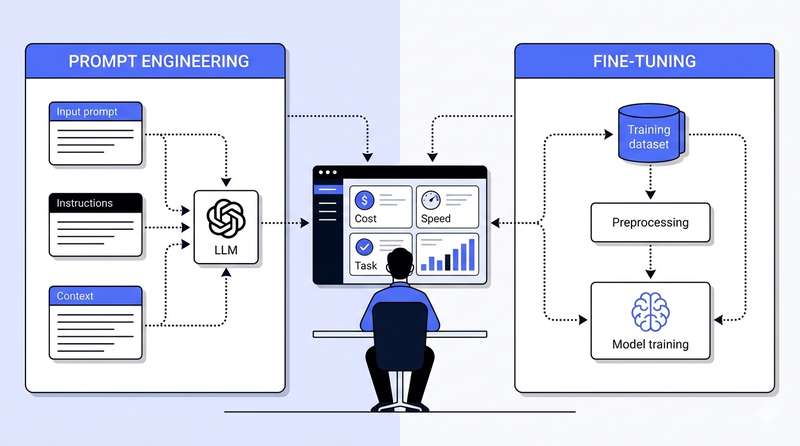
Every US enterprise exploring LLM deployment eventually faces this question. Do you customize the model itself through fine-tuning, or guide its behavior through carefully designed prompts? Both approaches work. Both have real limitations. Choosing the wrong one will cost you time, money, and internal credibility. Understanding the Baseline Modern foundation models have remarkable general capabilities. What they cannot do by default is know your business – your products, internal terminology, compliance requirements, or tone of voice. Closing that gap is exactly what prompt engineering and fine-tuning are designed to do, in very different ways. What Prompt Engineering Actually Is Prompt engineering is the practice of designing the instructions, context, and examples you provide to a model at query time to shape its output. At its simplest it is writing better instructions. At its most sophisticated it involves chain-of-thought prompting, few-shot examples, system prompt design, and output format specification. Advantages: fast to implement and iterate, no training data required, works with any model, lower cost. Limitations: context window constraints, inconsistent results on tasks requiring deep domain adaptation. Advanced prompt engineering techniques that US enterprises are using to customize LLM behavior What Fine-Tuning Actually Is Fine-tuning takes a pretrained foundation model and continues its training on a curated dataset specific to your use case. The model’s weights are updated to reflect the patterns and behavior in your training data – it genuinely internalizes your domain knowledge rather than receiving it through a prompt each time. Advantages: consistent behavior baked into the model, significantly better performance on specialized tasks, lower per-request token costs, better maintenance of consistent tone and style across responses. The Case for Combining Both One of the most effective strategies is using both together: fine-tune the model on your domain data to establish a strong baseline of specialized knowledge, then use prompt engineering at runtime to handle task-specific instructions, formatting requirements, and dynamic context. This combination is particularly powerful for customer-facing applications where consistency and accuracy both matter enormously. The combined approach: fine-tuning for domain expertise, prompt engineering for task-specific guidance Making the Right Call For most US enterprises early in their LLM journey, prompt engineering is the right starting point – faster, cheaper, and reversible. Fine-tuning becomes the right answer when you have validated the use case, have the training data to do it properly, and need performance or consistency levels that prompt engineering cannot reliably achieve.
RAG Explained: The LLM Technique Changing Enterprise AI in the US
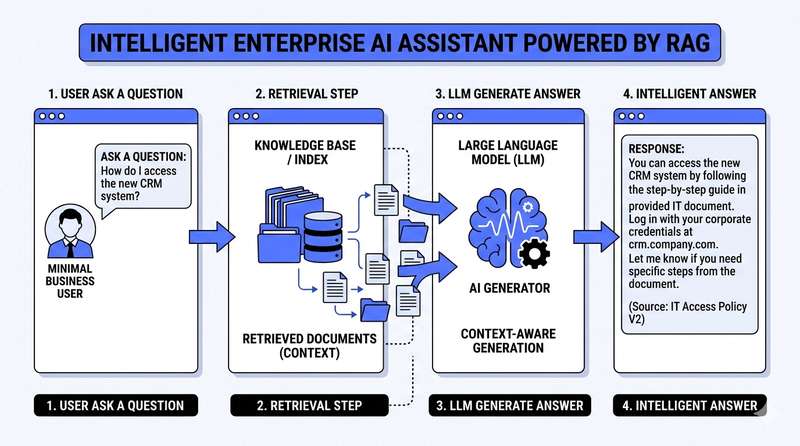
Large language models are remarkable at generating fluent, contextually aware text. They are also, by default, completely disconnected from your business. They do not know your products, your policies, or anything that happened after their training data was collected. Retrieval-Augmented Generation – RAG – is the technique that solves this problem for US enterprises. What RAG Actually Does Instead of asking an LLM to answer purely from internal training data, RAG adds a retrieval step. Before generating a response, the system searches your knowledge base – documents, databases, any structured or unstructured data – for relevant information, then passes it to the LLM as context. A standard LLM is like a brilliant consultant who has read everything ever published but knows nothing about your company. A RAG system gives that consultant instant access to your entire internal knowledge base before they answer. Why RAG Beats Fine-Tuning for Many Enterprise Use Cases Fine-tuning involves retraining the model on proprietary data – powerful but expensive and requiring retraining every time your data changes significantly. RAG does not change the model at all – it changes what information the model accesses at query time. Your knowledge base can be updated in real time without touching the model. It reduces hallucination because the model is anchored to retrieved facts, provides transparency since you can see exactly what documents were retrieved, and works with any LLM. RAG powering real enterprise use cases across industries in the US Real Enterprise Applications of RAG Internal knowledge management allows employees to query policy documents, HR handbooks, and technical documentation using natural language rather than keyword search. Customer support automation grounds the LLM in your actual product documentation so it answers questions accurately without hallucinating features that do not exist. Legal and compliance research retrieves relevant regulations and case law before generating analysis. Sales enablement gives sales teams instant access to relevant case studies and competitive intelligence. The Technical Architecture in Plain Terms A RAG system has three core components: the knowledge base and indexing layer where your documents are converted into a searchable format using embeddings; the retrieval mechanism where the system searches for semantically similar content when a query is submitted; and the generation layer where the LLM receives the query plus retrieved context and generates a response. The three-layer architecture that makes RAG systems work reliably in production What Determines RAG Quality Not all RAG systems perform equally. Quality depends on chunking strategy, embedding model quality, retrieval depth, context window management, and reranking. These details separate a RAG system that impresses in a demo from one that performs reliably across millions of real queries in production.