
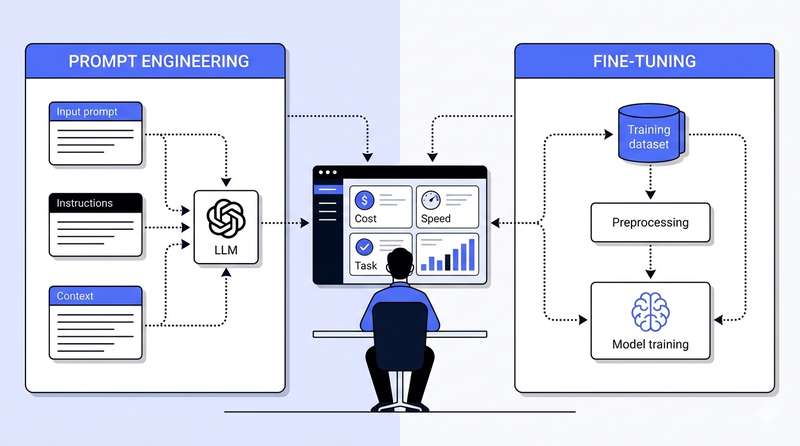
Every US enterprise exploring LLM deployment eventually faces this question. Do you customize the model itself through fine-tuning, or guide its behavior through carefully designed prompts? Both approaches work. Both have real limitations. Choosing the wrong one will cost you time, money, and internal credibility.
Modern foundation models have remarkable general capabilities. What they cannot do by default is know your business – your products, internal terminology, compliance requirements, or tone of voice. Closing that gap is exactly what prompt engineering and fine-tuning are designed to do, in very different ways.
Prompt engineering is the practice of designing the instructions, context, and examples you provide to a model at query time to shape its output. At its simplest it is writing better instructions. At its most sophisticated it involves chain-of-thought prompting, few-shot examples, system prompt design, and output format specification. Advantages: fast to implement and iterate, no training data required, works with any model, lower cost. Limitations: context window constraints, inconsistent results on tasks requiring deep domain adaptation.
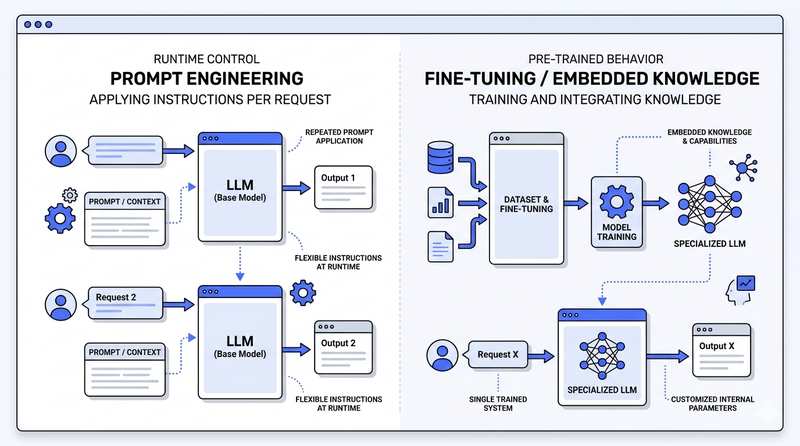
Advanced prompt engineering techniques that US enterprises are using to customize LLM behavior
Fine-tuning takes a pretrained foundation model and continues its training on a curated dataset specific to your use case. The model’s weights are updated to reflect the patterns and behavior in your training data – it genuinely internalizes your domain knowledge rather than receiving it through a prompt each time. Advantages: consistent behavior baked into the model, significantly better performance on specialized tasks, lower per-request token costs, better maintenance of consistent tone and style across responses.
One of the most effective strategies is using both together: fine-tune the model on your domain data to establish a strong baseline of specialized knowledge, then use prompt engineering at runtime to handle task-specific instructions, formatting requirements, and dynamic context. This combination is particularly powerful for customer-facing applications where consistency and accuracy both matter enormously.
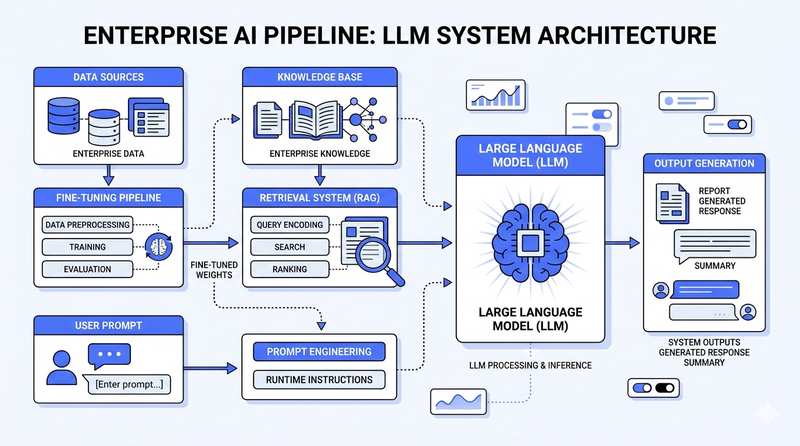
The combined approach: fine-tuning for domain expertise, prompt engineering for task-specific guidance
For most US enterprises early in their LLM journey, prompt engineering is the right starting point – faster, cheaper, and reversible. Fine-tuning becomes the right answer when you have validated the use case, have the training data to do it properly, and need performance or consistency levels that prompt engineering cannot reliably achieve.
We help US enterprises make this decision based on their specific workload requirements, existing infrastructure, and long-term AI roadmap - not platform preference.
Get expert insights on your use case and identify the most effective path forward.