
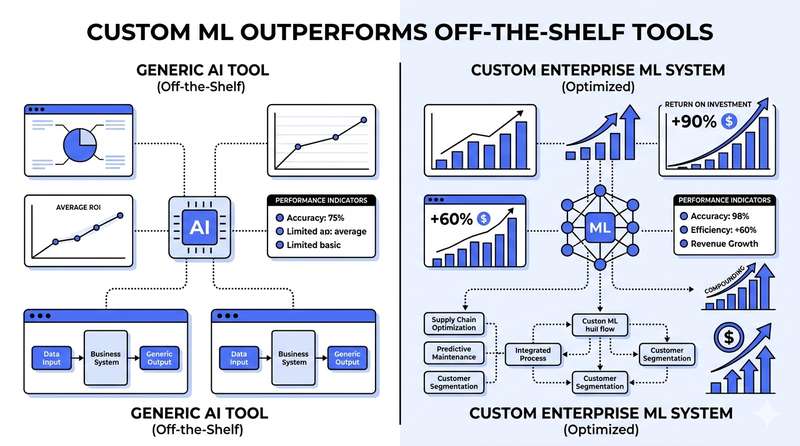
Return on investment is the question every US business leader asks before committing to a machine learning project. It also gets answered most vaguely by vendors who are more interested in closing a deal than setting accurate expectations. Custom machine learning delivers strong ROI for the right problems in the right organizations – the difference between those two outcomes is almost entirely about execution, not technology.
Pre-packaged AI tools are trained on generic data and optimized for the average use case. A model trained on your proprietary historical data, engineered specifically for your operational environment, will outperform a generic tool on your specific problem almost every time. The cost of that customization is offset by the performance gap – and for enterprise-scale operations, even a 10 percent improvement in a key metric can represent millions of dollars in annual value.
The highest ROI applications cluster consistently around demand forecasting and inventory optimization (15–30% reduction in carrying costs), predictive maintenance in manufacturing (30–50% reduction in unplanned downtime), customer churn prediction and intervention (10–25% churn rate reduction when model predictions are connected to actual retention workflows), and fraud detection and risk scoring in financial services.
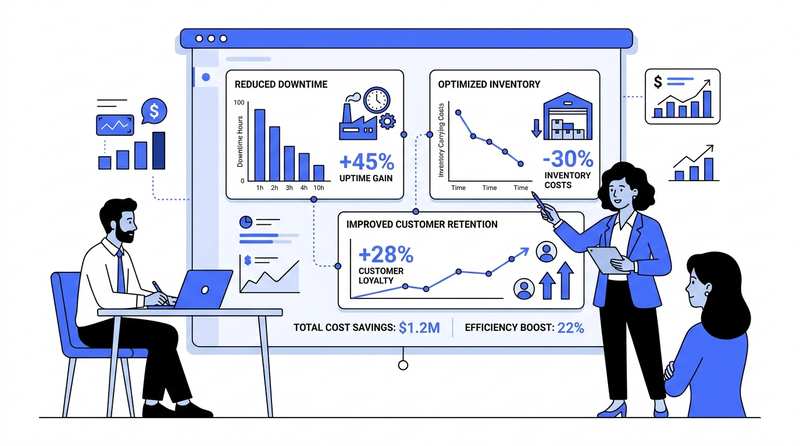
The highest-ROI ML applications for US enterprises in 2026
Machine learning systems improve over time as they accumulate more data and go through retraining cycles. The first version of a model is rarely the best version. US enterprises that evaluate ROI only at the six-month mark often conclude a project underperformed, when in reality the system was still in its highest-value growth phase. Setting the right expectation – that ROI compounds over 18 to 36 months rather than delivering immediately – is essential for accurate project evaluation.
Several factors consistently erode ML ROI: poor data quality requiring expensive remediation mid-project, scope creep adding complexity without proportional value, lack of end-user adoption because model output was never integrated into actual workflows, no monitoring infrastructure leading to undetected model decay, and rebuilding from scratch every time conditions change instead of maintaining and retraining.
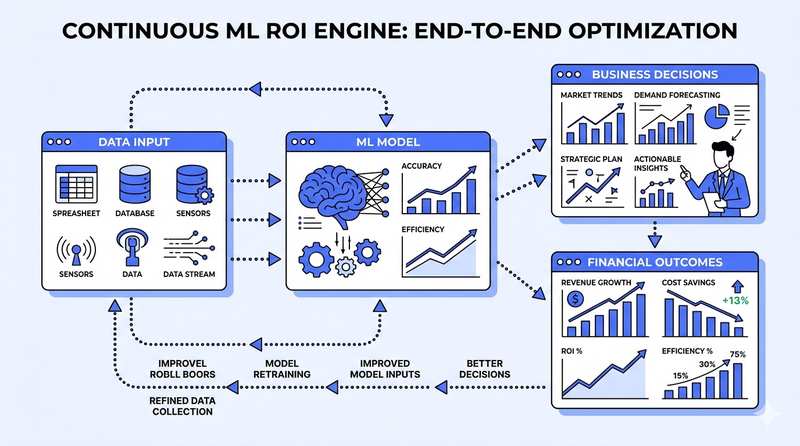
Key factors that reduce ML ROI and how to avoid them
Custom machine learning is a capital investment with a risk-adjusted return that depends heavily on how the project is structured and executed. The businesses getting the best returns identified the right problem, built on clean data, integrated output into real decision-making processes, and committed to maintaining the system over time.
We help US enterprises make this decision based on their specific workload requirements, existing infrastructure, and long-term AI roadmap - not platform preference.
Get expert insights on your use case and identify the most effective path forward.