
Custom Machine Learning ROI: What US Enterprises Are Actually Getting Back
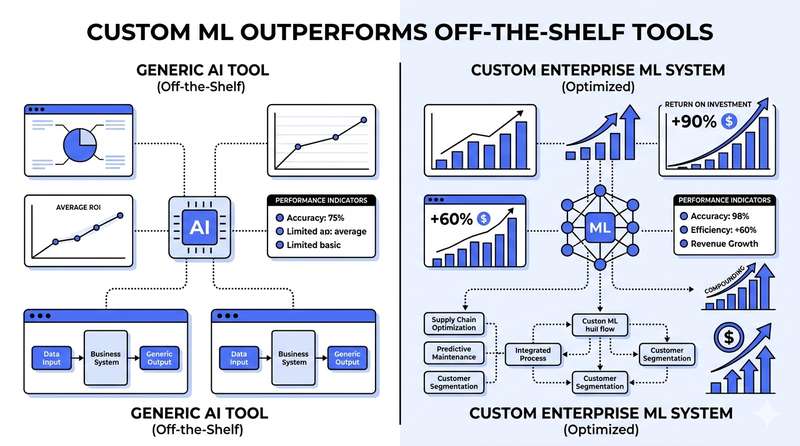
Return on investment is the question every US business leader asks before committing to a machine learning project. It also gets answered most vaguely by vendors who are more interested in closing a deal than setting accurate expectations. Custom machine learning delivers strong ROI for the right problems in the right organizations – the difference between those two outcomes is almost entirely about execution, not technology. Why Custom Beats Off-the-Shelf for Serious ROI Pre-packaged AI tools are trained on generic data and optimized for the average use case. A model trained on your proprietary historical data, engineered specifically for your operational environment, will outperform a generic tool on your specific problem almost every time. The cost of that customization is offset by the performance gap – and for enterprise-scale operations, even a 10 percent improvement in a key metric can represent millions of dollars in annual value. Where US Enterprises Are Seeing the Strongest Returns The highest ROI applications cluster consistently around demand forecasting and inventory optimization (15–30% reduction in carrying costs), predictive maintenance in manufacturing (30–50% reduction in unplanned downtime), customer churn prediction and intervention (10–25% churn rate reduction when model predictions are connected to actual retention workflows), and fraud detection and risk scoring in financial services. The highest-ROI ML applications for US enterprises in 2026 The Timeline Reality Machine learning systems improve over time as they accumulate more data and go through retraining cycles. The first version of a model is rarely the best version. US enterprises that evaluate ROI only at the six-month mark often conclude a project underperformed, when in reality the system was still in its highest-value growth phase. Setting the right expectation – that ROI compounds over 18 to 36 months rather than delivering immediately – is essential for accurate project evaluation. What Reduces ROI Dramatically Several factors consistently erode ML ROI: poor data quality requiring expensive remediation mid-project, scope creep adding complexity without proportional value, lack of end-user adoption because model output was never integrated into actual workflows, no monitoring infrastructure leading to undetected model decay, and rebuilding from scratch every time conditions change instead of maintaining and retraining. Key factors that reduce ML ROI and how to avoid them Setting the Right Expectations Custom machine learning is a capital investment with a risk-adjusted return that depends heavily on how the project is structured and executed. The businesses getting the best returns identified the right problem, built on clean data, integrated output into real decision-making processes, and committed to maintaining the system over time.
The Real Reason US Machine Learning Projects Fail and What to Do Instead
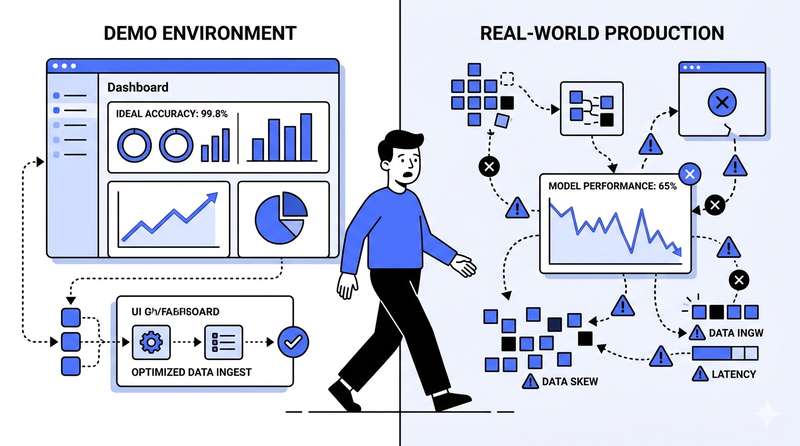
Somewhere between 80 and 90 percent of enterprise ML projects never make it to production. What is surprising is that most of these failures have nothing to do with the technology. The failure happens earlier, deeper, and in places much harder to debug than a line of code. Failure Point One: Starting With Technology Instead of the Problem This is the most common and most costly mistake. Leadership gets excited about AI, allocates budget, and the first question asked is “what should we build?” instead of “what problem are we solving and how will we know if we solved it?” Machine learning is a tool – its value is entirely dependent on whether it is applied to the right problem with a measurable definition of success. Failure Point Two: Underestimating the Data Problem Ask any experienced ML engineer what they spend most of their time on and the answer is almost always data. US enterprises consistently underestimate both the quality and volume of data required to build a functional model. Typical issues include data spread across multiple systems with no unified schema, missing values, inconsistent formatting, historical data that does not reflect current business conditions, and labels created inconsistently over time. Poor data quality is the leading cause of ML project failure in US enterprises Failure Point Three: Building for the Demo, Not Production A data science team builds a model that performs beautifully in a controlled environment. Leadership approves further investment. Then the wheels come off during deployment. Production environments are messy. Data pipelines break. Edge cases appear that never showed up in training data. The model that scored 94 percent accuracy in testing suddenly produces nonsense in the real world. Failure Point Four: No Clear Ownership After Deployment ML models require ongoing maintenance, monitoring, and periodic retraining as data distribution shifts over time – called model drift. US enterprises that treat ML deployment as the finish line rather than the starting line consistently see their models degrade quietly until someone notices the predictions no longer make sense. Failure Point Five: Misaligned Success Metrics A data science team optimizes for accuracy. The business needed to reduce churn. These are not the same objective. The right success metrics for an ML project are always defined in business terms first, then translated into technical objectives. Not the other way around. The characteristics shared by ML projects that successfully deliver business value What Successful ML Implementation Looks Like The enterprises that get this right start with a tightly scoped problem that has clear business value, invest seriously in data infrastructure before touching model development, involve end users in the design process, build monitoring and retraining into the project scope from day one, and measure success in business outcomes, not model metrics.
TensorFlow or PyTorch: A Straight Answer for US Business Decision-Makers in 2026
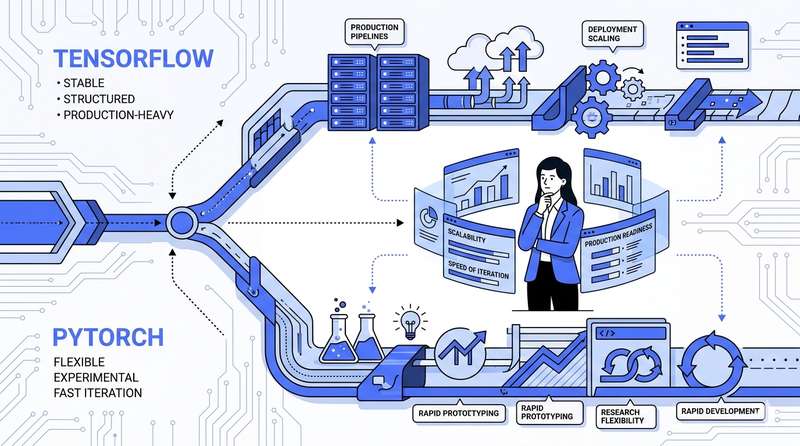
TensorFlow or PyTorch? Most content written about this debate is aimed at data scientists, not the business leaders who actually need to make a framework decision. This is a practical, honest breakdown from the perspective of what matters for a US enterprise building real AI systems in 2026. What These Frameworks Actually Are Both are open-source machine learning frameworks providing the building blocks for developing, training, and deploying AI models. TensorFlow was developed by Google and released in 2015. PyTorch was developed by Meta and released in 2016. Both are production-grade tools used by some of the largest organizations in the world. The choice affects how quickly your team can build and iterate, how easily you can deploy models at scale, and your long-term maintenance burden. Where TensorFlow Excels TensorFlow’s biggest strengths are in production deployment and scalability. Key advantages include TensorFlow Serving for high-availability model deployment, TensorFlow Lite for mobile and edge devices, native Google Cloud integration, mature tools for model monitoring and governance, and strong distributed training support across multiple machines and GPUs. TensorFlow’s production tooling makes it a strong choice for large-scale enterprise deployments Where PyTorch Excels PyTorch has become the dominant framework in research and is rapidly closing the gap in production. Its primary advantage is flexibility and development speed. A dynamic computation graph makes debugging and experimentation significantly faster. Dominance in academic research means the newest model architectures almost always appear in PyTorch first. Strong adoption in generative AI and LLM development makes it particularly well-suited for teams building on modern architectures. The current enterprise ML framework landscape in 2026 strongly favors PyTorch for new projects What the Current Landscape Looks Like Something important has happened in the past two years. PyTorch’s adoption in production has grown dramatically and is now the default choice for most new projects, including those at large US enterprises that previously standardized on TensorFlow. The shift is driven largely by the explosion of generative AI and LLM development where PyTorch’s ecosystem is simply stronger. TensorFlow remains the stronger choice for specific deployment scenarios – particularly mobile and edge – and for organizations deeply integrated with Google Cloud’s ML infrastructure. Our Recommendation For most US enterprises starting new AI development projects in 2026, we recommend PyTorch as the default starting point. The ecosystem momentum, the generative AI tooling, and the development experience advantages make it the more future-proof choice for the majority of use cases. TensorFlow remains the right answer for organizations with specific requirements around mobile deployment, existing Google Cloud MLOps infrastructure, or large legacy TensorFlow codebases that are expensive to migrate.
Predictive Analytics Is Quietly Saving US Enterprises Millions. Here Is How.
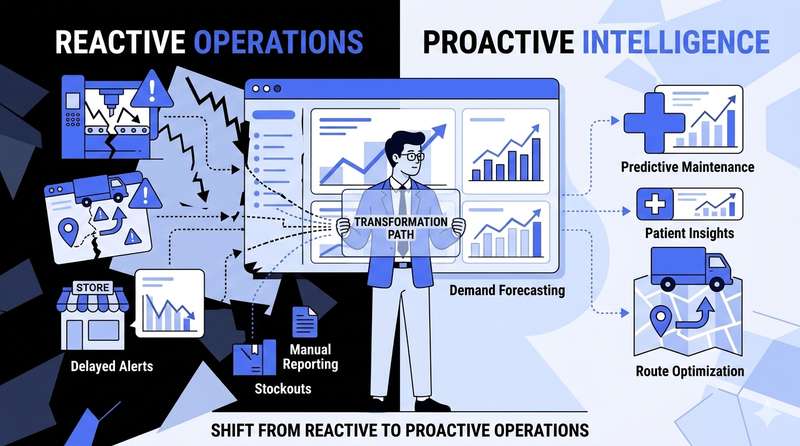
Most businesses are sitting on a goldmine they cannot see. Every transaction, every customer interaction, every equipment log generates data. For most US enterprises, that data sits in storage doing absolutely nothing. Predictive analytics changes that – turning historical patterns into forward-looking intelligence, and the companies that have embraced it are not just saving money. They are operating fundamentally differently from their competitors. What Predictive Analytics Actually Means in Practice Strip it down and predictive analytics is the use of historical data, statistical algorithms, and machine learning models to forecast future outcomes. In practical terms this might look like a manufacturing plant predicting equipment failure 72 hours before it happens, a retail chain forecasting demand spikes at individual store locations two weeks out, or a healthcare provider identifying patients most likely to be readmitted within 30 days. Predictive analytics in action across manufacturing, retail, healthcare, and logistics Where the Real Savings Come From Maintenance costs drop significantly when predictive models replace fixed maintenance schedules. US manufacturing firms report predictive maintenance alone reducing maintenance costs by 25 to 30 percent while extending equipment life. Inventory management is another major area – overstocking ties up capital while understocking leads to lost sales. Predictive models trained on sales history and seasonal patterns allow procurement teams to order with precision rather than intuition. Workforce planning is less talked about but equally impactful – predictive models can forecast staffing needs based on historical demand patterns, reducing overtime costs and improving service levels simultaneously. The Technology Stack Behind It Predictive analytics at enterprise scale is a combination of data infrastructure, machine learning models, and integration layers working together. We typically build on a foundation that includes data pipelines consolidating information from multiple sources, feature engineering processes identifying which variables drive outcomes, ensemble ML models trained on historical data, monitoring systems tracking model performance, and integration layers connecting predictions directly into the tools your teams already use. System architecture and workflow for enterprise predictive analytics implementation Why Most Implementations Fail Most predictive analytics projects fail not because of technology limitations but because of execution problems: starting with the technology instead of the business problem, using dirty or siloed data as the model foundation, building a model that is technically accurate but practically unusable, deploying once and never updating it, and measuring success by model accuracy metrics instead of actual business outcomes. We have seen enterprises spend six figures on predictive analytics platforms and walk away with nothing to show for it because these fundamentals were ignored. The Competitive Reality Your competitors are not waiting. Predictive analytics adoption among US enterprises has accelerated sharply over the past three years. The gap between companies that use predictive intelligence and those that do not is widening. The laggards are not just missing cost savings – they are making slower decisions with less confidence while competitors act faster with greater precision.