
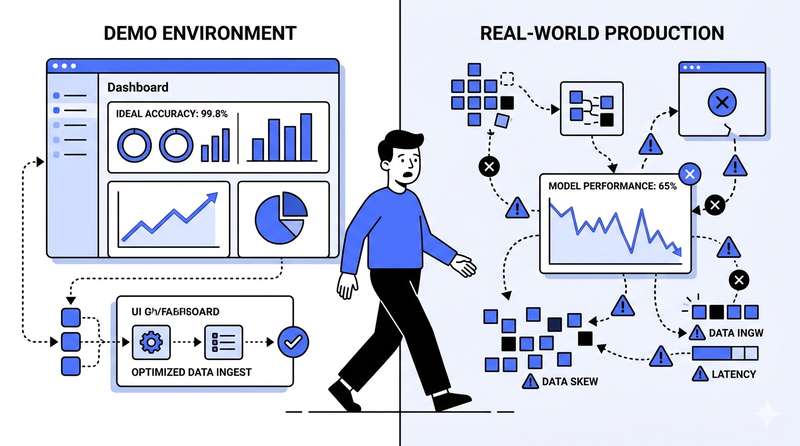
Somewhere between 80 and 90 percent of enterprise ML projects never make it to production. What is surprising is that most of these failures have nothing to do with the technology. The failure happens earlier, deeper, and in places much harder to debug than a line of code.
This is the most common and most costly mistake. Leadership gets excited about AI, allocates budget, and the first question asked is “what should we build?” instead of “what problem are we solving and how will we know if we solved it?” Machine learning is a tool – its value is entirely dependent on whether it is applied to the right problem with a measurable definition of success.
Ask any experienced ML engineer what they spend most of their time on and the answer is almost always data. US enterprises consistently underestimate both the quality and volume of data required to build a functional model. Typical issues include data spread across multiple systems with no unified schema, missing values, inconsistent formatting, historical data that does not reflect current business conditions, and labels created inconsistently over time.
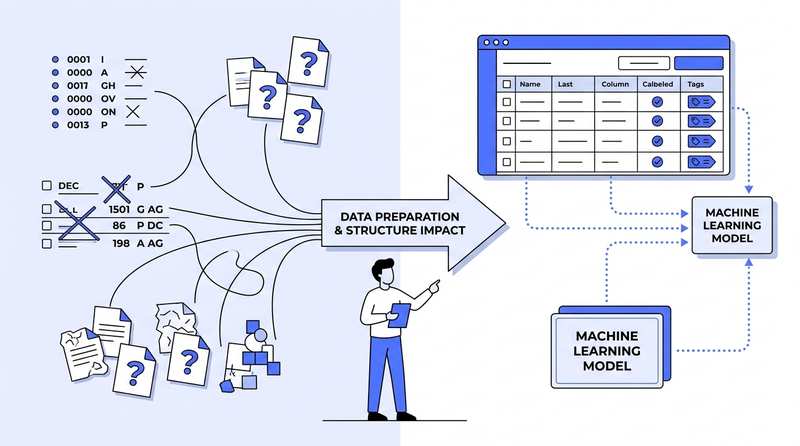
Poor data quality is the leading cause of ML project failure in US enterprises
A data science team builds a model that performs beautifully in a controlled environment. Leadership approves further investment. Then the wheels come off during deployment. Production environments are messy. Data pipelines break. Edge cases appear that never showed up in training data. The model that scored 94 percent accuracy in testing suddenly produces nonsense in the real world.
ML models require ongoing maintenance, monitoring, and periodic retraining as data distribution shifts over time – called model drift. US enterprises that treat ML deployment as the finish line rather than the starting line consistently see their models degrade quietly until someone notices the predictions no longer make sense.
A data science team optimizes for accuracy. The business needed to reduce churn. These are not the same objective. The right success metrics for an ML project are always defined in business terms first, then translated into technical objectives. Not the other way around.
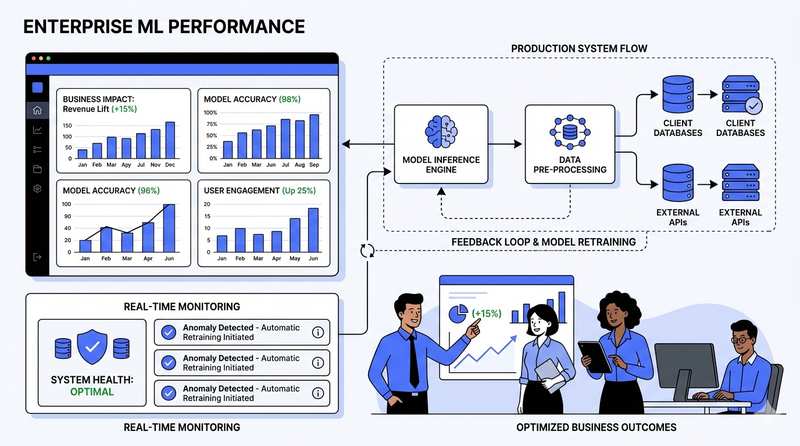
The characteristics shared by ML projects that successfully deliver business value
The enterprises that get this right start with a tightly scoped problem that has clear business value, invest seriously in data infrastructure before touching model development, involve end users in the design process, build monitoring and retraining into the project scope from day one, and measure success in business outcomes, not model metrics.
We help US enterprises make this decision based on their specific workload requirements, existing infrastructure, and long-term AI roadmap - not platform preference.
Get expert insights on your use case and identify the most effective path forward.