
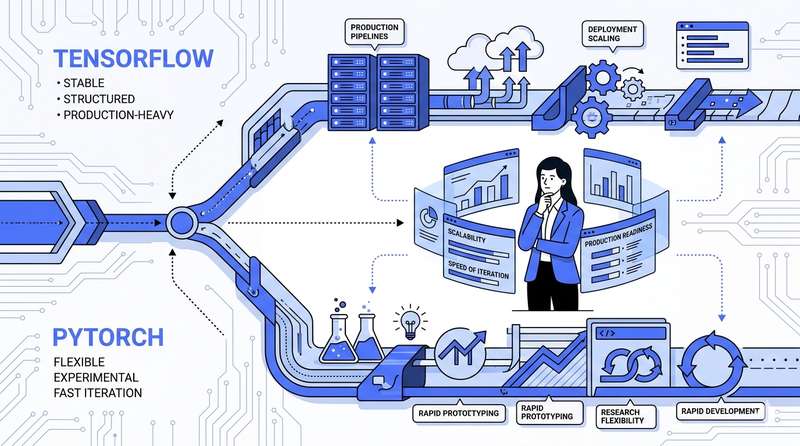
TensorFlow or PyTorch? Most content written about this debate is aimed at data scientists, not the business leaders who actually need to make a framework decision. This is a practical, honest breakdown from the perspective of what matters for a US enterprise building real AI systems in 2026.
Both are open-source machine learning frameworks providing the building blocks for developing, training, and deploying AI models. TensorFlow was developed by Google and released in 2015. PyTorch was developed by Meta and released in 2016. Both are production-grade tools used by some of the largest organizations in the world. The choice affects how quickly your team can build and iterate, how easily you can deploy models at scale, and your long-term maintenance burden.
TensorFlow’s biggest strengths are in production deployment and scalability. Key advantages include TensorFlow Serving for high-availability model deployment, TensorFlow Lite for mobile and edge devices, native Google Cloud integration, mature tools for model monitoring and governance, and strong distributed training support across multiple machines and GPUs.
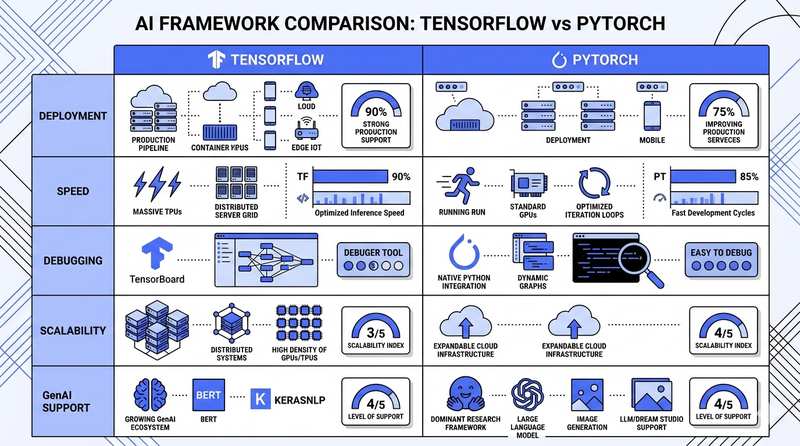
TensorFlow’s production tooling makes it a strong choice for large-scale enterprise deployments
PyTorch has become the dominant framework in research and is rapidly closing the gap in production. Its primary advantage is flexibility and development speed. A dynamic computation graph makes debugging and experimentation significantly faster. Dominance in academic research means the newest model architectures almost always appear in PyTorch first. Strong adoption in generative AI and LLM development makes it particularly well-suited for teams building on modern architectures.
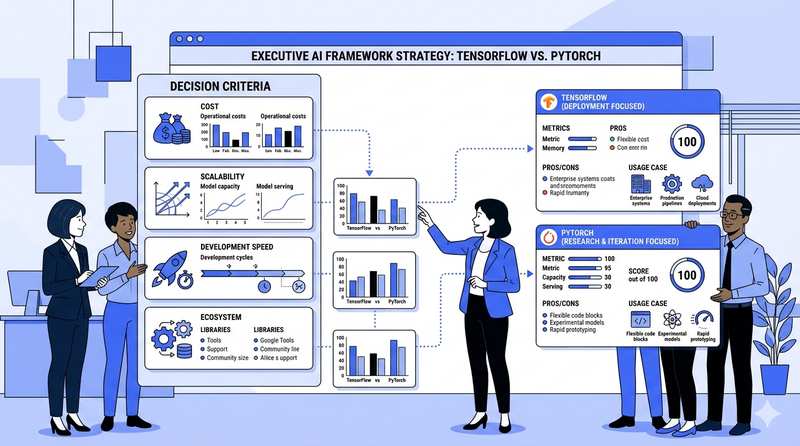
The current enterprise ML framework landscape in 2026 strongly favors PyTorch for new projects
Something important has happened in the past two years. PyTorch’s adoption in production has grown dramatically and is now the default choice for most new projects, including those at large US enterprises that previously standardized on TensorFlow. The shift is driven largely by the explosion of generative AI and LLM development where PyTorch’s ecosystem is simply stronger. TensorFlow remains the stronger choice for specific deployment scenarios – particularly mobile and edge – and for organizations deeply integrated with Google Cloud’s ML infrastructure.
For most US enterprises starting new AI development projects in 2026, we recommend PyTorch as the default starting point. The ecosystem momentum, the generative AI tooling, and the development experience advantages make it the more future-proof choice for the majority of use cases. TensorFlow remains the right answer for organizations with specific requirements around mobile deployment, existing Google Cloud MLOps infrastructure, or large legacy TensorFlow codebases that are expensive to migrate.
We help US enterprises make this decision based on their specific workload requirements, existing infrastructure, and long-term AI roadmap - not platform preference.
Get expert insights on your use case and identify the most effective path forward.