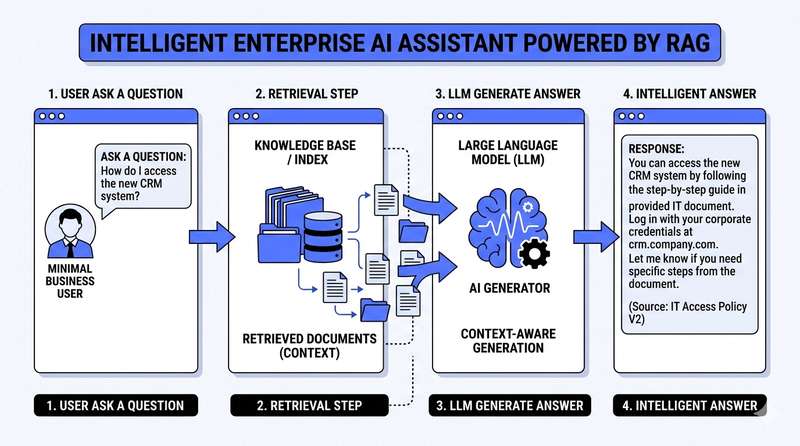
Large language models are remarkable at generating fluent, contextually aware text. They are also, by default, completely disconnected from your business. They do not know your products, your policies, or anything that happened after their training data was collected. Retrieval-Augmented Generation – RAG – is the technique that solves this problem for US enterprises.
Instead of asking an LLM to answer purely from internal training data, RAG adds a retrieval step. Before generating a response, the system searches your knowledge base – documents, databases, any structured or unstructured data – for relevant information, then passes it to the LLM as context. A standard LLM is like a brilliant consultant who has read everything ever published but knows nothing about your company. A RAG system gives that consultant instant access to your entire internal knowledge base before they answer.
Fine-tuning involves retraining the model on proprietary data – powerful but expensive and requiring retraining every time your data changes significantly. RAG does not change the model at all – it changes what information the model accesses at query time. Your knowledge base can be updated in real time without touching the model. It reduces hallucination because the model is anchored to retrieved facts, provides transparency since you can see exactly what documents were retrieved, and works with any LLM.
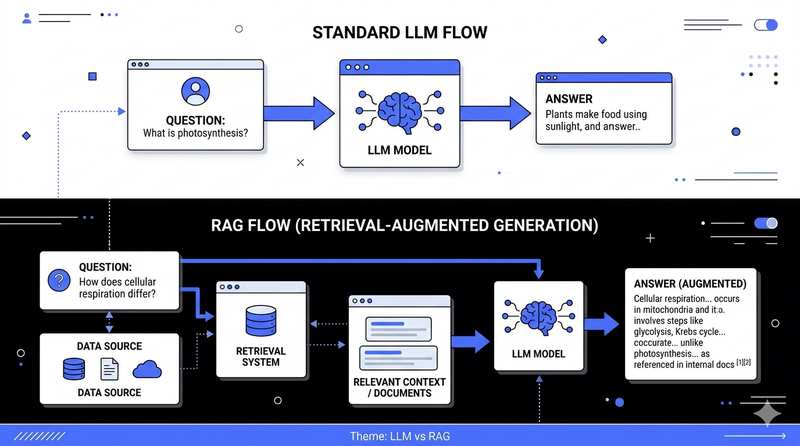
RAG powering real enterprise use cases across industries in the US
Internal knowledge management allows employees to query policy documents, HR handbooks, and technical documentation using natural language rather than keyword search. Customer support automation grounds the LLM in your actual product documentation so it answers questions accurately without hallucinating features that do not exist. Legal and compliance research retrieves relevant regulations and case law before generating analysis. Sales enablement gives sales teams instant access to relevant case studies and competitive intelligence.
A RAG system has three core components: the knowledge base and indexing layer where your documents are converted into a searchable format using embeddings; the retrieval mechanism where the system searches for semantically similar content when a query is submitted; and the generation layer where the LLM receives the query plus retrieved context and generates a response.
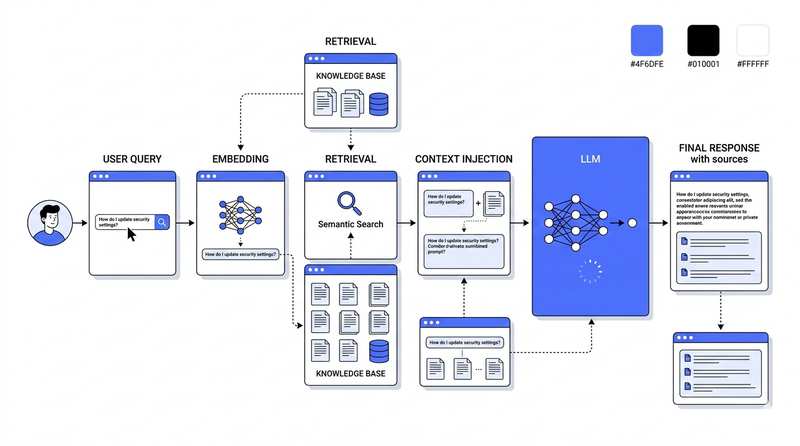
The three-layer architecture that makes RAG systems work reliably in production
Not all RAG systems perform equally. Quality depends on chunking strategy, embedding model quality, retrieval depth, context window management, and reranking. These details separate a RAG system that impresses in a demo from one that performs reliably across millions of real queries in production.
We help US enterprises make this decision based on their specific workload requirements, existing infrastructure, and long-term AI roadmap - not platform preference.
Get expert insights on your use case and identify the most effective path forward.