
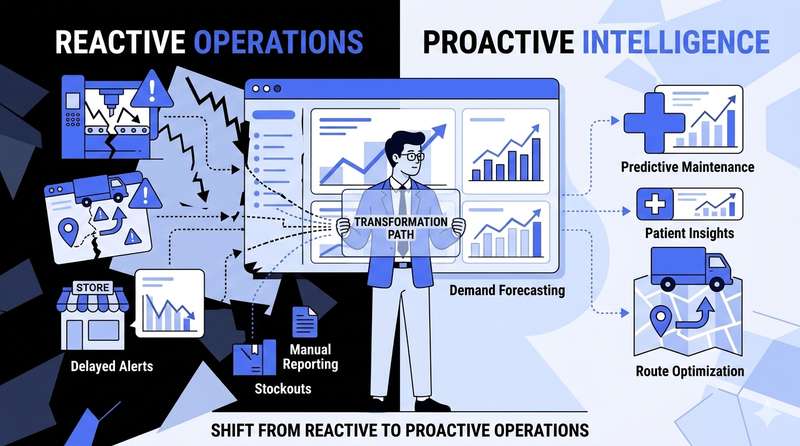
Most businesses are sitting on a goldmine they cannot see. Every transaction, every customer interaction, every equipment log generates data. For most US enterprises, that data sits in storage doing absolutely nothing. Predictive analytics changes that – turning historical patterns into forward-looking intelligence, and the companies that have embraced it are not just saving money. They are operating fundamentally differently from their competitors.
Strip it down and predictive analytics is the use of historical data, statistical algorithms, and machine learning models to forecast future outcomes. In practical terms this might look like a manufacturing plant predicting equipment failure 72 hours before it happens, a retail chain forecasting demand spikes at individual store locations two weeks out, or a healthcare provider identifying patients most likely to be readmitted within 30 days.
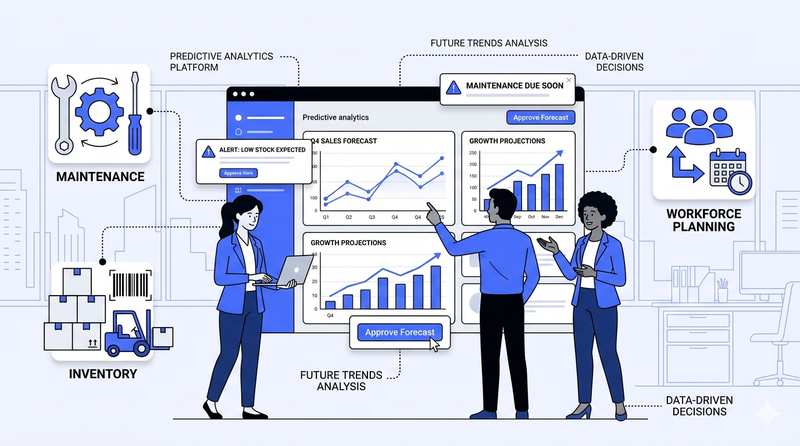
Predictive analytics in action across manufacturing, retail, healthcare, and logistics
Maintenance costs drop significantly when predictive models replace fixed maintenance schedules. US manufacturing firms report predictive maintenance alone reducing maintenance costs by 25 to 30 percent while extending equipment life. Inventory management is another major area – overstocking ties up capital while understocking leads to lost sales. Predictive models trained on sales history and seasonal patterns allow procurement teams to order with precision rather than intuition. Workforce planning is less talked about but equally impactful – predictive models can forecast staffing needs based on historical demand patterns, reducing overtime costs and improving service levels simultaneously.
Predictive analytics at enterprise scale is a combination of data infrastructure, machine learning models, and integration layers working together. We typically build on a foundation that includes data pipelines consolidating information from multiple sources, feature engineering processes identifying which variables drive outcomes, ensemble ML models trained on historical data, monitoring systems tracking model performance, and integration layers connecting predictions directly into the tools your teams already use.
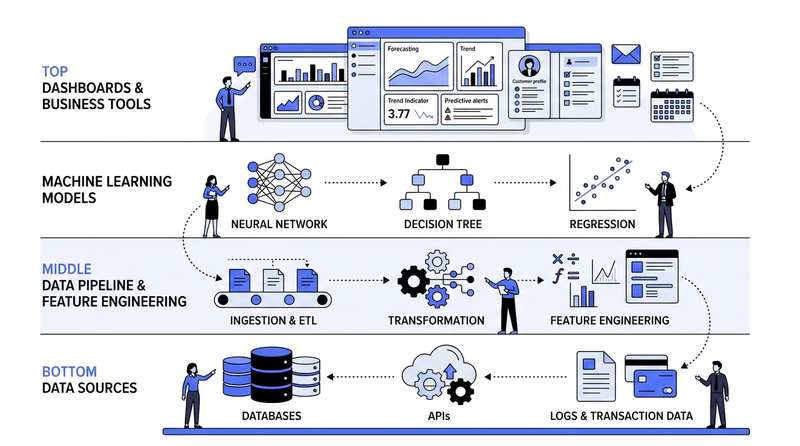
System architecture and workflow for enterprise predictive analytics implementation
Most predictive analytics projects fail not because of technology limitations but because of execution problems: starting with the technology instead of the business problem, using dirty or siloed data as the model foundation, building a model that is technically accurate but practically unusable, deploying once and never updating it, and measuring success by model accuracy metrics instead of actual business outcomes. We have seen enterprises spend six figures on predictive analytics platforms and walk away with nothing to show for it because these fundamentals were ignored.
Your competitors are not waiting. Predictive analytics adoption among US enterprises has accelerated sharply over the past three years. The gap between companies that use predictive intelligence and those that do not is widening. The laggards are not just missing cost savings – they are making slower decisions with less confidence while competitors act faster with greater precision.
We help US enterprises make this decision based on their specific workload requirements, existing infrastructure, and long-term AI roadmap - not platform preference.
Get expert insights on your use case and identify the most effective path forward.