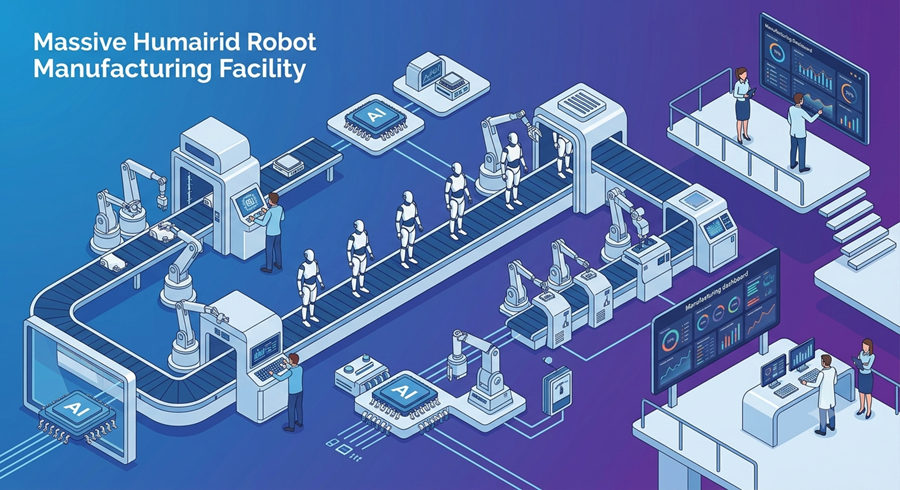
The robotics industry is undergoing a major transformation, and companies like Tesla and Figure AI are at the center of this shift. What once looked like experimental humanoid prototypes on stage is now evolving into full-scale industrial strategies involving AI chips, factories, training clusters, and real-world deployment plans. The focus has moved far beyond demonstration videos. Today, the real competition is about building complete ecosystems where hardware, software, and manufacturing all work together.
Tesla’s Optimus program and Figure AI’s advanced humanoid systems represent two different but equally important directions in this race. One is focused on mass production at an unprecedented scale, while the other is solving core reliability and autonomy challenges that have limited humanoid robots for years.
Tesla Optimus and the Scale of Ambition
Tesla’s Optimus project is no longer just a side experiment within the company. It is becoming a central pillar of Tesla’s long-term future. The company is restructuring factory space, reusing existing production lines, and preparing entirely new manufacturing systems dedicated to humanoid robots.
The planned production targets are extremely ambitious. Tesla is aiming for millions of units annually, with early production starting at Fremont and large-scale manufacturing expected at Gigafactories in Texas. If these targets are achieved, Optimus could become one of the most widely produced humanoid robots in history.
However, the real breakthrough is not just the physical robot. It is the integration of AI systems, chips, and manufacturing infrastructure into a single unified ecosystem. Tesla is no longer thinking in terms of separate technologies. Instead, it is building a vertically integrated system where every layer supports the others.
AI5 Chip: The Brain Behind Optimus Intelligence
At the center of Tesla’s robotics strategy is the AI5 chip. Originally designed for self-driving vehicles, this chip is now being adapted for humanoid robotics and large-scale AI infrastructure.
The AI5 chip represents a significant leap in computing power compared to previous generations. It is designed to handle complex real-time processing tasks such as vision recognition, motion control, and decision-making. For Optimus, this is critical because humanoid robots cannot rely on cloud computing for every action. Even a slight delay could lead to errors or physical damage in real-world environments.
By integrating AI5 into both vehicles and robots, Tesla is essentially creating a shared intelligence layer across its entire ecosystem. This allows knowledge and learning from one system to improve performance in another, especially between autonomous driving and humanoid robotics.
The Role of Full-Stack AI Integration
Optimus is not powered by a single technology but by a combination of three major systems. First is Tesla’s self-driving AI, which provides visual understanding and environmental awareness. Second is the Grok language model, which enables reasoning and natural communication. Third is the AI5 chip, which delivers the raw computing power needed for real-time decisions.
Together, these systems allow Optimus to understand its surroundings, interpret human instructions, and act quickly without external support. This layered intelligence model is what differentiates Tesla’s approach from traditional robotics companies.
Figure AI and the Reliability Revolution
While Tesla focuses on scale, Figure AI is addressing one of the most difficult problems in robotics: reliability. Most humanoid robots fail when even a single mechanical component stops working. In traditional systems, a broken joint often leads to a complete shutdown and manual repair.
Figure AI’s new Vulcan system changes this completely. With Vulcan, Figure 03 robots can continue operating even after multiple joint failures. Instead of collapsing, the robot adjusts its balance and continues performing tasks. This represents a major breakthrough in operational stability.
This advancement is especially important for industrial environments where downtime is costly. A robot that can keep working despite partial failure significantly increases efficiency and reduces maintenance requirements.
Helix 02: A Unified AI Control System
Another key innovation from Figure AI is the Helix 02 architecture. Unlike traditional robots that separate movement into different control systems, Helix 02 treats the entire body as a single coordinated model.
This means the robot does not separately control arms, legs, or torso. Instead, all movements are generated through one unified neural network that responds to visual and sensor input in real time. This design allows the robot to adapt more naturally to complex environments.
For example, when handling objects or navigating tight spaces, the robot can adjust its entire body dynamically, similar to how humans naturally coordinate movement without thinking about each limb individually.
Toward Fully Autonomous Robotic Systems
Both Tesla and Figure AI are moving toward a future where humanoid robots are not just tools but autonomous systems capable of independent operation. Tesla is building large-scale production and AI infrastructure, while Figure AI is focusing on intelligence, adaptability, and real-world reliability.
The combination of these approaches points toward a future where robots can operate in factories, homes, and public environments with minimal human intervention. However, challenges such as safety, cost, and long-term stability still remain.