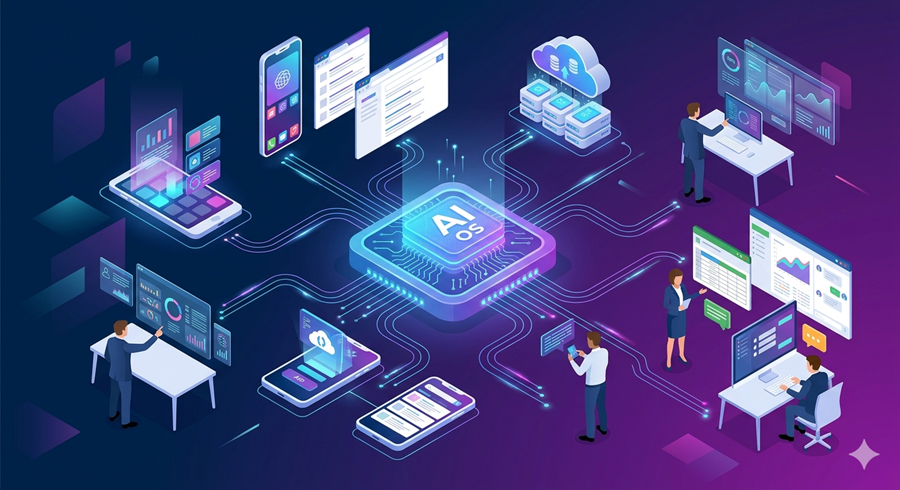
The AI industry in 2026 is no longer evolving in small steps it is undergoing a complete structural transformation. What was once a competition between smartphone features and assistant apps has now become a full-scale battle over who controls the “intelligence layer” of everyday life. Google’s introduction of Gemini Intelligence marks one of the biggest turning points in this shift. Instead of treating AI as an added feature, Google is rebuilding Android itself into an intelligence-driven ecosystem where the operating system actively completes tasks for users.
This change signals something much deeper than a product upgrade. It represents a future where devices no longer wait for commands but instead anticipate needs, execute actions, and manage workflows across apps and platforms automatically.
Gemini Intelligence: The Shift From Tools to Agents
At the core of Google’s strategy is Gemini Intelligence, a system designed to turn Android into an autonomous assistant. Instead of manually switching between apps, users can simply state a goal, and the system handles everything in the background. Whether it is creating shopping lists, booking appointments, or managing subscriptions, Gemini reduces multi-step tasks into single instructions.
Chrome is also evolving into an agentic browser capable of performing real actions like scrolling, clicking, and filling forms. This means browsing is no longer passive it becomes task execution. Features like Magic Q further extend this capability by proactively surfacing relevant information before users even ask.
This fundamentally changes the role of smartphones. They are no longer just tools for communication or entertainment; they are becoming proactive digital operators embedded in daily life.
Expansion Beyond Phones: A Multi-Device AI Ecosystem
Google’s vision does not stop at mobile devices. Gemini Intelligence is being integrated into cars, smartwatches, augmented reality glasses, and even a new laptop category known as Google Book. This creates a unified intelligence layer that follows users across all environments.
In cars, AI can handle navigation, messaging, and ordering food. On watches, it provides real-time assistance without requiring phone interaction. On laptops, Gemini becomes deeply embedded into productivity workflows through features like Magic Pointer and native Android app support.
The goal is clear: create a single AI system that understands context across every device and reduces friction between human intention and digital execution.
Industry-Wide Acceleration and Infrastructure Wars
While Google pushes toward consumer-facing intelligence systems, other companies are focusing on infrastructure dominance. Anthropic’s partnership with large-scale GPU clusters highlights how critical computing power has become. Modern AI performance is no longer limited by algorithms alone but by access to electricity, chips, and large-scale data centers.
These infrastructure demands are reshaping global competition. Companies are securing massive computing resources years in advance, signaling a future where AI capability is directly tied to hardware control. Even experimental ideas like orbital data centers reflect how far companies are willing to go to overcome physical limitations.
At the same time, governments are stepping in to evaluate AI systems before public release, introducing oversight into a space that was previously driven almost entirely by private innovation.
Open vs Closed Models: A Deepening Divide
One of the most important tensions in 2026 is the divide between closed proprietary AI systems and open-source models. Closed models like GPT-5.5 and Gemini prioritize performance, reliability, and integration within controlled ecosystems. They are powerful but expensive, both to run and to scale.
On the other side, open-source models such as DeepSeek V4 are redefining expectations by delivering comparable performance at dramatically lower costs. This shift introduces economic pressure that challenges the traditional pricing structures of AI companies.
If developers can access similar intelligence at a fraction of the cost, the entire business model of premium API access becomes harder to justify. This is not just a technical competition, it is an economic restructuring of the AI market.
The Future of AI: Intelligence as Infrastructure
As these systems evolve, AI is transitioning from a standalone product into foundational infrastructure. It is becoming embedded in operating systems, browsers, cloud platforms, and even physical devices. The distinction between software and intelligence is beginning to blur.
This shift raises important questions about control, safety, and dependency. As AI agents gain the ability to act on behalf of users, issues like permissions, trust, and oversight become critical. Governments and companies alike are now working on frameworks to ensure that these systems remain safe as they grow more autonomous.
Conclusion: A Turning Point in Technological History
The AI landscape of 2026 is defined by acceleration on every front capability, scale, integration, and accessibility. Google’s Gemini Intelligence represents the beginning of a world where devices actively work for users. At the same time, infrastructure battles and open-source disruption are reshaping the economics of the entire industry.
What emerges from this moment is not just a smarter phone or a better chatbot, but a completely new computing paradigm. Intelligence is becoming the interface of technology itself. And as this shift continues, the competition will no longer be about who builds the best app but who controls the intelligence layer that runs everything else.