


Introduction: A New Phase of AI Competition
The AI industry is no longer just about who builds the smartest model. It has entered a phase where cost, accessibility, hardware flexibility, and global strategy matter just as much as raw intelligence. With breakthroughs coming from OpenAI, Google, Anthropic, and unexpected challengers like DeepSeek, the entire ecosystem is shifting faster than most companies can adapt. What used to be a race for performance is now becoming a race for efficiency and distribution. Every new release is not just a product update; it is a strategic move that reshapes pricing, infrastructure, and global power dynamics.
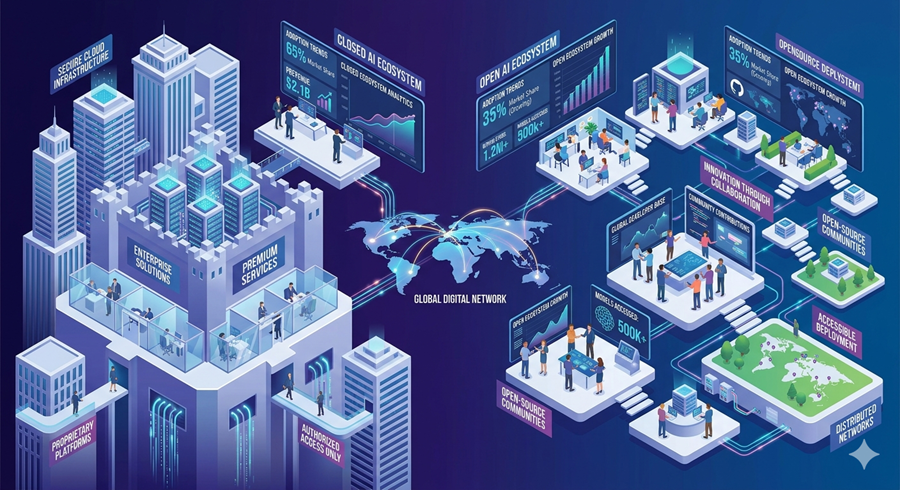
At the center of this transformation is a growing tension. On one side are closed systems that depend on massive funding, expensive GPUs, and tightly controlled APIs. On the other side are open models that prioritize accessibility, cost reduction, and widespread adoption. This divide is defining the next era of artificial intelligence.
DeepSeek and the Disruption of AI Economics
DeepSeek V4 has become a symbol of how quickly the balance of power is changing. By delivering performance comparable to leading models while drastically reducing cost, it challenges one of the core assumptions of the AI boom: that cutting-edge intelligence must always be expensive.
What makes this shift important is not just technical performance, but economic pressure. If a model can deliver similar results at a fraction of the cost, developers and companies naturally migrate toward it. This creates a ripple effect across the entire industry. Pricing models are forced to adjust, infrastructure investments come under scrutiny, and even the largest AI labs must rethink their long-term strategy.
The introduction of open-source availability adds another layer of disruption. Instead of locking innovation behind paywalls, models like this allow developers to experiment, customize, and deploy without dependency on centralized providers. This weakens the traditional moat that big AI companies rely on to maintain dominance.
Industry Response: Scaling, Safety, and Control
While open models push toward accessibility, major companies are doubling down on scale and safety. Firms like Google and Microsoft are integrating AI deeper into operating systems, browsers, and hardware ecosystems. The goal is no longer just to provide AI tools but to build entire environments where AI becomes the default interface between humans and technology.
At the same time, governments are stepping in with oversight frameworks. As models become more capable of handling sensitive tasks writing code, analyzing medical data, or generating financial strategies concerns about misuse are increasing. Regulatory bodies are beginning to evaluate these systems before release, marking a major shift from the previously unregulated pace of AI deployment.
This dual movement rapid expansion on one side and increasing oversight on the other creates a complex environment where innovation and regulation must evolve together.
What This Means for Developers and Businesses
For developers, the landscape has never been more competitive or more opportunistic. The availability of powerful open-source models reduces barriers to entry, allowing smaller teams to build products that previously required massive infrastructure budgets. At the same time, large companies still offer advantages in reliability, integration, and enterprise support.
Businesses now face a strategic choice. They can adopt closed ecosystems for stability or embrace open models for flexibility and cost efficiency. In many cases, hybrid systems are emerging, combining the strengths of both approaches.
The real shift, however, is psychological. AI is no longer seen as a rare, expensive capability. It is becoming a commodity layer something expected, integrated, and assumed in every digital product.
Conclusion: The Beginning of a Price-Driven AI Era
The AI industry is entering a new phase where intelligence alone is not enough to win. Efficiency, accessibility, and ecosystem strategy are becoming equally important. As models like DeepSeek V4 push prices downward and major tech giants push integration upward, the middle ground is being reshaped entirely.
What happens next will likely define the next decade of technology. If the trend continues, AI will become less of a premium service and more of a foundational utility embedded in every device, application, and workflow. And in that world, the winners will not just be those who build the smartest systems, but those who make them the most usable, affordable, and widespread.
