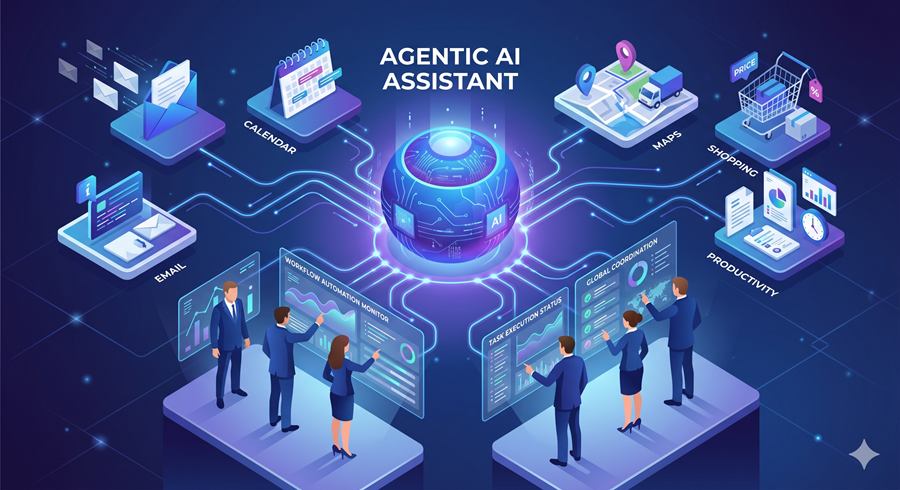
The artificial intelligence race has entered a completely new phase. What started as a competition between chatbots has now evolved into a battle for the future of digital assistants. Companies like Google, OpenAI, Amazon, Apple, and Nvidia are investing heavily in AI, but Google appears to be taking a bold step forward with its vision of Agentic AI.
Unlike traditional AI chatbots that simply answer questions, Agentic AI can plan, reason, and perform tasks on behalf of users. It acts more like a personal assistant that understands context, makes decisions, and completes actions across multiple applications. With Google introducing several new AI models and features, the way people search, shop, work, and consume content may change dramatically over the next few years.
What Is Agentic AI And Why Does It Matter?
Agentic AI refers to artificial intelligence systems that have the ability to take initiative and perform actions with minimal human involvement. Instead of waiting for instructions at every step, these systems can understand goals, create plans, and execute tasks independently.
Google’s vision is to integrate Agentic AI across its ecosystem, including Search, Maps, YouTube, Gmail, Android, and productivity tools. This creates an environment where AI becomes deeply embedded in everyday life. Rather than opening multiple apps and manually completing tasks, users can simply describe what they want, and AI handles the rest.
Google Maps Is Becoming Smarter Than Ever
One of the most significant updates is the evolution of Google Maps into a more intelligent assistant. Future versions of Maps may help users make decisions based on their preferences, budget, location history, and even traffic conditions.
For example, instead of manually searching for restaurants, comparing ratings, and checking travel times, users could simply ask Google to plan a dinner outing. The AI would recommend suitable restaurants, suggest the best departure time, and optimize the overall experience.
This could have a major impact on local businesses because visibility may increasingly depend on AI recommendations rather than traditional search rankings.
The Future Of Search And YouTube Discovery
Google is also transforming the way people search for information and consume video content. Traditional search engines provided thousands of links and allowed users to find answers themselves. Today, AI-generated summaries are increasingly replacing that process.
Similarly, YouTube is introducing more intelligent search experiences. Instead of watching an entire video, users may be directed directly to the specific section that answers their question. This could improve user convenience but may also create challenges for content creators who depend on watch time and audience retention.
The shift represents a move from information discovery toward direct answer delivery.
AI-Powered Shopping Is Changing E-Commerce
Shopping may be one of the industries most affected by Google’s AI strategy. Future shopping experiences could allow users to upload an image of a product and instantly compare prices across multiple stores.
Google’s AI could automatically identify the best deals, apply discounts, and recommend purchasing options without requiring users to visit multiple websites. Integration with YouTube could even allow viewers to purchase products directly while watching reviews.
This creates new opportunities for smaller retailers while simultaneously increasing competition for major e-commerce platforms.
Gemini And Personal Productivity Automation
Google’s AI assistant capabilities are expanding through Gemini and related technologies. By connecting with Gmail, Calendar, Drive, and other Google services, AI can automate complex workflows.
Imagine scheduling appointments, creating event invitations, sending reminders, and coordinating schedules with a single prompt. Tasks that previously required multiple tools and significant manual effort could be completed automatically in the background.
This level of automation has the potential to save time, but it also raises important questions about privacy and data access.
AI Video Generation And The Creator Economy
Google’s latest video generation technologies are becoming increasingly advanced. These systems can understand context, generate realistic animations, and even create new camera angles from existing footage.
For content creators, marketers, and businesses, this could significantly reduce production costs. However, it may also disrupt industries that rely on traditional video editing, animation, and visual effects work.
As AI-generated content becomes more realistic, distinguishing between real and synthetic media will become increasingly difficult.
Balancing Innovation With Privacy Concerns
While these innovations are exciting, they also introduce serious privacy considerations. Google services already store vast amounts of personal information, including emails, photos, schedules, financial records, and location history.
As AI becomes more deeply integrated into these systems, the amount of data used to personalize experiences will continue to grow. This has sparked discussions around data protection, transparency, and data localization policies, particularly in countries where privacy regulations are still evolving.
The challenge will be balancing convenience with user control.