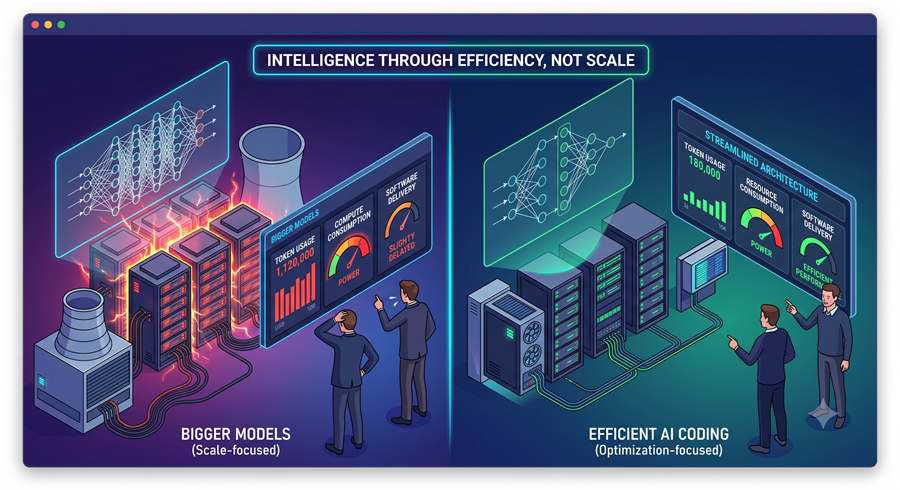
The artificial intelligence industry has spent the last few years competing to build larger and more powerful models. Bigger context windows, more reasoning capabilities, and higher token usage have often been presented as signs of progress. However, Google has recently highlighted an important reality that many AI coding companies prefer not to discuss. Bigger models are not always better, and more tokens do not automatically produce better results.
Google’s latest update introduces Gemini 3.5 Flash Low to its AI coding platform, and the company claims this model uses approximately 45% fewer tokens while still outperforming the previous Gemini Flash High model on software engineering benchmarks. This shift suggests that the future of AI coding may depend less on raw power and more on efficiency.
The Growing Cost Problem in AI Development
One of the biggest challenges facing developers today is cost. Every AI-generated code review, debugging session, automated workflow, or coding assistant interaction consumes tokens. As usage increases, so do expenses.
Reports have highlighted how expensive large-scale AI adoption can become. Some organizations are already feeling the pressure of rising AI costs. As businesses integrate AI into daily workflows, managing token consumption becomes just as important as model performance.
This is where Google’s strategy becomes interesting. Rather than focusing entirely on creating larger models, the company is working to reduce the resources required for common development tasks. Lower token usage can significantly reduce operating costs while maintaining strong performance.
Different Tasks Need Different Levels of Intelligence
Google’s new approach introduces multiple reasoning levels, including low, medium, and high. The idea is simple. Not every coding task requires the most advanced reasoning model available.
Many everyday development activities involve repetitive work, such as renaming variables, generating boilerplate code, fixing syntax errors, creating unit tests, or explaining simple functions. Using a highly advanced reasoning model for these tasks can be inefficient and unnecessarily expensive.
By offering a lightweight model option, Google allows developers to reserve more powerful models for complex engineering challenges while handling routine work with a cheaper alternative.
Why the 45% Reduction Is Important
The most significant figure in Google’s announcement is the claimed 45% reduction in token usage. This number represents more than just a technical improvement. It reflects a broader shift occurring across the AI industry.
For years, the assumption was that achieving better AI performance required more computing power, larger infrastructure investments, and greater token consumption. Now, newer, smaller models are beginning to outperform older, larger systems.
This trend suggests that intelligence is becoming more affordable over time. Just as cloud computing reduced infrastructure costs and open source software lowered development expenses, AI is now reducing the cost of accessing advanced intelligence.
A Strategic Move for Google’s Ecosystem
Google’s decision is not only about technology. It is also a business strategy. By making AI coding more affordable, the company encourages developers to build more applications, run more experiments, and deploy more products.
Lower operating costs remove barriers that often prevent developers from fully embracing AI-powered workflows. The more developers rely on Google’s tools, the more likely they are to remain within Google’s ecosystem of products and services.
This aligns with statements from Alphabet CEO Sundar Pichai, who recently revealed that approximately 75% of Google’s code is now generated with AI assistance. That figure demonstrates how deeply AI has become integrated into modern software development.
The Debate Over AI Coding’s Future
Not everyone agrees with Google’s approach. Some developers continue to demand larger context windows and more advanced capabilities. Requests for context lengths of 256,000 tokens or even one million tokens have become increasingly common.
As a result, two competing visions for AI coding are emerging. One group wants maximum intelligence and the largest possible context windows, regardless of cost. The other group prioritizes efficiency, affordability, and practical performance.
Google appears to be betting that most developers will ultimately prefer solutions that deliver strong results at a lower cost.
The Bigger Industry Shift
While Gemini 3.5 Flash Low may not generate the same excitement as major AI model releases, it could represent an important turning point. The AI industry is beginning to recognize that success is not only about creating smarter systems. It is also about making those systems affordable enough for widespread adoption.
Building intelligence remains difficult, but making intelligence cost-effective may be an even greater challenge. Google’s latest move suggests the company believes efficiency will be one of the defining factors in the next stage of AI development.