At the Google I/O 2026 conference, Google proved once again that it is fully committed to becoming an AI-first company. Over the last 10 years, the company has transformed almost every major product with artificial intelligence, and today, Google has more than 13 products with over one billion users each. During the event, Google introduced several groundbreaking AI tools and features that could completely change how people interact with technology. The company’s goal is no longer just to build AI chatbots, but to integrate AI into every app, device, and daily activity. From search engines and video creation to personal assistants and smart glasses, Google showed a future where AI becomes a constant companion in human life.
Gemini Omni: The Future of AI Video Creation
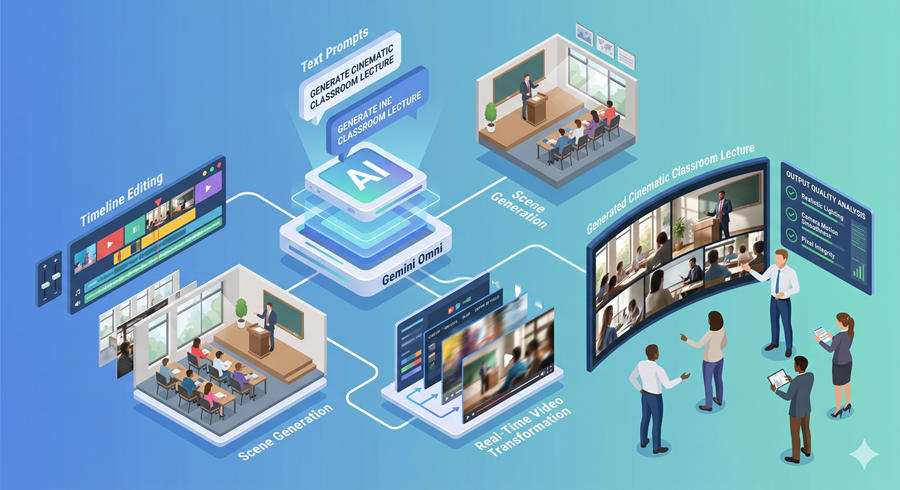
One of the most exciting announcements at the event was Gemini Omni, Google’s newest AI model capable of generating realistic videos from text, images, and existing videos. Users can simply provide a short prompt, and the AI creates cinematic-quality videos within seconds. During the demonstration, Google showed a professor explaining Einstein’s equation E = MC² on a chalkboard. The video looked incredibly realistic, with natural voice, camera angles, movements, and facial expressions.
What makes Gemini Omni even more impressive is its editing capability. Users can upload a video and instantly change elements within it. For example, if someone wants to change the clothing of a character or modify the environment, the AI can recreate the entire video while maintaining consistency. This technology could revolutionize content creation, filmmaking, marketing, and social media production by making professional-quality editing accessible to everyone.
Gemini Spark: A 24/7 AI Assistant
Another major highlight was Gemini Spark, a powerful AI agent designed to automate digital tasks continuously. Unlike traditional AI assistants that only answer questions, Spark can actively perform tasks on behalf of users. It works through dedicated virtual machines on Google Cloud and continues operating even when the user’s laptop or phone is turned off.
Gemini Spark can organize files, manage emails, schedule meetings, track shopping deals, compare products online, and even complete bookings or purchases automatically. Users can create custom workflows and automation systems without any coding knowledge. This technology represents a huge step toward fully autonomous AI systems that can save time and improve productivity for individuals and businesses alike.
AI-Powered Search and Maps
Google also announced the biggest upgrade to Search in over 25 years. Instead of simply displaying a list of links, the new AI-powered Search provides direct answers, summaries, images, videos, and interactive suggestions. Users can search using text, voice, images, or uploaded files, creating a much more intelligent and personalized experience.
One of the standout features introduced was Ask Maps. This feature allows Google Maps to understand real-world situations and provide practical solutions instantly. In one example, a parent whose child accidentally ruined a dress before a wedding could ask Maps where to quickly buy a replacement nearby. The AI understands the urgency and context behind the request, making navigation and search more human-like than ever before.
Google Flow and Creative AI Tools
For creators and designers, Google launched Google Flow, a new AI-powered creative platform. This tool combines video editing, image generation, animation, and AI-assisted design into one system. Users can create AI avatars, animated scenes, visual effects, and even music compositions using simple prompts.
Google also introduced Flow Music, which helps musicians and artists create original songs by turning melodies and ideas into fully developed musical tracks. These tools are designed to simplify the creative process and make professional-level content production available to everyone, regardless of technical skills.
AI in Everyday Life
Beyond software tools, Google showcased AI-powered smart glasses capable of providing real-time assistance through voice interactions. Users can navigate directions, order coffee, make calls, and interact with apps without touching their phones. Google also introduced features like Daily Brief, which creates personalized summaries from emails, calendars, and tasks to help users start their day efficiently.
Another important feature was Universal Cart, which allows users to add products to a shopping cart across multiple Google services, including Search, YouTube, and Gmail. These innovations demonstrate how Google aims to make AI deeply integrated into everyday life.
Conclusion
Google I/O 2026 highlighted a future where AI becomes more proactive, creative, and personal than ever before. With tools like Gemini Omni, Gemini Spark, AI Search, and Google Flow, Google is moving beyond simple AI assistants toward systems that can think, create, and act independently. These technologies could transform industries such as education, entertainment, business, healthcare, and communication. As AI continues to evolve, Google is positioning itself at the center of this technological revolution.