AI Was Everywhere, But in a Different Form
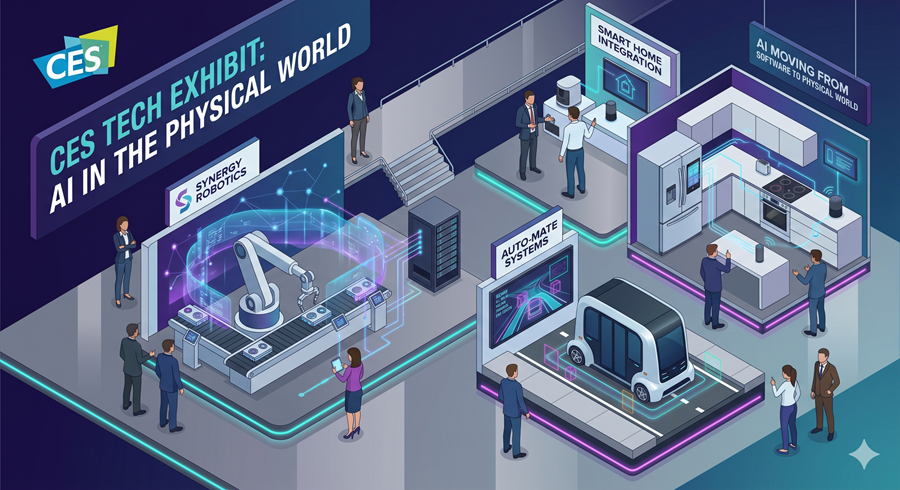
CES 2026 officially opened in Las Vegas with a major shift in focus across the technology industry. Artificial intelligence was still the center of attention, but this time AI was no longer presented as the final product. Instead, it became the invisible system powering robots, vehicles, household machines, wearables, and industrial devices. Companies were no longer talking only about chatbots or cloud services. They were demonstrating machines designed to function in the physical world using AI for perception, movement, and decision making.
The biggest sign of this transformation was the overwhelming presence of robotics on the showroom floor. Humanoid robots continuously walked, balanced, and interacted with visitors instead of performing short pre programmed routines. Companies focused on real time movement control and physical coordination rather than flashy presentations.
Robotics Took Over CES
One of the standout demonstrations came from Unitree, where robots performed complex full body movement sequences without pausing between actions. The robots adjusted posture while moving and recovered balance after physical disturbances, showing how far real time robotic control has advanced.
Sharpa presented a robotic hand capable of highly precise object manipulation. The hand adjusted grip strength and finger placement while handling small items. The company confirmed that universities are already purchasing the technology for research purposes, proving that advanced robotic manipulation is moving beyond laboratory testing into practical use.
LG introduced its autonomous home robot called Clody. The robot featured a wheeled base, two highly flexible robotic arms, and five fingered hands designed for delicate tasks. During the presentation, Clody slowly folded laundry and handled household objects with careful movements. The slow pace appeared intentional, emphasizing reliability and safety instead of speed. LG clearly positioned the robot as a long term household assistant rather than a temporary technology showcase.
AI Companions and Smart Devices Expand
Robot companions also became a major category at CES 2026. SwitchBot showcased small robotic pets capable of recognizing faces, understanding gestures, and reacting to emotional expressions. With pricing around $64 in Japan, these devices are being positioned for mainstream consumers rather than luxury buyers.
Gaming company Razer revealed a physical version of Project Ava, an AI gaming assistant displayed as a desktop companion device. The assistant reacts to gameplay in real time and offers strategic suggestions while users play. Another company, Lepro, introduced an AI companion device designed to simulate emotional interaction through voice and visual responses. These products showed that AI companionship is quickly becoming a serious commercial market.
AI Hardware Became the Main Attraction
Laptop and smartphone companies also pushed hardware innovation heavily connected to AI. Lenovo revealed rollable laptop concepts with expandable OLED displays, while Motorola introduced its new Razr Fold smartphone with a large foldable internal display and an advanced camera system.
AI has also entered sports technology. Lenovo partnered with FIFA to create AI-powered three-dimensional digital avatars for the 2026 FIFA World Cup. These avatars will assist with refereeing visuals and broadcast analysis, allowing fans to better understand player positioning and match events.
NVIDIA, AMD, and Intel Shift Toward Physical AI
The chip industry strongly reinforced the industry-wide move toward physical AI systems. Intel launched its new Panther Lake processors, promising extremely long battery life and improved graphics performance. AMD focused on AI infrastructure and server chips while predicting that AI adoption would grow dramatically over the next five years.
NVIDIA delivered perhaps the clearest message of the entire event. CEO Jensen Huang focused almost entirely on robotics, autonomous systems, and industrial AI infrastructure rather than gaming graphics cards. NVIDIA repeatedly used the term “physical AI,” signaling that the company sees its future in powering machines operating in the real world.
CES 2026 Showed a Fully Connected AI Future
By the end of the opening day, one trend became impossible to ignore. AI was no longer being treated as a standalone software feature. It had become the foundation connecting robotics, computing, entertainment, energy systems, transportation, and consumer devices together.
CES 2026 demonstrated that the next stage of artificial intelligence is not happening inside screens alone. It is moving directly into homes, workplaces, vehicles, and public infrastructure, creating a future where AI quietly controls much of the technology people interact with every day.