


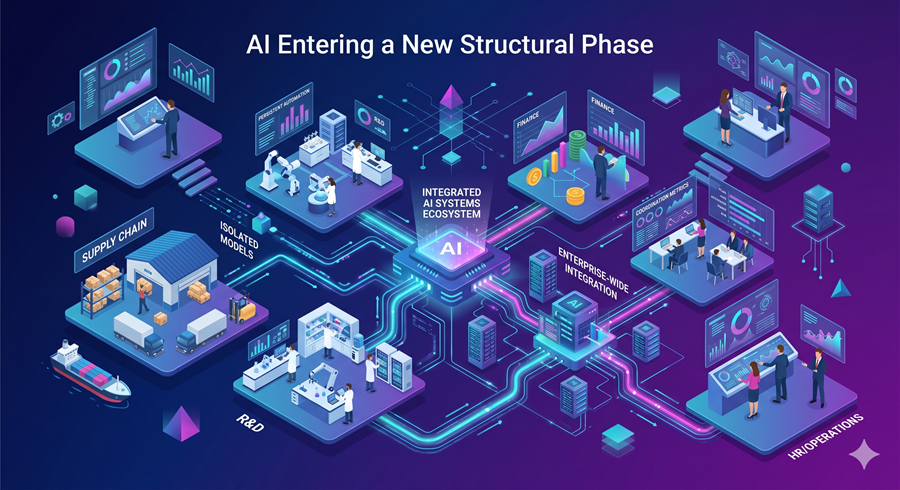
The pace of AI development no longer feels incremental. It feels structural. Every week now brings signs that the industry is shifting from isolated model improvements into something much larger: AI systems that are faster, more persistent, more autonomous, and deeply integrated into real workflows.
What stands out most is how the competition is changing shape. It is no longer just about who has the smartest model. The real battle is becoming about infrastructure, scale, and utility.
Speed Is Becoming a Competitive Advantage
One of the clearest shifts is the move toward models that balance intelligence with responsiveness. The newest generation of lightweight AI systems is no longer sacrificing quality for speed. That changes the economics of deployment entirely.
When high-level reasoning becomes available at near-instant latency, AI stops feeling like a separate tool and starts behaving like an operating layer. Faster inference means more continuous usage, more automation, and far lower friction in everyday workflows.
This is especially important for products that rely on constant interaction rather than occasional prompting.
Context Windows Are Quietly Redefining AI Capability
A major architectural breakthrough emerged this week with models capable of handling context windows at a scale that previously sounded unrealistic. A 12 million token memory fundamentally changes what an AI system can track, analyze, and reason through over time.
The significance is not just technical. It changes the type of problems AI can solve.
Instead of short interactions, models begin operating across entire knowledge systems, large research archives, financial histories, legal records, or persistent organizational memory. Sparse attention architectures are making this computationally possible while dramatically reducing cost.
That may end up being more important than raw benchmark performance.
AI Is Moving From Assistant to Workforce
Another pattern is becoming impossible to ignore: AI companies are aggressively targeting structured white-collar labor.
Finance is the clearest example. Analyst workflows that once required teams of junior employees are increasingly being packaged into repeatable AI agents capable of research, valuation review, reporting, and presentation generation.
This is not simply productivity software. It is operational replacement.
The shift matters because repetitive analytical work has historically been the training ground for entire industries. If AI absorbs those entry-level layers, organizations will need to rethink how expertise is developed in the first place.
The Real Story Is Ecosystems, Not Models
The most important developments are no longer standalone releases. They are ecosystems forming around multimodal generation, autonomous agents, visual development environments, and persistent AI infrastructure.
The companies moving fastest understand that the winning product may not be the most intelligent model. It may be the system that disappears most naturally into everyday work.
That is the phase AI appears to be entering now.
Follow Us on:
Clutch
Goodfirms
Linkedin
Instagram
Facebook
Youtube
