For years, the dominant assumption in AI was simple: better models come from more compute and more data.
That was true when the internet was still a usable training corpus. General-purpose systems improved by absorbing more text, more code, more images, and more public knowledge. But that strategy is reaching its limits. The next frontier is not broad intelligence. It is domain-specific competence, and that depends less on raw data volume than on data quality.
That is where the bottleneck shifts.
Why Synthetic Data Matters Now
The real problem is no longer whether enough data exists. It is whether the right data exists in usable form.
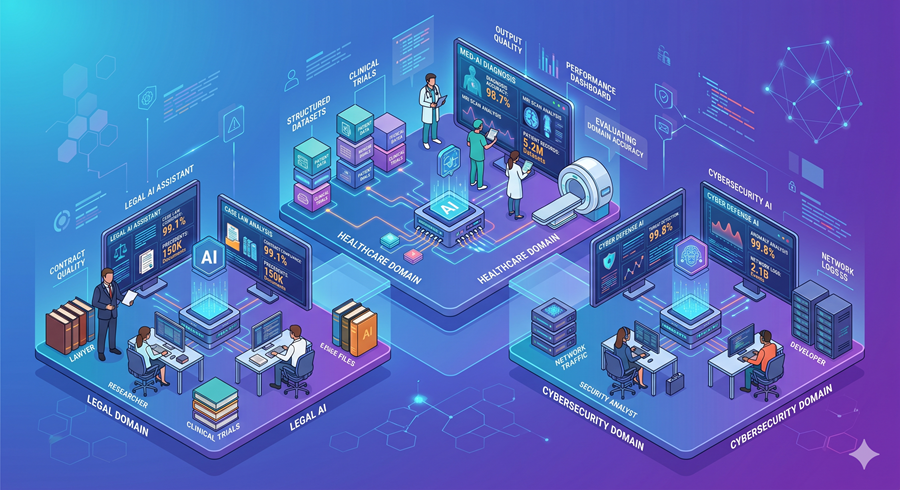
High-value domains like cybersecurity, law, medicine, and compliance do not produce clean, abundant, public training data at internet scale. What exists is often private, expensive, fragmented, or regulated. That makes brute-force data collection less viable.
The strategic response is synthetic data. Not synthetic in the shallow sense of mass-generated examples, but synthetic as engineered training infrastructure.
That distinction matters.
The Important Shift Is From Data Collection to Data Design
What makes systems like Simula important is not that they generate synthetic examples. It is that they treat dataset creation as a design problem.
Instead of prompting a model to generate arbitrary examples and filtering the output afterward, the system defines the structure of the domain first. It maps the space, samples deliberately across it, controls complexity independently, and evaluates outputs with explicit quality checks.
That turns dataset construction into something closer to systems engineering than content generation.
The advantage is not just better data. It is controllable data.
This Changes Where AI Advantage Comes From
That shift matters because it changes what competitive advantage in AI looks like.
The previous advantage was access: more scraped data, more proprietary corpora, more compute. The emerging advantage is design: who can generate the most useful training distributions, with the best coverage, the best difficulty calibration, and the least noise.
That is a different game entirely.
It favors labs that can engineer data pipelines, not just accumulate raw inputs.
Why This Matters Beyond Training
At the same time, another bottleneck is becoming obvious: understanding what AI systems are doing once deployed.
As AI moves from prompts into agents, workflows, and tool use, observability becomes as important as training. That is why infrastructure for inspecting agent behavior matters just as much as infrastructure for generating better data.
These two shifts are tightly linked. One improves what systems learn. The other improves how we control what they do.
That is the deeper pattern: AI is maturing from model building into systems engineering.