


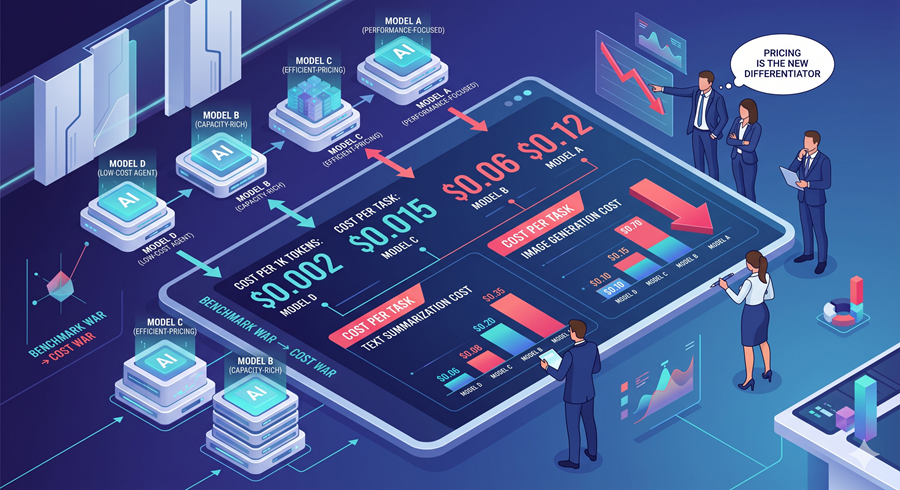
DeepSeek V4 matters for a simple reason: it changes the economics of AI faster than it changes the quality ceiling.
Most frontier model launches compete on capability. DeepSeek is competing on cost, openness, and deployment flexibility at the same time. That combination is more disruptive than another incremental benchmark win because it changes how companies make buying decisions.
The real threat is not that DeepSeek is better everywhere. It is that it may be good enough almost everywhere for much less.
This Is Bigger Than a Model Release
What makes V4 strategically important is that it is not just a model. It is part of a broader stack.
DeepSeek is not only shipping cheaper inference. It is aligning model performance with domestic chips, local cloud infrastructure, open deployment, and lower operational cost. That matters because it turns model competition into ecosystem competition.
This is no longer just OpenAI versus another lab. It is closed American AI platforms versus a cheaper, increasingly capable open alternative with national infrastructure behind it.
That is a different kind of competitive pressure.
Why Price Is Becoming the Real Battlefield
The most important number in AI is no longer the benchmark score. It is the cost per useful task.
As enterprise AI usage scales, price becomes behavior. When models get cheaper, teams automate more workflows, expand usage, and stop reserving AI for high-value edge cases. That changes adoption far faster than small gains in reasoning quality.
This is the real risk for premium labs. A model does not need to outperform the frontier to become dangerous. It only needs to be strong enough for most workflows and cheap enough to become the default.
That is how pricing turns into distribution.
The Vision Breakthrough May Matter Even More
DeepSeek’s multimodal work may be the more important signal.
The core insight is not simply better visual perception. It is a better visual reference. Instead of only seeing more detail, the model anchors its reasoning to specific coordinates while it thinks. That makes visual reasoning more stable, more efficient, and more usable in real-world systems where consistent object tracking matters more than raw image resolution.
This is the kind of architectural improvement that compounds quietly and matters later.
Why GPT 5.6 Showing Up Now Makes Sense
If GPT 5.6 is already surfacing in internal routing, the timing is not hard to explain.
DeepSeek does not need to surpass OpenAI at the top of the market to create pressure. It only needs to compress the middle: lower costs, acceptable quality, flexible deployment, and enough capability to force pricing and product responses from everyone above it.
That is how markets shift. Not when the incumbent is beaten outright, but when the floor rises fast enough to make the premium harder to justify.
