The most important shift in 3D AI right now is not another flashy model release. It is the quiet maturation of the tooling around it.
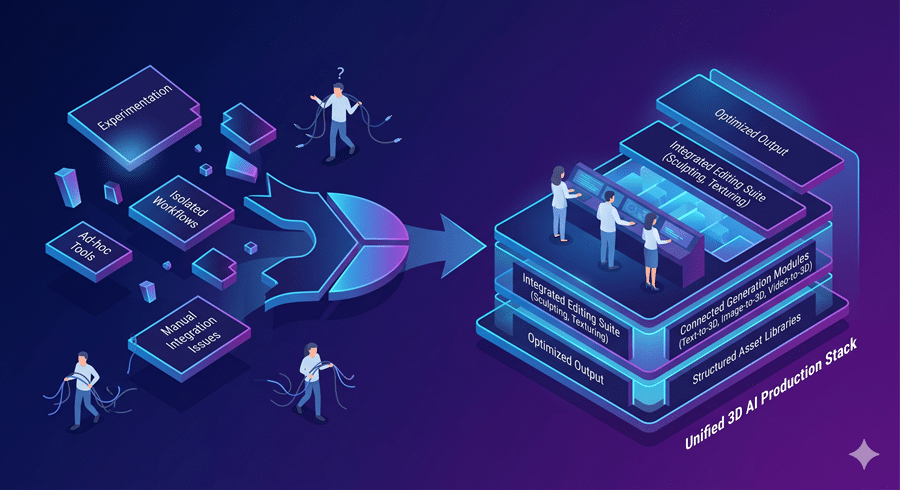
For the past year, the biggest limitation in AI-generated 3D was never just model quality. It was workflow friction. Too many disconnected tools, too much cleanup, and too little control once assets left the generation stage. That is finally starting to change.
3D AI Is Becoming a Real Production Stack
The release of 3DGen Studio is a strong signal that 3D AI is moving beyond experimentation and into usable infrastructure. What makes it notable is not just that it is open source or local-first. It is that it treats 3D generation as a full production workflow rather than a single prompt-to-mesh event.
That shift matters. Asset libraries, graph-based workflows, mesh editing, and local inpainting move AI 3D closer to an actual studio environment. The value is no longer just generating a model. It is being able to manage, refine, and iterate on one without leaving the pipeline.
This is the kind of tooling 3D AI has been missing.
Anthropic Is Making a Strategic Play for Creative Infrastructure
Anthropic joining the Blender Foundation matters for a reason that goes beyond sponsorship. It signals that frontier AI labs are starting to see creative software as infrastructure worth owning.
The deeper implication is not branding. It is control. Blender is one of the most important open creative tools in the world, and direct integration with Claude turns it into something more than a DCC tool. It becomes an AI-native production environment.
That changes the role of the assistant entirely. Instead of generating ideas outside the tool, the model begins operating inside the creative system itself.
Local AI Is Quietly Winning on Practicality
A clear pattern is emerging across this wave of releases: local AI is becoming more usable, lighter, and harder to ignore.
Tools like Skintoken running in modest VRAM, world generation models operating in 8GB, and mesh projection workflows landing near 6GB all point to the same trend. Capability is becoming more accessible without depending on expensive cloud infrastructure.
That matters because local AI is no longer just about privacy or cost. It is about creative control. Artists can iterate faster, own the full pipeline, and avoid the latency and limitations that come with remote systems.
The tools may still be rough, but the direction is unmistakable.
The Real Race Is Workflow Compression
The most useful releases are not necessarily the most dramatic. Image-to-material systems, auto-rigging, relighting tools, and character reconstruction pipelines all solve a less glamorous but more important problem: workflow compression.
That is where the next advantage in 3D AI will come from. Not from isolated model breakthroughs, but from removing the friction between steps.
The companies that matter most in this category will not just generate better assets. They will eliminate the tedious work between generation and production.
That is where 3D AI starts becoming less of a demo and more of a discipline.
Follow Us on:
Clutch
Goodfirms
Linkedin
Instagram
Facebook
Youtube