I used to think the idea of a “dead internet” meant something external. A flood of bots, foreign interference, or coordinated misinformation campaigns is slowly drowning out real voices. It sounded like something that would happen to the internet.
Now it feels like something is happening within it.
The Shift From Human Content to Machine Output
What’s unsettling is not just that AI-generated content is everywhere. It’s how quickly it has blended into platforms that once felt deeply human. Spaces that were built on creativity, discussion, and shared experiences are now saturated with content that feels hollow, repetitive, or synthetic.
I notice it most when scrolling. It takes longer to find something real. The signal-to-noise ratio has flipped. Instead of discovering meaningful content, I find myself filtering out waves of automated output just to get there.
The experience itself has changed. It feels less like exploration and more like extraction.
When Platforms Start Replacing Their Own Users
What makes this shift more complicated is that platforms are not just reacting to AI. They are actively integrating it.
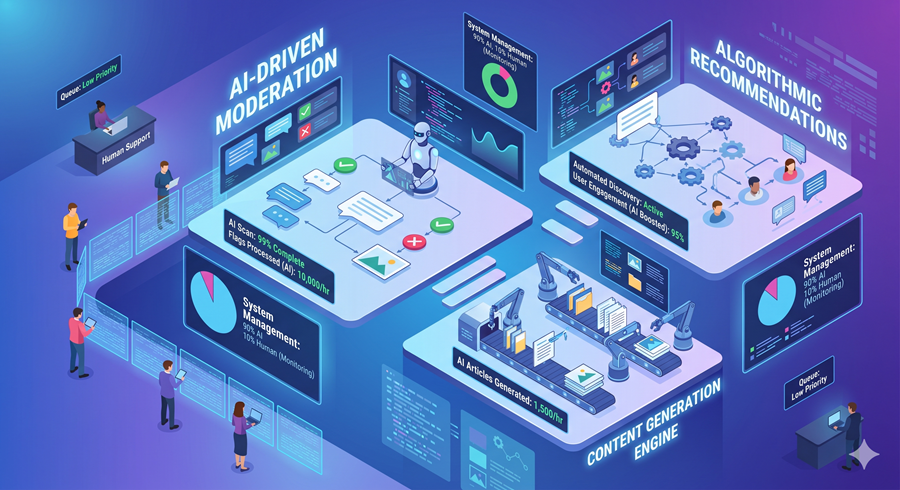
Instead of protecting the human layer that made them valuable, many are leaning further into automation. Moderation systems, recommendation engines, and content generation tools are increasingly powered by AI. In theory, this should improve efficiency. In practice, it often introduces new problems.
False flags, mislabeling, and inconsistent enforcement create friction for real users. People who create original work now have to defend it, prove it, and sometimes fight to keep it visible. That adds a layer of effort that did not exist before.
Over time, that friction pushes people away.
The Data Economy Behind the Transformation
There is also a deeper incentive driving this shift. Human-generated content is not just content. It is training data.
Platforms hold vast archives of conversations, ideas, and interactions. That data has become incredibly valuable in training AI systems. Once access to that data is monetized, the relationship between platform and user starts to change.
Users are no longer just participants. They become sources of raw material.
This creates a feedback loop. AI systems learn from human content, generate new content, and then feed on that output again. The result is a cycle that gradually drifts further from its human origin.
The Rise of Synthetic Communities
I also notice how communities themselves are changing. Discussions that once felt organic now sometimes feel staged or exaggerated. Emotional posts, debates, and opinions can be amplified or even manufactured.
It becomes harder to tell what is genuine and what is constructed. That uncertainty affects how people engage. If I cannot trust that the interaction is real, my incentive to participate drops.
And when enough people feel that way, the entire dynamic of a platform shifts.
Creative Spaces Under Pressure
Creative ecosystems are feeling this pressure as well. Whether it is visual art, writing, or game development, the volume of AI-generated output makes it harder for original work to stand out.
Discovery becomes more difficult. Quality becomes harder to signal. And creators face a new challenge that has nothing to do with skill, but everything to do with visibility.
The barrier is no longer just creating something good. It is making sure it is seen.
No Clear Escape From the System
What stands out most to me is how widespread this shift has become. It is not isolated to one platform or one type of content. It is happening across social spaces, creative tools, and communication channels.
Even private or smaller communities are beginning to integrate AI features, whether users want them or not. The idea of escaping to a purely human corner of the internet is becoming harder to sustain.
What This Means Going Forward
I do not think the internet is disappearing. It is evolving into something different.
The question is not whether AI will be part of it. That is already decided. The real question is how much of the human layer will remain visible, valued, and protected as this transformation continues.
Because once that layer fades too far into the background, the internet may still exist, but it will no longer feel like a place built by people.
Follow Us on:
Clutch
Goodfirms
Linkedin
Instagram
Facebook
Youtube