I have been watching AI evolve quickly, but this feels like a different phase entirely. It is no longer just about generating text or writing code. It is now stepping directly into fields where the stakes are much higher, and the consequences are far more real.
Why Biology Is the Next Frontier for AI
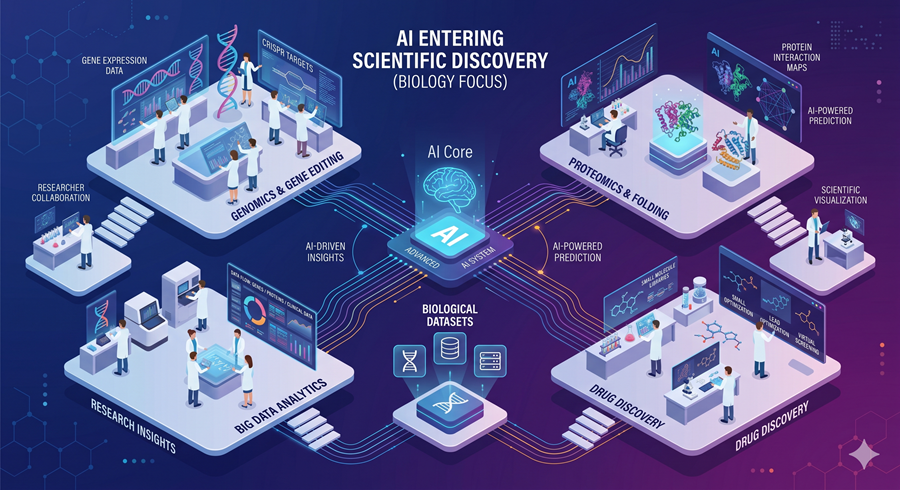
What stands out to me about this new model is its focus on life sciences. Biology, drug discovery, and genomics are not simple domains. They are complex, interconnected systems where progress is often slow because of how much information needs to be processed and validated.
Traditional drug development can take over a decade, with most of that time spent figuring out what is even worth testing. That early-stage uncertainty is where the biggest inefficiencies exist. If AI can reduce that uncertainty, the impact could ripple across the entire pipeline.
Instead of just answering questions, this system is designed to act more like a research assistant. It can analyze scientific literature, connect insights across datasets, and even suggest new experimental directions.
From Information Retrieval to Scientific Reasoning
What makes this shift more meaningful is the move from passive output to active reasoning. The model is not just summarizing papers. It is working across biological systems like proteins, genes, and disease pathways to generate hypotheses.
That changes how I think about AI in research. It is no longer a tool for convenience. It is becoming a collaborator that can contribute to decision-making processes.
The integration with scientific tools is also important. By connecting to databases, analysis systems, and specialized research platforms, the model becomes part of the workflow rather than sitting outside of it.
Early Signals That AI Is Becoming a Real Research Partner
The performance signals are hard to ignore. In certain evaluation settings, the model is approaching or even exceeding expert-level outputs in specific tasks like sequence prediction and experimental design.
That does not mean it replaces scientists. But it does suggest a shift where researchers can explore more possibilities faster, test ideas earlier, and potentially reduce the time spent on repetitive analysis.
The broader context matters too. Billions have already been invested in AI-driven drug discovery, yet results have been slow to materialize. This feels like an attempt to push the field past that early plateau.
Cybersecurity Is Moving in Parallel
At the same time, I notice a similar pattern emerging in cybersecurity. New AI systems are being designed specifically for defensive work, including analyzing compiled software and identifying vulnerabilities without needing source code.
This mirrors the biology push. In both cases, the focus is on complex, multi-step workflows rather than isolated tasks. The goal is to assist professionals in environments where precision and context matter more than speed alone.
Access to these systems is being carefully controlled, which reflects how sensitive these capabilities are. It is a reminder that more powerful tools also come with higher responsibility.
The Rise of AI Agents That Actually Do Work
Another piece that ties everything together is the push toward agents that can act, not just respond. These systems can interact with files, run tasks, and operate within controlled environments.
This is a big shift. Instead of asking for outputs, I can assign objectives. The system then figures out how to execute them across multiple steps and tools.
It feels like the beginning of AI systems that function more like operators than assistants.
When Technology Starts Affecting the Real World
What makes all of this more intense is how it is starting to spill beyond technology itself. As AI becomes more powerful and influential, reactions to it are becoming stronger and, in some cases, more extreme.
This is no longer just a technical conversation. It is shaping public perception, policy discussions, and even personal safety concerns.
That tells me something important. AI is not just advancing. It is becoming embedded in the real world in ways that are harder to ignore.