


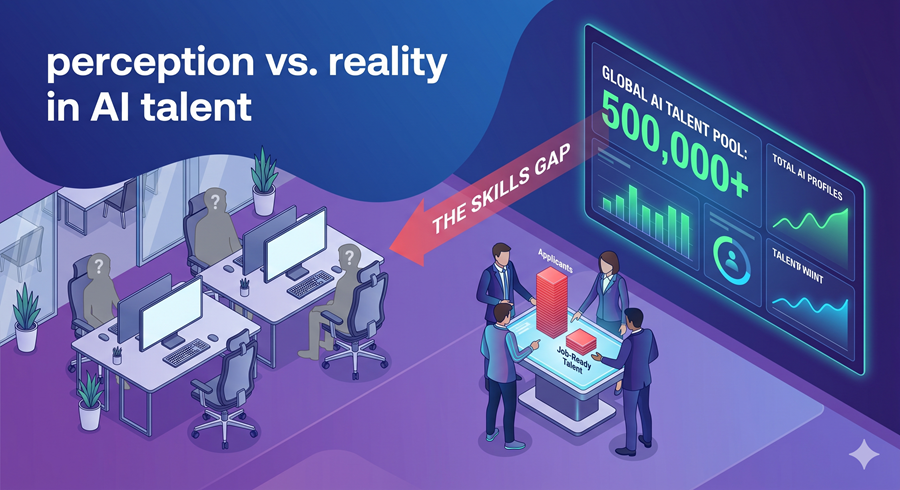
I keep hearing the same narrative everywhere. India is the next AI superpower, a global hub of talent, a country with scale that no one else can match. On paper, it all sounds convincing. But when I look closer, something does not add up.
There is an empty desk in this story. Actually, millions of them.
The Illusion of a Massive Talent Pool
We are told there are around four lakh AI professionals in the country. That sounds like a formidable workforce. But when companies actually try to hire, the reality looks very different.
For every ten AI roles that open up, only about six candidates are considered truly job-ready. That gap is not just a hiring inconvenience. It signals something deeper. It suggests that what we call a “talent pool” is not fully aligned with what the market actually needs.
This is not about a lack of effort or intelligence. It is about a mismatch.
The Rise of a Missing Middle Layer
What companies are increasingly looking for is not just someone who can write code. They want people who can design systems, work with complex data, and think in terms of architecture.
That middle layer of talent, the experienced, specialized professionals, is where the shortage becomes most visible. It feels like an entire generation of workforce readiness is missing or underdeveloped.
Two years ago, advanced tech roles made up roughly 30 percent of hiring. Today, that number has doubled to 60 percent. The demand did not just grow. It shifted.
Degrees Are Growing, But Skills Are Not Catching Up
At first glance, it might seem like the solution is simple. Produce more graduates. Increase the number of degrees. Expand the pipeline.
But that is already happening. Degrees are being produced faster than ever. The issue is not volume. It is relevant.
The curriculum, in many cases, is not evolving at the same pace as industry demand. While companies are moving toward areas like AI systems, cloud infrastructure, and cybersecurity, many graduates are still trained for roles that are quickly becoming outdated.
The result is a growing disconnect between education and employability.
Why Entry-Level Roles Are No Longer Safe
If I were starting today, I would be worried about one thing in particular. Entry-level roles are no longer the safe starting point they once were.
A large portion of junior candidates are struggling to get placed, not because there are no jobs, but because their skills do not match what is being hired. The market has already moved ahead.
If someone is still focused only on basic development without exposure to areas like large language models, cloud systems, or security, they are not just competing. They are falling behind.
The Bottleneck That Could Slow Everything Down
This gap between demand and capability is starting to act like a bottleneck. On one side, investment is pouring in. Global companies are expanding aggressively. Adoption of AI is accelerating.
On the other side, execution is struggling to keep pace.
You cannot scale innovation without the right people to build, maintain, and evolve it. If that gap continues, growth will not stop, but it will slow in ways that are hard to ignore.
Opportunity or Warning Sign
I see this situation as both a risk and an opportunity. Those empty roles are not just vacancies. They are signals.
The people who step into that gap, who build the right skills and adapt early, will define the next phase of growth. Everyone else risks being left behind in a system that is moving faster than traditional paths can handle.
The future is not waiting. The question is whether we are preparing for it fast enough.
