Artificial intelligence is no longer just a buzzword; it has become one of the most powerful tools for building modern businesses. However, not all AI-based opportunities are equal. Many trending ideas rely on selling services that are quickly losing value as AI tools become cheaper and more accessible. If you’re serious about starting something sustainable in 2026, you need to focus on models that create long-term value, not just short-term income.
1. AI-Powered E-commerce (The Most Reliable Model)
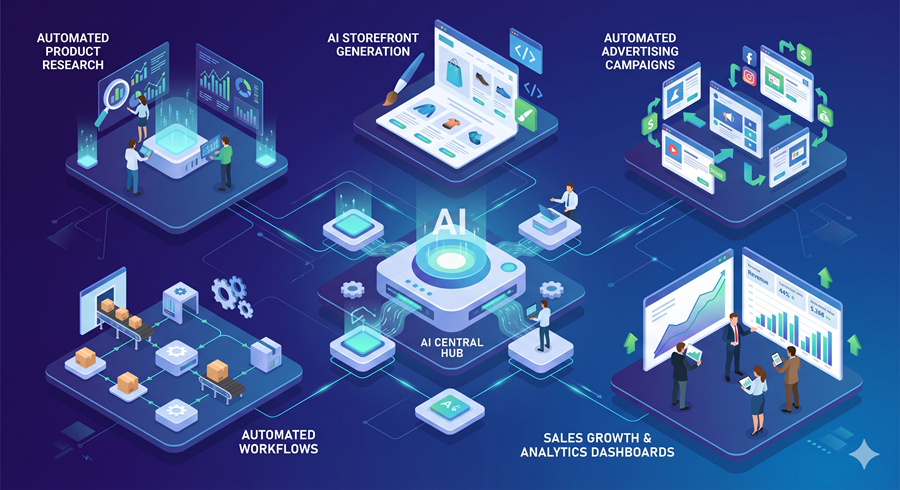
E-commerce remains one of the strongest business models, and AI is making it faster and more efficient than ever. Instead of spending weeks researching products, building stores, and creating ads, AI tools can now handle these tasks in hours. You can identify trending products, design a professional store, and generate high-quality ad creatives without hiring a team.
The key advantage here is ownership. Unlike service businesses, where you trade time for money, e-commerce allows you to build a brand and a customer base. This makes it far more scalable and valuable in the long run. While it may require an initial investment of around $500–$1,000, the potential returns are significantly higher.
2. AI Product (Micro SaaS) Business
Another strong opportunity lies in creating small, focused AI tools that solve specific problems. These are often called micro SaaS products. Instead of building complex platforms, you can create simple tools like email summarizers, content generators, or workflow assistants.
The barrier to entry is lower than ever, thanks to no-code platforms and APIs. However, success in this space depends more on marketing than technology. Many tools fail not because they don’t work, but because no one knows about them. If you can identify a real problem and promote your solution effectively, this model can scale quickly.
3. AI Automation Services
Businesses are full of repetitive tasks—data entry, customer responses, reporting—that can be automated using AI. This creates a huge opportunity to offer automation services. Instead of selling generic AI solutions, you focus on solving specific operational problems for companies.
You can build simple workflows using tools like automation platforms and demonstrate their value with real examples. Once clients see how much time and money they can save, they are more likely to pay for implementation and ongoing support. This model can generate quick income and recurring revenue.
4. AI Consulting
Many businesses know AI is important, but don’t know how to use it effectively. This gap creates demand for AI consultants. Your role is to analyze a business, identify inefficiencies, and recommend AI-driven solutions.
You don’t need to be a developer to succeed here. What matters is your ability to understand business problems and explain solutions clearly. Starting with free audits can help you build trust and land your first clients. Over time, consulting can evolve into higher-ticket projects or even full implementation services.
5. AI Creative Agency
Content creation is evolving rapidly, and AI is transforming how creative work is produced. An AI creative agency focuses on using AI tools to generate, edit, and optimize content at scale. This includes repurposing long-form content into short videos, creating ad variations, and improving marketing performance.
The real value is not just producing content but delivering results, higher engagement, better conversions, and faster output. Businesses are willing to pay for this because it directly impacts their revenue.
Follow Us on:
Clutch
Goodfirms
Linkedin
Instagram
Facebook
Youtube