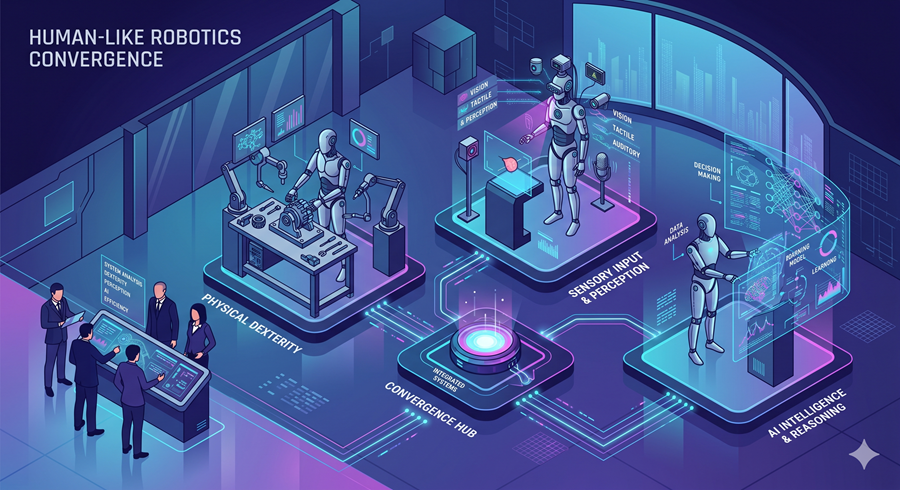
I have been following robotics for a while, but what stands out to me now is how multiple breakthroughs are converging at once. It is no longer just about movement or intelligence in isolation. It is about combining precision, physical realism, and adaptive reasoning into systems that begin to resemble human capability in a much deeper way.
A recent robotic hand moving at extreme speeds with remarkable precision caught my attention. But the real question I keep coming back to is not just how fast or accurate these systems are. It is how close they are getting to human-like interaction with the physical world.
The Rise of Hyper-Dexterous Robotic Hands
I see a major shift happening in robotic manipulation. New tendon-driven designs mimic how human hands actually work, routing force through cable-like structures similar to biological tendons. This allows fingers to flex, rotate, and adapt with a much more natural range of motion.
What makes this impressive is not just movement, but control. With high degrees of freedom and precise force handling, these hands can perform delicate tasks like handling lab equipment or assembling tiny components. This moves robotics beyond repetitive industrial motion into environments where subtlety and precision matter.
From Mechanical Parts to Synthetic Muscles
At the same time, I notice another approach that goes even deeper. Instead of building robots with rigid motors and joints, some systems are now recreating the human body itself using artificial bones, ligaments, and muscle-like fibers.
These synthetic muscles contract, respond quickly, and generate significant force while remaining lightweight. Combined with anatomically accurate skeletons, this creates robots that are not just functional, but structurally similar to human bodies. It feels like a shift from machines that imitate movement to machines that replicate biology.
The Missing Piece: A Brain That Can Adapt
Even the most advanced body needs intelligence to make it useful. That is where generalist AI models for robotics come in. I see a new generation of systems trained on massive amounts of real-world physical data, allowing them to perform a wide range of tasks rather than specializing in just one.
What stands out is their ability to improvise. Unlike traditional robots that follow fixed instructions, these systems can adapt to new situations, learn from experience, and solve problems in unpredictable environments. That flexibility feels like a key step toward more general intelligence in the physical world.
Turning Existing Robots Into Autonomous Agents
Not every breakthrough requires building new hardware from scratch. I also see platforms emerging that can upgrade existing robots with perception, navigation, and reasoning capabilities.
By combining vision systems, spatial understanding, and task planning, these platforms allow robots to operate more independently. They can understand their environment, move through it, and complete tasks based on high-level instructions. This lowers the barrier to deploying intelligent robotics across industries.
Where Is All of This Heading
What stands out to me is how these layers are coming together. Precision hands, biological structures, adaptive intelligence, and autonomous software are no longer separate tracks. They are starting to integrate into complete systems.
We are moving from robots that perform tasks to robots that understand, adapt, and interact with the world in more human-like ways.
Short Paragraph
What I find most striking is not any single breakthrough, but the convergence of body and intelligence. Robotics is no longer just about machines doing work. It is about creating systems that can operate in the real world with flexibility, precision, and awareness. That shift feels foundational.