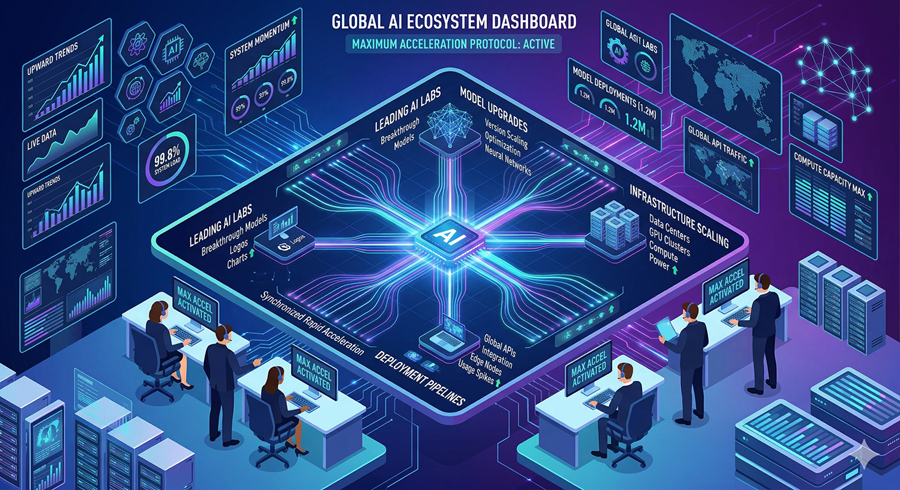
I have never seen a week like this. Every major player moved at once, and it felt like the entire AI industry shifted gears overnight. New models, new capabilities, and real-world deployments all landed within days of each other.
What stood out was not just progress, but convergence. Everything is starting to connect.
AI Models Are Getting Sharper and More Reliable
The latest wave of models showed a clear jump in reasoning and consistency. I noticed systems holding focus across massive inputs without drifting, handling text, images, and video as one continuous stream.
Instead of reacting randomly, they now plan. Give them a messy problem, and they break it down into steps before acting. That shift from response to structured thinking changes how useful they are in real work.
At the same time, error rates are dropping fast. Some models are cutting hallucinations dramatically, and users are starting to trust outputs in ways that felt risky just months ago.
Image Generation Is Learning to Think
Image models are no longer just creating visuals. They are maintaining logic across scenes.
I saw examples where characters stayed consistent across multiple frames, environments changed without breaking continuity, and even real-world details like layouts and data visualizations were updated accurately.
This is more than style. It feels like reasoning applied to visuals. When an AI can understand space, identity, and context inside an image, it opens the door to storytelling, design, and simulation at a completely different level.
AI Is Becoming an Operating Layer
One of the biggest shifts is how AI is being embedded everywhere. It is no longer a separate tool you open. It is becoming the layer that sits across everything.
Search, documents, spreadsheets, presentations, and even browsers are turning into AI-driven environments. Instead of doing tasks manually, I can describe what I want and watch the system build it, refine it, and even ask follow-up questions.
This changes productivity entirely. The interface is no longer buttons and menus. It is intent.
Agents Are Entering Real Workflows
The rise of agents is where things get real. These systems are not just answering questions. They are taking action inside actual environments.
I saw tools operating inside logged-in browsers, using real accounts, navigating platforms, and completing tasks without breaking authentication. That removes one of the biggest barriers to automation.
It also makes AI feel less like a demo and more like a coworker. You can watch it work, step in if needed, and let it handle repetitive processes end-to-end.
The Physical World Is Catching Up
What surprised me most was how quickly AI is moving beyond screens.
Humanoid robots are starting to operate in homes and factories with a level of stability that feels practical rather than experimental. They are walking, handling objects, and completing tasks with increasing confidence.
At the same time, major investments are flowing into companies building AI for the physical world, from manufacturing to aerospace. This signals a shift from digital intelligence to embodied intelligence.
The competition is getting intense, and not always graceful, but that tension is pushing the field forward faster than ever.
This was not just a busy week. It was a glimpse of where everything is heading.
Follow Us on:
Clutch
Goodfirms
Linkedin
Instagram
Facebook
Youtube